Neewer

Neewer 40100304NE CM14 PRO On-Camera Video Microphone Kit

3.6 (81 reviews)

A super-cardioid on-camera microphone kit that tightens your recording pattern and cuts ambient room noise for cleaner vlog and streaming audio straight from the source.

$15.99*$16.99Save 5%
Check availability

*Price sourced from Amazon.com. Last updated:Jun 27, 2026.Price and availability are subject to change.

Affiliate Disclosure: Studio Supplies may earn a commission from qualifying purchases made through links on this page, at no additional cost to you. This helps support our editorial team.

Notice a mistake? Let Us Know

Overview

The Neewer CM14 PRO is a super-cardioid condenser microphone designed to mount directly to a camera or smartphone cold shoe and deliver a meaningfully cleaner signal than any built-in microphone can provide. Its super-cardioid polar pattern is the defining technical characteristic: compared to a standard cardioid, a super-cardioid tightens the acceptance angle along the front axis, pushing the null points inward from 90 degrees to roughly 126 degrees off-axis, and trading some side rejection for better front-focus. What you hear is a more isolated, direct capture of whatever is in front of the lens — voice, instrument, ambient sound — with room reflections and off-axis noise pushed further down in the mix. The 75dB SNR and -32dB sensitivity spec place the CM14 PRO at the upper end of consumer on-camera condensers, meaning the microphone's own electronic noise is not the limiting factor in most real-world recording environments.

For vloggers, content creators, and journalists who need reliable on-camera audio without the complexity of a wireless lav or boom operator, the CM14 PRO's kit format covers the practical bases. The upgraded cold shoe shock mount reduces mechanical transmission from camera handling, while the dual-windscreen system — fur deadcat for outdoor wind, foam for indoor breath blasts — addresses the two most common audio artifacts in uncontrolled recording environments. Plug-in-power operation via 3.5mm means there is no battery to manage and no setup beyond connecting the cable. The 20Hz–20kHz frequency response captures the full audible spectrum, and the included TRS and TRRS cables make the same microphone usable on both dedicated cameras and smartphones without an additional interface. For creators building a competent, low-friction audio setup around an existing camera or phone, the CM14 PRO delivers clear, directional sound in a package that asks very little in return.

Key Features

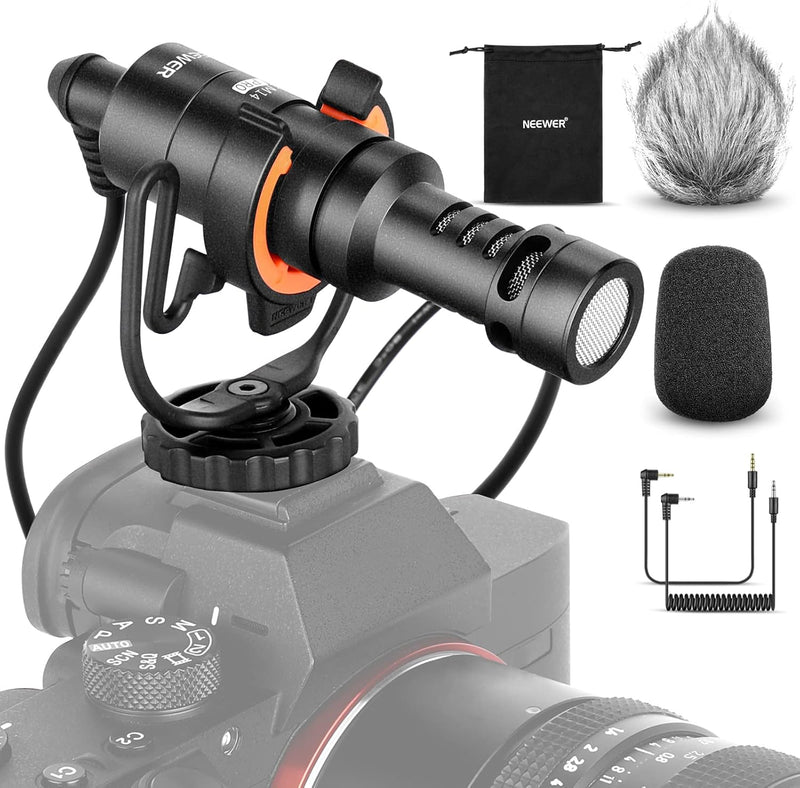
【Universal Mini video Vlog Microphone Kit】 Small & compact super cardioid microphone enhances the recording quality for vlogging, live streaming, and podcasting on your smartphone or camera. The upgraded cold shoe shock mount fits the CM14 PRO body design, sturdy and stable, effectively reducing the noise caused by vibration. Plus, the fur windshield minimizes wind noise when recording outside and the foam windscreen helps filter breath blasts

【Crisp & Clear Audio】 Popular for its superior directivity, the super cardioid microphone detects sound captured from the front while reducing noise from the sides. The super cardioid pattern also features a sensitive rear flap that picks up sound from the back of the microphone. Optimal recording distance: 3.3'-4.9' / 100-150cm

【Plug & Play】 Directly connect to the camera via 3.5mm TRS to TRS audio cable or Connect the microphone to your iPhone 6s or earlier models with the included 3.5mm TRS to TRRS audio cable to get started. For iPhone 7 or later, a Lightning to 3.5mm Headphone Jack Adapter is required (not included).

【Wide Compatibility】 Compatible with iPhone iPad Android phones and tablets, DLSR cameras, camcorders, and more. Lightning to 3.5mm adapter and USB type C to 3.5mm adapter are not included

【Package Contents】 1 x NEEWER CM14PRO Microphone; 1 x Upgraded Cold Shoe Shock Moun; 1 x Fur Windshield; 1 x Foam Windscreen; 1 x 3.5mm TRS to TRS Audio Cable; 1 x 3.5mm TRS to TRRS Audio Cable; 1 x User Manual

Specifications

Brand
Neewer
Model
CM14 PRO (40100304NE)
Microphone Type
Super Cardioid Condenser
Polar Pattern
Super Cardioid
Frequency Response
20Hz – 20kHz
Signal-to-Noise Ratio
75dB
Sensitivity
-32dB
Output Impedance
2000 Ohm
Optimal Recording Distance
100–150cm (3.3–4.9 ft)
Audio Interface
3.5mm TRS / TRRS
Power
Plug-in power (no battery required)
Dimensions
10.2 x 6.26 x 2.83 inches
Weight
5.46 oz
Included Accessories
Cold shoe shock mount, fur windshield, foam windscreen, TRS-TRS cable, TRS-TRRS cable

Pros & Cons

👍 Pros

  • 75dB signal-to-noise ratio produces a clean noise floor for an on-camera condenser, keeping electronic self-noise below audible threshold in typical shooting environments.
  • Super-cardioid polar pattern delivers tighter front-axis focus than standard cardioid on-camera mics, meaningfully reducing side and ambient noise in uncontrolled environments.
  • Plug-and-play 3.5mm connectivity requires no app, no drivers, and no battery — usable on cameras, camcorders, and smartphones immediately out of the box.
  • Kit includes both fur windshield and foam windscreen, covering both outdoor wind rejection and indoor breath blast filtering without additional accessory purchases.
  • Upgraded cold shoe shock mount is purpose-fit to the CM14 PRO body, providing more secure mechanical coupling than generic mounts.

👎 Cons

  • The small rear lobe of the super-cardioid pattern picks up a narrow window of sound directly behind the microphone — in reverberant spaces, this can introduce subtle ambient bleed that a cardioid would not capture.
  • 2000 ohm output impedance is high relative to many camera preamp input impedances, which can cause slight high-frequency rolloff depending on the host device's input impedance spec.
  • Lightning and USB-C adapters for current iPhones and modern Android devices are not included, creating an additional accessory requirement for smartphone users.
  • Optimal recording distance of 100–150cm requires consistent positioning discipline — subjects who move significantly within frame will produce audible level variation.

Frequently Asked Questions

No. The CM14 PRO is a passively powered condenser — it draws operating current through the 3.5mm connection from the camera or device's plug-in power (bias voltage). No phantom power, no internal battery. This keeps the form factor compact and eliminates battery management entirely, but it also means the mic won't work with interfaces that don't supply plug-in power on their 3.5mm input.
Super-cardioid polar patterns provide tighter front-axis focus than standard cardioid designs — side rejection is approximately 8–12dB better than a cardioid at the 90-degree null points, and there is a small rear lobe. In practice, this means the CM14 PRO reduces room reflections and off-axis ambient noise more aggressively than a standard cardioid on-camera mic, but it does not eliminate reverb in acoustically untreated spaces. Keep the source within the 100–150cm optimal distance for best results.
The upgraded cold shoe shock mount mechanically decouples the microphone body from the camera's cold shoe, attenuating low-frequency vibration from button presses, footsteps, and camera body handling. It is not a floating elastic isolation system — it reduces mechanical transmission rather than eliminating it. For walking/moving shots, the windshield and shock mount together manage most handling artifacts.
TRS (Tip-Ring-Sleeve) is the standard connection for cameras with a dedicated 3.5mm microphone input — it carries a balanced or unbalanced mono/stereo mic signal. TRRS (Tip-Ring-Ring-Sleeve) is the four-conductor format used by smartphones, which combines mic input and headphone output on one jack. Use the TRS-to-TRS cable for cameras and camcorders; use the TRS-to-TRRS cable for Android phones and older iPhones (6s and earlier).
The CM14 PRO is rated at 75dB SNR with a sensitivity of -32dB. A 75dB SNR is a competent figure for an on-camera condenser at this price — it means the mic's self-noise floor is low enough that ambient room tone rather than the microphone's own electronics will dominate the noise floor in most recording environments. In very quiet treated spaces, electronic self-noise may become audible at maximum gain on a camera preamp.