



Neewer
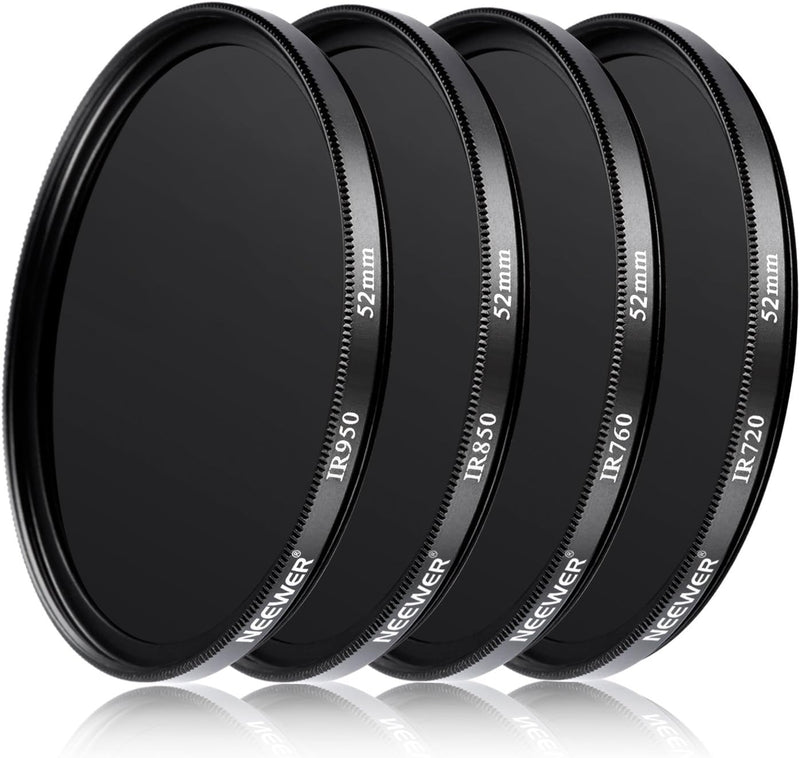
Neewer IR 52MM Infrared Filter Set IR720, IR760, IR850, IR950
★★★★★
f/1.8
Four infrared cutoff wavelengths in one set unlock the full tonal range of infrared landscape and fine-art photography.
Check availability
Affiliate Disclosure: Studio Supplies may earn a commission from qualifying purchases made through links on this page, at no additional cost to you. This helps support our editorial team.
Notice a mistake? Let Us Know
Overview
Key Features
This infrared filter set includes: (1)IR720 Infrared Filter + (1)IR760 Infrared Filter + (1)IR850 Infrared Filter + (1)IR950 Infrared Filter + (1)Carrying Pouch. PLEASE NOTE: Lens NOT Included!
The IR filters are made of high quality optical glass and premium aluminum alloy. Double threaded frame to allow additional filters or hoods.
Fit for any camera which lens thread is 52mm, such as PENTAX (K-30 K-50 K-5 K-5 II) DSLR Cameras, 18-55mm F3.5-5.6 AL zoom Lens, and Canon EF 50mm f/1.8 II and the EOS M Compact System Mirrorless Camera EF-M 18-55mm IS STM zoom lenses.
Often used in crime detection, medical photography, detection of distribution of vegetation, etc.
For photographer, these filter can be used with infrared film or digital photography to get interesting artistic and sometimes creative photos.
Specifications
Filter Thread Diameter
52mm
Filter Types Included
IR720, IR760, IR850, IR950
Filter Material
Optical glass with aluminum alloy frame
Frame Design
Double-threaded (accepts additional filter or hood)
Accessories Included
Carrying pouch
Quantity
4 filters
Pros & Cons
👍 Pros
- Four-filter set (IR720–IR950) covers the full practical range of infrared cutoff wavelengths, from subtle warm IR tones to full deep-infrared dramatic effects — one purchase serves multiple creative approaches
- Double-threaded aluminum alloy frame allows stacking a lens hood or additional filter without losing the filter's mount position
- 52mm thread matches a wide range of affordable prime and kit lenses (Canon 50mm f/1.8, many kit zooms), making infrared accessible without investing in specialty glass
- Optical glass construction maintains image sharpness through the filter — no soft-focus degradation attributable to the filter glass itself at typical shooting apertures
- Carrying pouch keeps all four filters organized and protected in a single, portable kit
👎 Cons
- On unmodified cameras, each filter requires multi-second to multi-minute exposures even in bright daylight — handheld infrared shooting is not possible with this set
- The 52mm thread is a single fixed size — photographers with lenses using 58mm, 67mm, 77mm, or other common filter diameters will need step-up rings (sold separately)
- Live view framing through IR850 and IR950 appears nearly black on unmodified cameras, making composition and focus confirmation slow and methodical
- White balance calibration must be performed manually for each filter strength when shooting in RAW+JPEG — auto white balance produces unreliable color casts in infrared
- IR720 through IR950 are opaque to the human eye — there is no visual confirmation through the filter that it is correctly seated, requiring test shots to verify proper installation
Frequently Asked Questions
What is the practical visual difference between the IR720, IR760, IR850, and IR950 filters in this set?
Each filter defines the cutoff wavelength at which visible light is blocked and infrared begins to pass. The IR720 passes the most visible light of the four, yielding warmer tones and relatively shorter exposures — a good starting point for infrared work. The IR950 blocks nearly all visible light, producing the deepest, most dramatic infrared effect (very pale foliage, dark skies) but requiring significantly longer exposures, sometimes several minutes on unmodified cameras. The IR760 and IR850 fall between, offering progressively stronger IR filtration and more pronounced "wood effect" (glowing foliage) with each step up.
How long are exposure times with these filters on an unmodified (non-converted) camera?
On a standard DSLR without sensor conversion, exposures with IR filters are long — typically 30 seconds to several minutes in bright daylight, depending on filter strength (IR720 being shortest, IR950 being longest). Live view composition is necessary since the viewfinder will appear black. A sturdy tripod is not optional; it is a requirement for this type of work.
Do these filters work with mirrorless cameras as well as DSLRs?
They work on any camera with a 52mm lens thread. The filter specification lists compatibility with PENTAX K-series bodies and certain Canon lenses. Mirrorless systems using lenses with 52mm filter threads (such as Canon EF 50mm f/1.8 II via adapter) will also accept these filters. Sensor sensitivity to infrared varies between camera models — some sensors are more IR-sensitive than others, affecting required exposure times.
Can I stack these infrared filters with a UV or polarizer filter?
The double-threaded aluminum frame allows stacking an additional filter or lens hood on top. However, stacking a UV filter beneath an IR filter adds glass elements that can cause vignetting at wider focal lengths and introduce additional flare. In infrared work, UV filters are generally unnecessary — infrared filters already reject the UV spectrum along with visible light.
Are these filters suitable for video work?
They can be used for infrared video, but the extreme exposure times required on unmodified cameras make live video capture impractical without a camera that has been converted for infrared sensitivity. For video applications, a converted mirrorless body is the conventional approach to make these filter strengths usable at normal shutter speeds.
Related Products


