



Neewer
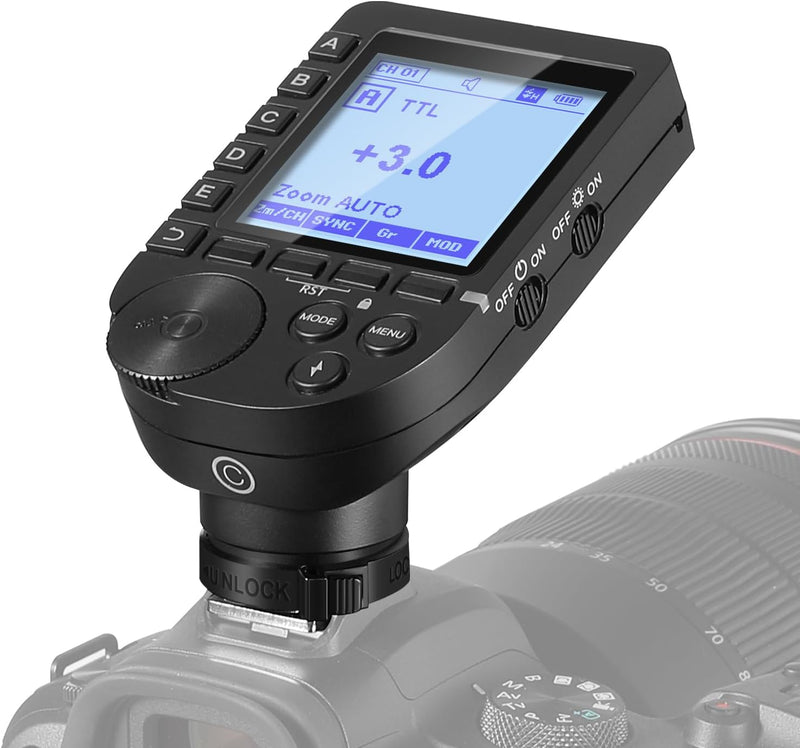
Neewer QPRO-C TTL Wireless Flash Trigger for Canon
300W400W
A feature-packed Canon TTL wireless flash trigger with 1/8000s high-speed sync and five-group control.
$64.49*
View on Amazon
✓ In Stock on Amazon.com
*Price sourced from Amazon.com. Last updated:Aug 31, 2026.Price and availability are subject to change — details.
Affiliate Disclosure: As an Amazon Associate, Studio Supplies earns from qualifying purchases made through links on this page, at no additional cost to you. This helps support our editorial team.
Notice a mistake? Let Us Know
Overview
Key Features
【Multifunctional Professional Flash Trigger】 The upgraded QPRO-C TTL wireless flash trigger is powerful and fully supports TTL automatic flash, flash exposure compensation (FEC), 1/8000s high speed sync, stroboscopic flash, manual flash, magnification function, group modeling lamp control, group zooming, single point triggering, and simultaneous output value adjustment for all groups. Note: Please disable single contact mode ''SHOOT'' for TTL and High Speed Sync .
【Single Point Triggering】Enter C.Fn SHOOT via the MENU button to start single point triggering with the trigger mounted on cameras for fast continuous shooting. Note: Only triggers flash under M/Multi Mode, not for parameter adjustment. The 1/8000s high speed synchronization allows for faster shutter speeds and ideal for fast moving subjects, and supports a focus assist light that automatically lights up under dim light when the camera is unable to focus .
【Built In 2.4G Wireless Q System】 Wirelessly trigger NEEWER Q6 Q4PRO Q4 Q120 Q3 Z3R Z3 Z2PRO Z2 Z1 Z880 Z760 NW760 S101-300W PRO S102-400W PRO thanks to the built in NEEWER wireless Q system, or control other flashes without a Q system using a NEEWER QR receiver and a 2.5mm sync cord (all .sold separately). Also remote control via 2.4GHz stable connection for flashes up to 5 groups, 32 channels, and 01-99 ID settings, and set them all on the same channel and ID settings to tigger without signal disturbance.
【Screen Magnification Function】 The flash trigger features an LCD ultra large high definition display screen where up to five flash groups are shown at one time. Double click the group button quickly to switch from the setting page of all groups (A-E) to the enlarged view of the settings and related details of the corresponding group. The five group buttons, four function buttons, and a scrolling wheel makes parameter settings clear, intuitive, and easy to use.
【Wide Compatibility】 The QPRO-C flash trigger can be quickly fixed on the camera with the metal hotshoe. Compatible with Canon EOS R6, R5, R3, R, M6, 850D, 800D/T7i, 760D/T6s, 750D/T6i, 650D, 600D, 7D Mark II, 6D Mark II, 6D, 5D Mark IV/III/II, 1D Mark III, 1DX, 550D, 500D, 450D, 90D, 80D, 70D, 60D, 50D, 1100D, 77D, SL3/250D, T7/1500D, 2000D, T100/3000D, 4000D. Note: Firmware upgrades are available to address compatibility issues (NOT compatible with RP R50) .
Specifications
Brand
Neewer
Model
QPRO-C
Compatibility
Canon (see full list; not compatible with RP, R50)
TTL Support
Yes, with flash exposure compensation
High-Speed Sync
1/8000s
Wireless System
2.4GHz Q System
Channels
32
ID Settings
01-99
Groups
5 (A-E)
Display
LCD Ultra Large HD Screen
Power
2x AA Batteries
Hotshoe
Metal
Dimensions
5.12 x 3.54 x 2.56 inches
Weight
5.3 ounces
Frequently Asked Questions
Which Canon cameras is the QPRO-C compatible with?
It supports a wide range including the EOS R6, R5, R3, R, M6, 5D Mark IV/III/II, 6D Mark II, 90D, 80D, 7D Mark II, and many Rebel/xxxD models. It is not compatible with the Canon RP or R50.
Does this trigger work with non-Neewer flash units?
Not wirelessly on its own. To trigger non-Neewer flashes, you need a Neewer QR receiver connected to the flash via a 2.5mm sync cord, both sold separately.
What batteries does the QPRO-C use?
It runs on two standard AA batteries.
Can the QPRO-C trigger non-Neewer flashes?
Yes, you can trigger non-Q-system flashes by using a Neewer QR receiver paired with a 2.5mm sync cord, both sold separately. However, TTL functionality requires compatible Neewer Q-system flashes.
What batteries does the QPRO-C use?
The trigger runs on two standard AA batteries.
Is this trigger compatible with the Canon EOS RP or R50?
No, Neewer explicitly states the QPRO-C is not compatible with the Canon RP or R50.
Can I control flash power levels directly from the trigger?
Yes, the QPRO-C allows you to adjust output levels for up to five groups simultaneously from its LCD screen, including simultaneous output value adjustment for all groups at once.
How many flash groups can I control simultaneously?
You can control up to five independent groups (A through E) with individual power, zoom, and mode settings visible on the LCD screen at once.
Does the QPRO-C support firmware updates?
Yes, Neewer provides firmware upgrades to address compatibility issues and add improvements over time.
Does TTL metering work in high-speed sync mode?
Yes, the QPRO-C supports both TTL and 1/8000s high-speed sync simultaneously, but you must disable the single contact SHOOT mode in the settings for TTL and HSS to function.
Related Products


