

Nikon
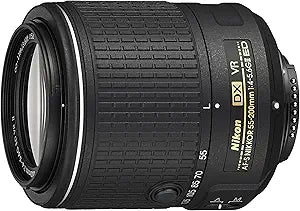
Nikon 20050 AF-S DX 55-200mm VR II Lens (New)
Reach across a festival crowd or compress a mountain vista into a tack-sharp frame — the VR II brings four stops of stabilization to every telephoto moment.
View price on Amazon
Affiliate Disclosure: As an Amazon Associate, Studio Supplies earns from qualifying purchases made through links on this page, at no additional cost to you. This helps support our editorial team.
Notice a mistake? Let Us Know
Overview
Key Features
Nikon AF-S DX NIKKOR 55-200MM f/4-5.6G ED VR II
Specifications
Focal Length Range
55-200mm
Minimum Focus Distance
3.7 ft (1.1 m)
Maximum Angle of View (DX-format)
28°50'
Minimum Angle of View (DX-format)
8°
Glass Type
Extra-low Dispersion (ED)
Coating
Super Integrated Coating (SIC)
Image Stabilization
Nikon Vibration Reduction (VR)
Diaphragm Blades
Rounded seven-blade
VR Stabilization Stops
4.0 stops
Frequently Asked Questions
Which Nikon bodies is this lens compatible with?
This lens is designed for Nikon DX-format DSLRs — cameras like the D3500, D5600, D7500, and similar APS-C sensor bodies. The focal length range becomes an equivalent 82–300mm in full-frame terms on DX. It will physically mount on Nikon FX bodies but is not optimized for full-frame use and will produce vignetting at wider focal lengths.
How much does the VR II stabilization actually help in practice?
The four stops of VR II compensation is genuinely useful. At 200mm, where camera shake is most pronounced, VR II lets many photographers shoot down to 1/30s or slower while retaining sharp images that would be blurred without it. It's particularly valuable for handheld travel work and event shooting in mixed light.
How close can this lens focus, and does it work for semi-macro subjects?
Minimum focus distance is 3.7 feet (1.1m). At 200mm and 1.1m, you can fill a reasonable portion of the frame with a medium-sized subject, but this isn't a macro lens. For close-up insect or product detail work, a dedicated macro lens is a better choice.
Does this lens support autofocus on entry-level Nikon bodies that lack an in-body AF motor?
Yes. The AF-S designation means this lens has a built-in Silent Wave Motor (SWM), so it autofocuses on all Nikon DSLRs including entry-level bodies like the D3500 that don't have an internal focus motor. This is an important compatibility advantage over older AF-D lenses.
How does the seven-blade rounded diaphragm affect bokeh?
The rounded seven-blade aperture produces smooth, circular out-of-focus highlights rather than harsh polygonal shapes. At 200mm with a subject-background separation of several meters, bokeh is pleasantly smooth — backgrounds dissolve naturally rather than distractingly.
Related Products


