



Nikon
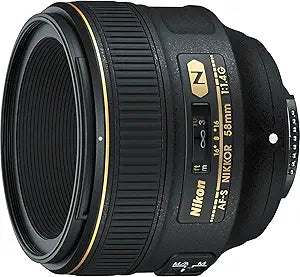
Nikon 2210 AF-S NIKKOR 58mm f/1.4G FX DSLR Lens
f/1.
Shoot full-body environmental portraits wide open at night and pull tack-sharp subjects from a sea of buttery, creamy bokeh with the NIKKOR 58mm f/1.4G.
View price on Amazon
Affiliate Disclosure: As an Amazon Associate, Studio Supplies earns from qualifying purchases made through links on this page, at no additional cost to you. This helps support our editorial team.
Notice a mistake? Let Us Know
Overview
Key Features
Excels in low-light and nighttime applications
Maximum reproduction ratio: 0. 13x. Exceptionally sharp, evenly lit, high-contrast shots Focus Mode - Auto, Manual, Manual/Auto
9 rounded-blade aperture for excellent bike control
Picture Angle with 35mm (135) format-40° 50′
Specifications
Focal Length
58mm
Maximum Aperture
f/1.4
Format Compatibility
FX and DX (Nikon F-mount)
Autofocus
AF-S (Silent Wave Motor)
Focus Modes
Auto, Manual, Manual/Auto
Aperture Blades
9 (Rounded)
Maximum Reproduction Ratio
0.13x
Picture Angle (FX)
40° 50'
Frequently Asked Questions
Is this lens designed for FX full-frame bodies only, or does it work on DX crop-sensor cameras?
It works on both FX and DX Nikon bodies. On a DX camera, the 1.5x crop factor gives a 35mm equivalent of approximately 87mm — a flattering short portrait length. The FX design means the image circle covers the full 35mm frame, so there is no vignetting on DX, and the lens performs identically if you later upgrade to a full-frame body.
How does the 58mm f/1.4G handle sagittal coma flare when shooting point light sources at night?
Controlling sagittal coma was the explicit engineering objective of this lens's optical redesign compared to earlier Nikon 50mm f/1.4 designs. Point light sources — stars, street lamps, bokeh specular highlights — render as clean circles rather than the comet-like smearing typical of most fast 50mm-class lenses shot wide open. This is its single most distinguishing optical characteristic.
How does the autofocus perform on moving subjects such as candid portraits or events?
The AF-S internal focusing motor is responsive and quiet, well-suited to candid portrait and lifestyle work. It is not a sports or action AF system — tracking fast, unpredictable movement is not this lens's strength. For posed portraits, street photography, and slower-paced event work, focus acquisition is confident and accurate.
What is the character of the bokeh this lens produces, and how does the 9-blade aperture contribute?
The 9 rounded aperture blades produce circular, smooth bokeh highlights throughout the mid-aperture range rather than the polygonal shapes that odd-numbered or straight-blade designs create. Combined with the longer-than-standard 58mm focal length and f/1.4 maximum aperture, the depth of field separation is pronounced and the transition from sharp to soft is gradual and organic.
How does this lens compare to the Nikon AF-S 50mm f/1.4G for portrait work?
The 58mm f/1.4G is a different optical proposition entirely. The 50mm f/1.4G is a conventional fast normal lens; the 58mm f/1.4G was designed around the concept of "3D rendering" — how the lens draws subjects with volumetric depth. It is larger, heavier, more expensive, and produces a quality of rendering that the 50mm cannot replicate, particularly at wide apertures and in controlled coma at night. It is a deliberate creative choice, not a direct cost-tier comparison.
Related Products


