



Nikon
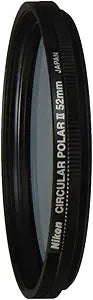
Nikon 2390 52mm Circular Polarizing Filter
★★★★★
Cut through glare and pull rich, saturated color from skies and water in every outdoor frame
$69.95*
View on Amazon
✓ In Stock on Amazon.com
*Price sourced from Amazon.com. Last updated:Jul 14, 2026.Price and availability are subject to change.
Affiliate Disclosure: Studio Supplies may earn a commission from qualifying purchases made through links on this page, at no additional cost to you. This helps support our editorial team.
Notice a mistake? Let Us Know
Overview
Specifications
Brand
Nikon
Model
2390
Filter Type
Circular Polarizing
Filter Size
52mm
Pros & Cons
👍 Pros
- Dramatically deepens blue skies and enhances cloud contrast for landscape work without any post-processing
- Cuts reflections off water and glass surfaces, letting you shoot through windows or into streams with clarity
- Boosts color saturation in foliage and outdoor scenes, giving images a richer, more finished look straight from camera
- Genuine Nikon glass maintains optical quality and color neutrality without introducing unwanted color casts
👎 Cons
- Rotating the filter ring to find the optimal polarization angle slows your workflow during fast-paced shooting
- The 1-2 stop light loss can push shutter speeds too low for handheld work in shade or overcast conditions
- 52mm thread size limits compatibility to smaller-diameter lenses, so it won't fit many pro zooms without a step-up ring
- Effect is uneven on ultra-wide focal lengths, producing banding across skies that's difficult to correct in post
Frequently Asked Questions
Which Nikon lenses does this 52mm polarizer fit?
It threads onto any lens with a 52mm filter thread. Common matches include the Nikon 50mm f/1.8D, the 35mm f/1.8G DX, and several older Nikkor primes. Check the front of your lens or its cap for the filter size marking.
How does a circular polarizer differ from a linear one for autofocus?
Use circular polarizing for any camera with autofocus or TTL metering. The circular design ensures the polarized light doesn't confuse your camera's AF or metering sensors, which linear polarizers can disrupt. This filter is safe to leave on for general shooting.
Will this filter cause vignetting on a crop-sensor or full-frame body?
At 52mm, this filter sits on relatively small-diameter lenses and its slim profile should not cause vignetting on either DX crop-sensor or FX full-frame bodies at the focal lengths those 52mm lenses typically cover.
How much light does the polarizer cut, and should I compensate exposure?
Expect roughly 1 to 2 stops of light loss depending on the rotation angle. Your camera's TTL metering will compensate automatically in most modes, but be aware that shutter speeds will drop — particularly relevant for handheld shooting in lower light.
Can I stack this polarizer with other filters like a UV or ND?
You can stack it, but adding filters increases the risk of vignetting, especially at wider focal lengths. If you need both polarization and ND, consider a single variable ND or remove the UV filter first to keep the stack thin.
Related Products


