

Nikon
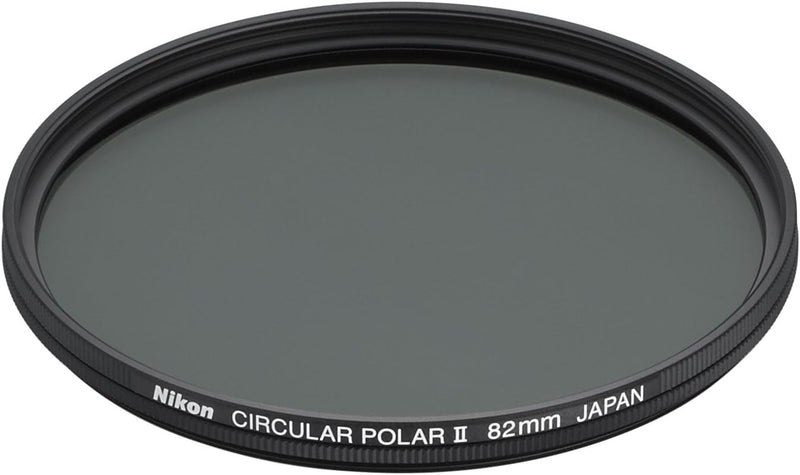
Nikon 2498 82mm Circular Polarizer II Camera Filter
★★★★★
Nikon's 82mm Circular Polarizer II cuts glare and saturates skies without vignetting — built thin for wide-angle glass where standard polarizers fail.
$189.95*
Check availability
*Price sourced from Amazon.com. Last updated:Jul 15, 2026.Price and availability are subject to change.
Affiliate Disclosure: Studio Supplies may earn a commission from qualifying purchases made through links on this page, at no additional cost to you. This helps support our editorial team.
Notice a mistake? Let Us Know
Overview
Key Features
ENHANCED IMAGE QUALITY - Nikon's advanced optical glass and multi-layer coating minimizes reflections and glare, ensuring crystal-clear, vibrant photos with exceptional detail and color fidelity.
SUPERIOR DURABILITY - Crafted with a robust, thin ring design, this Nikon polarizer filter withstands daily use, protecting your valuable lens from scratches, dust, and accidental impacts for lasting performance.
BROAD COMPATIBILITY - Featuring a standard mount and 82mm circular filter size, this polarizer is compatible with a wide range of Nikon lenses, offering versatile use across your photography equipment.
EXCELLENT LIGHT REDUCTION - Effectively reduces glare and reflections from non-metallic surfaces, deepening sky hues and enhancing contrast, resulting in richer, more dramatic landscapes and outdoor shots.
TRUSTED BRAND REPUTATION - Rely on Nikon's legacy of optical excellence; this polarizer filter delivers consistent, professional-grade results, making it an essential tool for photographers of all levels.
Specifications
Brand
Nikon
Model
2498
Filter Size
82mm
Filter Type
Circular Polarizer II
Coating
Multi-layer
Material
Glass, Plastic ring
Ring Design
Thin (low-profile)
Effect
Polarizer — reduces glare, reflections, deepens sky contrast
Water Resistance
Not water resistant
Dimensions
3.23" L x 3.23" W
Pros & Cons
👍 Pros
- Thin ring construction prevents corner vignetting on wide-angle lenses where full-depth polarizers visibly intrude into the frame.
- Multi-layer coating controls internal flare and ghosting, keeping color rendering accurate and contrast clean.
- Effective sky darkening and reflection control in a single rotation — no post-processing needed for the core polarization effect.
- Nikon optical glass quality matches the resolving capability of high-end lenses rather than softening fine detail.
- 82mm size covers Nikon's most demanding professional zoom and prime glass.
👎 Cons
- 1.5–2 stop light reduction requires exposure compensation and can cause focus hunting in mixed light when shooting wide open.
- Not weather resistant — needs to come off or be protected in rain, spray, or dusty conditions where your lens likely has sealing.
- 82mm is one of the largest common filter threads, so this filter cannot step down to smaller lenses without a step-down ring.
- Polarization effect diminishes when shooting parallel or directly into the light source — angle to the sun matters, and not every composition gives you the right angle.
Frequently Asked Questions
Which Nikon lenses use an 82mm filter thread?
The 82mm thread fits several of Nikon's larger-aperture wide and standard zooms, including the AF-S 14-24mm f/2.8 (with an adapter), the AF-S 24-70mm f/2.8E, and select telephoto primes. Always verify your specific lens's filter thread size before ordering.
Will the thin ring design actually eliminate vignetting on wide-angle lenses?
The thin ring is specifically engineered to reduce vignetting at wide focal lengths where standard-depth filter rings intrude into the image circle. At 14–16mm, some corner vignetting is still possible depending on the lens, but the Circular Polarizer II performs significantly better than conventional-depth filters in this regard.
How much light does this filter cut, and will I need to adjust exposure?
A circular polarizer typically reduces light transmission by 1.5 to 2 stops. You will need to compensate — either open the aperture, lower the shutter speed, or raise ISO. In bright outdoor conditions this is rarely a problem, but it becomes a factor in mixed or lower light.
Does the multi-layer coating affect the color rendition of the final image?
Multi-layer coating on this filter is designed to minimize reflections within the filter glass itself — flare and ghosting that would otherwise shift or muddy color. The result is cleaner, more neutral transmission with accurate color fidelity rather than the warm or cool cast that single-coated filters can introduce.
Can I stack this filter with a UV or ND filter?
Technically yes, but stacking increases vignetting risk, particularly at wide angles where this filter is most commonly used. The thin-ring design is meant to minimize a single filter's intrusion — adding another filter layer largely defeats that engineering advantage.
Related Products


