



Nikon
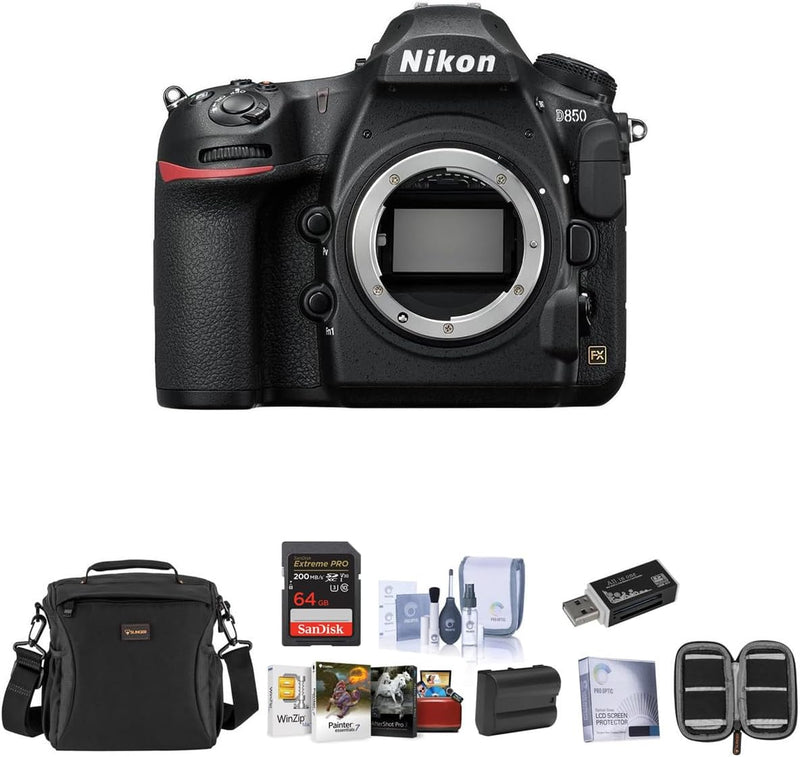
Nikon D850 DSLR Camera Body Bundle
The Nikon D850 delivers 45.7 megapixels of full-frame resolving power with enough speed to track fast-moving subjects — a rare combination for landscape, portrait, and event photographers alike.
$1,996.95*$2,856.64Save 30%
View on Amazon
✓ In Stock on Amazon.com
*Price sourced from Amazon.com. Last updated:Oct 22, 2026.Price and availability are subject to change — details.
Affiliate Disclosure: As an Amazon Associate, Studio Supplies earns from qualifying purchases made through links on this page, at no additional cost to you. This helps support our editorial team.
Notice a mistake? Let Us Know
Overview
Key Features
Next-generation, full-frame Nikon D850 DSLR Camera Body for exceptional image quality
Bundle includes 64GB SDXC U3 Card, camera case, spare battery, cleaning kit, memory wallet, card reader, glass screen protector, and Mac software package
High-resolution and high-speed capabilities for capturing dynamic events and detailed imagery
Successor to the highly acclaimed Nikon D810, offering sharp, clear rendering and rich tone characteristics
Engineered with innovative technologies and features based on user feedback
Specifications
Brand
Nikon
Model
D850
Sensor
Full-frame CMOS
Resolution
45.7 megapixels
ISO Range
Expanded min ISO 100 / Expanded max ISO 25600
Autofocus Points
153 (including 99 cross-type)
Video
4K UHD
Lens Mount
Nikon F-mount
Connectivity
USB, HDMI, Wi-Fi
Included in Bundle
64GB SDXC U3 card, camera case, spare battery, cleaning kit, memory wallet, card reader, glass screen protector, Mac software package
Frequently Asked Questions
Is the D850 compatible with older Nikon F-mount lenses?
Yes — the D850 uses the Nikon F-mount, giving it full compatibility with decades of Nikon AF, AF-D, AF-S, and AF-P lenses. Manual focus AI and AI-S lenses are also supported with metered exposure. This is one of the strongest arguments for the F-mount system — your existing glass works.
How does the 153-point autofocus system perform for moving subjects like performers or athletes?
The Multi-CAM 20K autofocus module with 153 focus points (99 cross-type) tracks moving subjects reliably in good light and holds well into moderately low-light conditions. For dedicated sports or wildlife work it performs competently, though mirrorless systems with on-sensor phase detection have narrowed the gap in challenging tracking scenarios.
What does the 64GB SDXC U3 card included in the bundle actually mean for shooting?
A U3-rated card is speed class 3, meaning sustained write speeds of at least 30MB/s — adequate for 4K video and continuous burst shooting at the D850's raw file sizes (approximately 50–90MB per uncompressed raw). It's a functional starting point, though high-volume shooters will want additional cards.
Can the D850 shoot 4K video, and what are the limitations?
The D850 captures full-frame 4K UHD video, which is uncommon — most DSLRs crop the sensor for 4K. The limitation is the absence of in-body optical image stabilization; video handheld requires a stabilized lens or external rig for smooth footage.
How does the D850 compare to the D810 it replaced?
The D850 adds 4 megapixels over the D810 (45.7 vs 36.3MP), improves continuous shooting speed to 7fps (9fps with optional battery grip), extends ISO range, and brings the focus system from the D5 sports body. The jump in low-light performance and focus tracking is meaningful across real-world shooting scenarios.
Related Products


