



Nikon
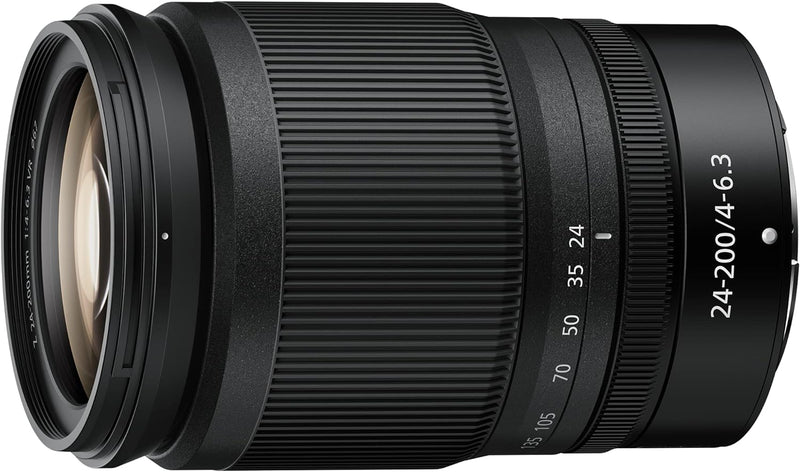
Nikon JMA710DA NIKKOR Z 24-200mm VR Mirrorless Lens
★★★★★
From wide-angle street scenes to compressed telephoto portraits, the NIKKOR Z 24-200mm VR covers an entire shoot without swapping lenses.
$696.67*
View on Amazon
✓ In Stock on Amazon.com
*Price sourced from Amazon.com. Last updated:Jul 14, 2026.Price and availability are subject to change.
Affiliate Disclosure: Studio Supplies may earn a commission from qualifying purchases made through links on this page, at no additional cost to you. This helps support our editorial team.
Notice a mistake? Let Us Know
Overview
Key Features
The NIKKOR Z 24-200mm f/4-6.3 VR joins the Nikon Z family as the perfect travel lens with which to capture richly detailed stills and movies.
As one of the most compact telephoto zoomz available today, it easily fits into smaller kit bags.
The large Z mount allows a unique design that places larger lens elements to the rear- enabling superb balance and handling.
Model number: JMA710DA
Specifications
Focal Length
24-200mm
Maximum Aperture
f/4-6.3 (variable)
Lens Mount
Nikon Z
Image Stabilization
Vibration Reduction (VR)
Lens Type
Telephoto Zoom
Zoom Ratio
8.3x
Model Number
JMA710DA
Pros & Cons
👍 Pros
- The 24-200mm focal range — an 8.3x zoom ratio — covers street, environmental portrait, architecture, and compressed telephoto work in a single lens, eliminating lens changes during dynamic shoots.
- Vibration Reduction rated at approximately 5 stops of compensation makes the 200mm end genuinely usable handheld in challenging light conditions where a non-stabilized telephoto would require a tripod.
- The large Z-mount diameter enables rear lens elements of unusual size for this form factor, contributing to optical performance and image balance that outperforms older F-mount travel zooms of comparable range.
- Its compact physical size relative to the zoom range allows it to fit in smaller camera bags alongside a mirrorless body — a practical advantage over larger telephoto alternatives on multi-day travel shoots.
- Full autofocus, VR, and electronic aperture control are retained when using this lens on F-mount bodies via the FTZ adapter, extending its utility across a mixed Nikon kit.
👎 Cons
- The variable maximum aperture — f/4 at 24mm narrowing to f/6.3 at 200mm — limits available light performance at telephoto lengths, making low-light shooting at 200mm genuinely challenging without ISO escalation or VR reliance.
- The f/6.3 maximum aperture at 200mm produces modest subject separation and background blur compared to a dedicated telephoto prime or faster zoom; bokeh quality at the long end is functional rather than exceptional.
- Optical compromises inherent in an 8.3x zoom ratio mean that corner sharpness at 24mm and chromatic aberration wide open at longer focal lengths are measurable, particularly versus prime lenses or shorter zoom ranges.
- The lens extends physically when zooming toward 200mm, which increases its profile in a camera bag and shifts the balance point on the camera body during shooting.
- At f/4-6.3, this lens is not suited for dedicated low-light event or indoor photography where a faster prime or shorter, faster zoom would be the correct tool.
Frequently Asked Questions
Which Nikon camera bodies is this lens compatible with, and does it work on older F-mount bodies with an adapter?
The NIKKOR Z 24-200mm is a Z-mount lens, natively compatible with all Nikon Z-series mirrorless bodies including the Z5, Z6, Z6II, Z7, Z7II, Z50, Z30, Z fc, and Z8/Z9. It can be used on F-mount DSLRs only via the FTZ or FTZ II adapter, which maintains full autofocus and VR functionality.
How effective is the Vibration Reduction, and can it replace a tripod for long-reach handheld shots?
Nikon rates the VR system in this lens for approximately 5 stops of compensation. At 200mm — a focal length where camera shake is most pronounced — this means you can handhold at shutter speeds that would produce motion blur on a non-stabilized lens. It does not compensate for subject motion, so fast-moving subjects at 200mm still require appropriately fast shutter speeds.
Does the variable aperture of f/4-6.3 cause exposure problems when zooming mid-shot?
In aperture-priority or manual mode, the camera's metering compensates automatically as the maximum aperture narrows during zoom, so exposure stays consistent. In manual mode, zooming from 24mm to 200mm will require a shutter speed adjustment if the maximum aperture is in use — a practical consideration for video shooters doing live zoom pulls.
How does this lens handle autofocus on Nikon Z bodies?
The Z-mount's communication protocol gives AF motors in Z lenses more bandwidth than F-mount glass. On Z6/Z7-class bodies, the 24-200mm tracks moving subjects reliably in good light. Low-light AF speed and accuracy are adequate for travel and general shooting but are not optimized for fast action or sports — that's a function of this lens's intended use case, not a defect.
How compact is this lens compared to a two-lens alternative covering the same range?
Nikon describes this as one of the most compact telephoto zooms available at this focal range. Carrying a 24-200mm in a single lens slot replaces a wide-to-normal zoom plus a dedicated telephoto — two lenses, two sets of filters, and the dead time of lens changes in the field. For travel and documentary work, that consolidation is the lens's primary engineering achievement.
Related Products


