



Nikon
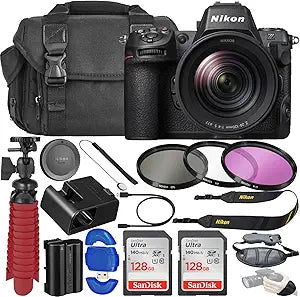
Nikon Z8 Mirrorless Camera with 24-120mm Lens Kit
The Nikon Z8 with 24-120mm S-line lens delivers 45.7MP stacked CMOS resolution and 8K video in a body light enough to carry all day.
View price on Amazon
Affiliate Disclosure: As an Amazon Associate, Studio Supplies earns from qualifying purchases made through links on this page, at no additional cost to you. This helps support our editorial team.
Notice a mistake? Let Us Know
Overview
Specifications
Camera Type
Mirrorless Camera
Lens Included
24-120mm Lens Kit
Frequently Asked Questions
Does the Z8 accept existing Nikon F-mount lenses, and what adapter is needed?
Yes — Nikon's FTZ II adapter is required to mount F-mount glass to the Z8's native Z mount. Autofocus performance with adapted lenses varies by lens type: AF-S lenses retain phase-detect AF, while older screw-drive AF and manual lenses require manual focus. The native NIKKOR Z 24-120mm f/4 S included in this kit requires no adapter.
What does the 493-point phase-detect AF system mean for tracking moving subjects?
493 AF points covering the full frame means the Z8's AI subject detection system can acquire and hold focus on eyes, faces, birds, vehicles, and aircraft across virtually the entire image area — not just the center zone. In practice, you can compose subjects in the corners of the frame and trust the AF to stay locked, which is a significant advantage for action, wildlife, and candid work.
How does the blackout-free viewfinder affect real shooting compared to a mechanical shutter camera?
The Z8's stacked CMOS sensor enables a fully electronic shutter with no viewfinder blackout at up to 20 fps Raw. You see continuous, uninterrupted motion through the EVF during burst shooting — the same view you'd have looking through a video monitor. For tracking fast, unpredictable subjects, this is a genuine operational advantage over cameras that black out between frames.
Is the 8K video captured internally, or does it require an external recorder?
8K video is captured internally at up to 30fps with 10-bit color depth — no external recorder required. The CFexpress Type B card slot handles the sustained write speeds that 8K RAW demands; a standard SD card in the secondary slot is insufficient for 8K capture.
How does the included NIKKOR Z 24-120mm f/4 S lens complement the Z8 body?
The 24-120mm f/4 S is an S-line (top-tier) Z-mount zoom with constant f/4 aperture across the zoom range — meaning exposure doesn't shift as you zoom from wide to telephoto. On the Z8's 45.7MP sensor, S-line optics resolve the full pixel count without becoming the optical bottleneck, which matters when you're cropping aggressively from high-resolution files.
Related Products


