



NiSi
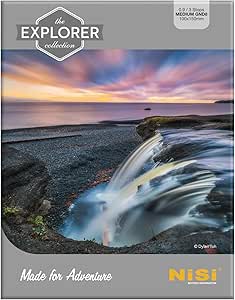
NiSi 111789 Medium GND8 100x150mm Explorer Filter
★★★★★
A 3-stop medium graduation in hardened glass lets you hold sky detail without blowing the foreground — built tough for photographers who shoot where conditions bite.
$145.00*
View on Amazon
✓ In Stock on Amazon.com
*Price sourced from Amazon.com. Last updated:Jul 14, 2026.Price and availability are subject to change.
Affiliate Disclosure: Studio Supplies may earn a commission from qualifying purchases made through links on this page, at no additional cost to you. This helps support our editorial team.
Notice a mistake? Let Us Know
Overview
Key Features
Hardened Glass Filter, Less Prone to Accidental Damage
Less Prone to Accidental Damage
Made for Active Photographers that Love Adventure
True to life color, No color cast
Perfect to balance the exposure when buildings, small mountains, and other elements protrude into the skyline
Specifications
Filter Type
Medium GND8
Construction Material
Hardened Glass
Color Accuracy
True to life color, No color cast
Filter Size
100x150mm
Pros & Cons
👍 Pros
- Medium graduation transition zone suits scenes with low skyline intrusions — buildings, ridgelines, piers — where a hard-edge grad would leave a visible dark band on foreground elements.
- 3-stop (GND8) density covers the most common exposure differential between sky and land in outdoor shooting, making it the single most useful GND density to own.
- Hardened optical glass construction withstands the physical demands of outdoor and adventure photography better than standard glass alternatives.
- Nano coating with IR technology delivers color-neutral filtration — the graduation blends without a perceptible color shift that would require correction in Lightroom or Capture One.
- 100x150mm dimensions fit the universal 100mm filter holder standard, making it compatible with a broad ecosystem of holders and stackable with other 100mm system filters.
👎 Cons
- Medium graduation is a compromise — it is less precise than a hard-edge grad on perfectly flat horizons and less forgiving than a soft-edge grad on heavily irregular skylines; neither specialist situation is its strength.
- At 100x150mm in hardened glass, this filter adds meaningful weight and bulk to a filter pouch compared to resin alternatives — a real consideration when counting grams on a long trek.
- 3-stop density only covers a specific exposure gap; scenes with 4–5 stop differentials or dynamic skies at golden hour may require stacking or a different density, adding cost.
- The protective sleeve and holder are not included — full system investment is required to use this filter correctly in the field.
Frequently Asked Questions
What does "medium" graduation mean on this GND filter, and when should I choose it over a soft or hard grad?
The medium graduation describes the width of the transition zone between the dark and clear halves. It's wider than a hard-edge grad but narrower than a soft-edge — ideal when your horizon has moderate protrusions like low buildings, gentle hills, or rocky shorelines. A hard grad cuts cleanly for a flat horizon; this medium grad avoids the obvious dark band on uneven skylines without the soft grad's tendency to leave your sky underexposed.
What does the GND8 / 3-stop density actually do to my exposure?
GND8 means the dark portion of the filter transmits one-eighth of the light that passes through the clear portion. A 3-stop difference corresponds exactly to that ratio. In practice, if your sky is 3 stops brighter than your foreground, this filter normalizes the scene so both zones expose correctly in a single frame without HDR blending.
Does this filter introduce a color cast, and how does the nano coating address that?
Uncoated or lower-quality GND filters frequently introduce a magenta or blue cast in the transition zone. The NiSi nano coating on this filter, combined with its IR technology, is designed to block infrared light that causes color shifts — reviewers consistently report neutral color rendition that needs minimal correction in post.
Is the hardened glass more resistant to scratching than standard optical glass?
Hardened glass resists impact and flex-induced cracking better than standard optical glass — that's the durability benefit for field use. It is not scratch-proof; the nano coating provides some protection, but standard filter care (lens cloths, protective sleeve) still applies.
Will this filter fit my existing 100mm filter system, and does it work with NiSi holders from other collections?
Yes — the 100x150mm dimensions are the industry-standard 100mm system size, compatible with NiSi's V5, V6, and V7 holders as well as third-party 100mm holders from other brands. The 150mm length gives you adjustment range to position the graduation precisely on your scene.
Related Products


