



Novation
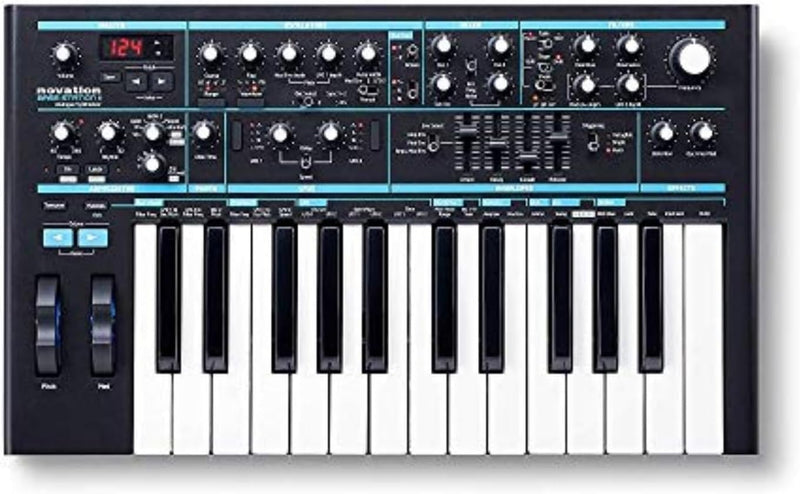
Novation AMS-BASS-STATION-II Bass Station II Analog Monosynth
Craft Powerful Basslines with the Novation Bass Station II The Novation Bass Station II is a reimagined classic analog monosynth, perfect for creating cutting-edge basslines, leads, and effects. With its versatile oscillators, multimode filter, and intuitive controls, this synth empowers you to s...
$579.99*
View on Amazon
✓ In Stock on Amazon.com
*Price sourced from Amazon.com. Last updated:Aug 27, 2026.Price and availability are subject to change — details.
Affiliate Disclosure: As an Amazon Associate, Studio Supplies earns from qualifying purchases made through links on this page, at no additional cost to you. This helps support our editorial team.
Notice a mistake? Let Us Know
Overview
Craft Powerful Basslines with the Novation Bass Station II
The Novation Bass Station II is a reimagined classic analog monosynth, perfect for creating cutting-edge basslines, leads, and effects. With its versatile oscillators, multimode filter, and intuitive controls, this synth empowers you to sculpt unique sounds and bring your musical ideas to life.
Specifications:
- Type: Analog Monosynth
- Oscillators: Two tuneable oscillators with four waveforms, sub-oscillator, noise and ring modulation
- Filter: Classic multimode filter (low-, high-, and band-pass) with 12 and 24dB/octave slopes, 24dB Acid Filter
- Sequencer: Pattern-based step sequencer with real-time recording
- Arpeggiator: Yes
- Presets: 64 factory presets, 64 user slots
- Keyboard: 25-note full-sized keyboard
- MIDI: MIDI I/O on 5 pin din ports
- Connectivity: USB, MIDI USB
- Headphones Jack: 6.35mm Jack
Key Features
Create a huge variety of sounds- Two tuneable, analogue oscillators offer a selection of four waveforms, a sub-oscillator, plus noise and ring modulation to help you achieve the sound you’re looking for
Enormous bass and shrieking leads- Switch the Classic Filter between low-, high- and band-pass modes with 12 and 24dB/octave slopes to make the Bass Station II as mellow or aggressive as you want
Improved analogue filter stage- Two distinct analogue filter types: the classic multi-mode filter and a new 24dB Acid Filter offer a massive variation in sonic possibilities
Instant Inspiration - Bass Station II's pattern-based arpeggiator and step sequencer are a fun way to find new inspiration. The sequencer lets you record your own notes, ties, rests, and rhythms in real time, and can use them with any patch you like
Easily load and save patches - There’s space for 128 patches, and 64 factory sounds are included. Downloadable artist packs cover a huge range of styles and give you even more presets to get inspired, and you can create your own sounds from scratch
Connect to Just About Anything- Bass Station II has MIDI I/O on 5 pin din ports, so you can connect your other MIDI gear. You can even connect an external instrument and run it through Bass Station II's analogue filter and effects
Specifications
Number of Oscillators
Two tuneable analogue
Oscillator Waveforms
Four
Filter Types
Classic multi-mode, 24dB Acid Filter
Filter Slopes
12 and 24dB/octave
Memory
128 patches (64 factory sounds)
MIDI Connectivity
5 pin DIN ports (I/O)
Additional Features
Sub-oscillator, noise, ring modulation, arpeggiator, step sequencer
Frequently Asked Questions
How many oscillators does the Novation Bass Station II have?
The Novation Bass Station II features two tuneable analogue oscillators, offering a selection of four waveforms, a sub-oscillator, plus noise and ring modulation for sound creation.
What kind of filters are available on the Bass Station II?
It includes two distinct analogue filter types: a classic multi-mode filter (low-, high-, and band-pass with 12 and 24dB/octave slopes) and a new 24dB Acid Filter, providing diverse sonic possibilities.
Can I save my own custom sounds on this synthesizer?
Yes, there is space for 128 patches, and you can easily load and save your own sounds. It also comes with 64 factory sounds and downloadable artist packs.
Does the Bass Station II include a sequencer?
Yes, it features a pattern-based arpeggiator and a step sequencer, which allows you to record notes, ties, rests, and rhythms in real time and use them with any patch.
Can I connect external instruments to the Bass Station II?
Yes, you can connect an external instrument and run it through the Bass Station II's analogue filter and effects, expanding its sound processing capabilities.
What kind of MIDI connectivity does this synth offer?
The Bass Station II has MIDI I/O on 5-pin DIN ports, allowing you to connect it with your other MIDI-compatible gear.
Related Products


