



Ortofon
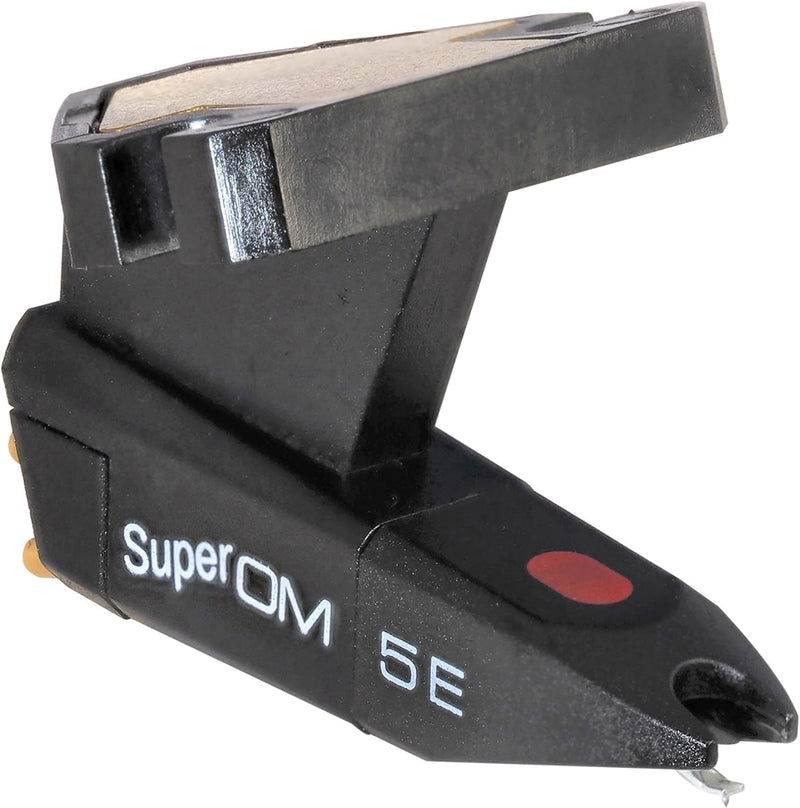
Ortofon SUPER OM 5E Elliptical Cartridge MM
Elliptical precision meets vinyl's full frequency spectrum — the Super OM 5E delivers clean channel separation and distortion-free tracking for serious turntable listening.
$89.99*$99.99Save 10%
View on Amazon
✓ In Stock on Amazon.com
*Price sourced from Amazon.com. Last updated:Oct 25, 2026.Price and availability are subject to change — details.
Affiliate Disclosure: As an Amazon Associate, Studio Supplies earns from qualifying purchases made through links on this page, at no additional cost to you. This helps support our editorial team.
Notice a mistake? Let Us Know
Overview
Key Features
The Ortofon Super OM 5 E cell is the sophisticated advancement of the OM 5 E
Improved frequency range and linearity
Increased channel separation and distortion reduction
Body material ensures high rigidity and absence of resonances
By simply replacing the diamond, the OM Super 5 E can be converted to Super 20, Super 30 or Super 40
Specifications
Stylus Type
Elliptical
Stylus Tip Radius
r/R 8/18 µm
Frequency Response
20–22,000 Hz ±3 dB
Output Voltage (1 kHz, 5 cm/sec)
4 mV
Channel Separation (1 kHz)
22 dB
Channel Separation (15 kHz)
15 dB
Channel Balance (1 kHz)
1.5 dB
Tracking Ability (315 Hz)
60 µm
Compliance, Dynamic, Lateral
20 µm/mN
Tracking Force Range
1.5–2.0 g (15–20 mN)
Recommended Tracking Force
1.75 g (17.5 mN)
Tracking Angle
20°
Internal Impedance
1.0 kOhm
Recommended Load Resistance
47 kOhm
Recommended Load Capacitance
200–500 pF
Internal Inductance
580 mH
Cartridge Type
Moving Magnet (MM)
Frequently Asked Questions
What kind of phono stage does the Super OM 5E require?
The Super OM 5E is a moving magnet (MM) cartridge with a 4 mV output at 1 kHz — well within the input sensitivity range of any standard MM phono stage. A recommended load resistance of 47 kOhm is the industry norm for MM, so virtually every phono preamp, integrated amp with phono input, or DJ mixer phono stage will interface correctly without any gain adjustments.
How does the elliptical stylus affect what I actually hear compared to a spherical tip?
The elliptical tip radius of r/R 8/18 µm traces groove modulations with significantly more contact precision than a spherical stylus. In practice, you'll hear tighter stereo imaging, improved high-frequency detail retrieval, and reduced inner-groove distortion — especially on complex program material in the final bands of an LP side.
What tracking force should I set, and why does it matter sonically?
Ortofon specifies 1.5–2.0 g with 1.75 g recommended. Running too light increases distortion and mistracking on dynamic peaks; too heavy accelerates stylus and record wear. At the recommended 1.75 g, the Super OM 5E's 60 µm tracking ability at 315 Hz gives it clean transient response on percussive material without the smearing you'd hear from an overtracked cartridge.
Can I upgrade this cartridge later without replacing the whole body?
Yes — this is one of the Super OM series' defining practical advantages. The stylus assembly is user-replaceable, and the Super OM body is compatible with Super 20, 30, and 40 stylus upgrades. You're not locked in; the cartridge body grows with your system and budget.
How sensitive is load capacitance, and do I need to worry about it?
With a recommended load capacitance of 200–500 pF, the Super OM 5E has a reasonably wide tolerance window. Tonearm cable capacitance typically runs 100–200 pF, and most phono stages add another 100 pF or so — you'll likely land within spec without modification. Capacitance outside this range can cause a treble peak or rolloff, so it's worth checking your phono stage's adjustable capacitance setting if one is available.
Related Products


