



Panasonic
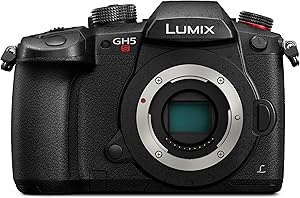
Panasonic DC-GH5S Lumix C4K Mirrorless Camera Refurbished
4K1080pUSB-C2MP
Push into the dark with confidence — the GH5S delivers clean, cinematic footage where other cameras surrender to noise.
$862.00*$2,097.99Save 58%
View on Amazon
✓ In Stock on Amazon.com
*Price sourced from Amazon.com. Last updated:Oct 23, 2026.Price and availability are subject to change — details.
Affiliate Disclosure: As an Amazon Associate, Studio Supplies earns from qualifying purchases made through links on this page, at no additional cost to you. This helps support our editorial team.
Notice a mistake? Let Us Know
Overview
Key Features
10.2MP High-sensitivity MOS sensor with multi-aspect and Dual native Iso (400 & 2, 500) with a range from 160 - 51, 200; extendable to 80 - 204, 800
Unlimited in-camera recording of C4K: 60p50p 8-bit, 30p25p/24p 4:2:2 10-bit, 4K: 60p50p 4:2:0 8-bit, 30p/25p/24p 4:2:2 10-bit. 1080p up to 240fps and C4K 60p VFR
4K anamorphic professional video production interchangeable Lens camera system with high performance, durability, and mobility. System frequency : 59.94Hz, 50.00Hz, 24.00Hz
Tc in/out/ synchro Terminal (via included BNC cable), 3.5mm mic jack with Line input, 3.5mm headphone jack 2.5mm remote socket, HDMI type a socket, USB-C 3.1 socket
Specifications
Model Name
DC-GH5S
Sensor Type
10.2MP High-sensitivity MOS sensor
ISO Range
160 - 51,200 (extendable to 80 - 204,800)
Native ISO
400 & 2,500
C4K Recording (8-bit)
60p50p
C4K Recording (10-bit)
30p25p/24p 4:2:2
4K Recording (8-bit)
60p50p 4:2:0
4K Recording (10-bit)
30p/25p/24p 4:2:2
1080p Recording
Up to 240fps
Variable Frame Rate (VFR)
C4K 60p
System Frequency
59.94Hz, 50.00Hz, 24.00Hz
Audio Input
3.5mm mic jack with Line input
Audio Output
3.5mm headphone jack
Remote Socket
2.5mm
Video Output
HDMI type A socket
Data Transfer
USB-C 3.1 socket
Sync Terminal
Tc in/out/synchro (via included BNC cable)
Frequently Asked Questions
How does the GH5S's dual native ISO actually help on a real shoot?
In practice, it means you have two clean base ISOs — 400 and 2500 — so switching to low-light conditions doesn't cost you image quality the way a single-ISO camera would. Shooting a dark reception hall or a dimly lit studio set, you can pull up to ISO 2500 without the muddy shadow detail you'd expect from a sensor this size.
Is the 10.2MP sensor a meaningful trade-off compared to the GH5's 20MP?
Yes, and it's an intentional one. The larger photosites on the GH5S exist specifically to gather more light per pixel, which is why the low-light performance is dramatically better. For video work — especially in mixed or dim lighting — the trade is well worth it. For stills-first shooters, the resolution drop will matter more.
What does "unlimited in-camera recording" mean for a long shoot?
It means you won't hit a clip length cap mid-interview or mid-performance. Many cameras impose 30-minute recording limits for regulatory or thermal reasons; the GH5S removes that ceiling, which matters on documentary shoots, live events, or any unscripted situation where stopping to restart a clip is not an option.
Does this refurbished unit include V-Log L?
V-Log L comes pre-installed on the GH5S from the factory, and a certified refurbished unit retains that. You get a flat log profile with roughly 12 stops of dynamic range ready to grade in post without an additional purchase.
What's the TC In/Out terminal used for on set?
The BNC timecode terminal lets you jam sync the GH5S to a timecode generator or another camera, which is critical for multicam shoots and double-system audio workflows. Without it, syncing clips in the edit relies on slates or waveform matching — the TC terminal makes that process reliable and frame-accurate.
Related Products


