



Panasonic
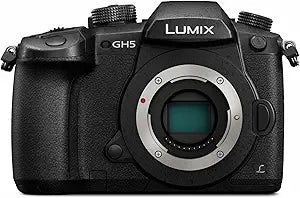
Panasonic GH5 4K Mirrorless Camera Body Renewed
4KFHD3MP
Shoot cinema-quality 4K video and sharp stills from a body built to handle a professional's daily demands.
$691.25*$729.00Save 5%
View on Amazon
✓ In Stock on Amazon.com
*Price sourced from Amazon.com. Last updated:Oct 21, 2026.Price and availability are subject to change — details.
Affiliate Disclosure: As an Amazon Associate, Studio Supplies earns from qualifying purchases made through links on this page, at no additional cost to you. This helps support our editorial team.
Notice a mistake? Let Us Know
Overview
Key Features
Professional photo and 4K video performance in a durable magnesium alloy body.
20.3MP Micro Four Thirds sensor with no low pass filter.
4K video: internal recording at 4k60/50P (4:2:0 8bit) & 4k30/25P/24P (4:2:2 10bit).
Variable video frame rates 4K: max. 60Fps & FHD: max. 180Fps.Full size Type A HDMI terminal with cable lock included & twin SD Card slots UHS-II U3 Compatible.
Specifications
Sensor
20.3MP Micro Four Thirds (no low-pass filter)
Lens Mount
Micro Four Thirds
4K Video
4K 60/50p (4:2:0 8-bit), 4K 30/25/24p (4:2:2 10-bit) internal
Variable Frame Rates
4K: up to 60fps / FHD: up to 180fps
Image Stabilization
5-Axis Dual I.S. 2.0
HDMI Output
Full Size Type A with cable lock
Memory Card Slots
Dual SD (UHS-II U3 compatible)
Body Material
Magnesium alloy, weather sealed
Condition
Renewed
Frequently Asked Questions
What lens mount does the GH5 use, and what glass is available for it?
The GH5 uses the Micro Four Thirds mount, which is one of the most extensively supported mirrorless mounts available — Panasonic, Olympus/OM System, Voigtländer, and many adapted lenses via cheap MFT adapters all work with it, giving you an enormous range of native and third-party options.
How does the 4K video actually perform in practice — is the 10-bit internal recording useful?
Very. The 4K 30p 4:2:2 10-bit internal recording gives you genuine grading latitude — skin tones hold up in color correction, and you can pull highlights or lift shadows without the banding you'd see in 8-bit footage. For interview, documentary, and narrative work, this is a meaningful advantage over competing bodies at this price point.
This is a Renewed unit — what should I check when it arrives?
Inspect the sensor for dust or scratches, test the dual SD card slots with your own cards, check that the 5-axis IBIS is functioning (shoot handheld at slow shutter and look for stabilization), and verify the magnesium body shows no damage around the weather sealing gaskets. Renewed units from reputable sellers are typically refurbished to functional spec, but these are the areas most relevant to a working camera body.
Does the GH5 have in-body stabilization, and how effective is it for video?
Yes — the GH5's 5-Axis Dual I.S. 2.0 combines in-body and in-lens stabilization when paired with compatible Panasonic lenses, and delivers genuinely usable handheld video. For solo shooters doing walk-and-talk or event coverage without a gimbal, this is one of the GH5's strongest real-world advantages.
What's the practical high-ISO ceiling for clean images?
The Micro Four Thirds sensor shows noise more readily than APS-C or full-frame at high ISOs — ISO 3200 is generally the practical ceiling for clean stills and video. For low-light work beyond that, expect visible luminance noise, though it's often manageable in post.
Related Products


