



Panasonic
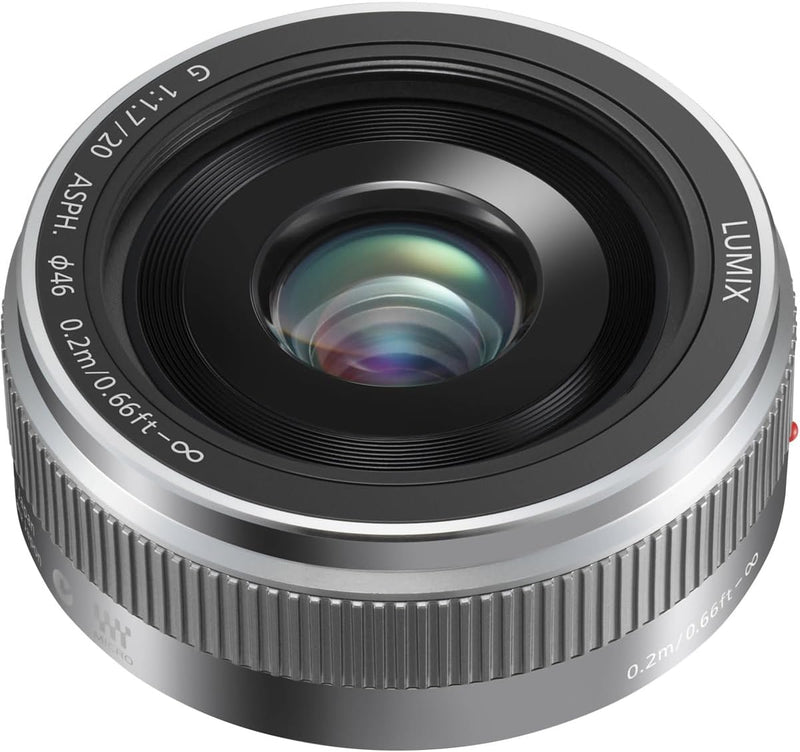
Panasonic H-H020AS LUMIX G 20mm f/1.7 II ASPH Lens
f/1.7
The sharpest compact prime for Micro Four Thirds street and portrait work, with an f/1.7 aperture that earns its reputation in low light.
View price on Amazon
Affiliate Disclosure: As an Amazon Associate, Studio Supplies earns from qualifying purchases made through links on this page, at no additional cost to you. This helps support our editorial team.
Notice a mistake? Let Us Know
Overview
Key Features
20mm focal length, equivalent to 40mm on a 35mm film camera
F1.7 brightness for beautiful, soft focus
Comprised of seven lenses in five groups, closest Focusing Distance:0.2m / 0.66 feet
Used with Lumix G Micro System Cameras, allows for use of the advanced contrast Auto Focus (AF) system
Lens not Zoomable
Specifications
Brand
Panasonic
Model
H-H020AS
Focal Length
20mm (40mm full-frame equivalent)
Maximum Aperture
f/1.7
Lens Construction
7 elements in 5 groups (includes 2 aspherical elements)
Mount
Micro Four Thirds (metal)
Closest Focusing Distance
0.2m / 0.66 feet
Optical Stabilization
None
Dimensions
1.02 x 2.48 x 2.48 inches
Weight
3.07 oz
Compatibility
Lumix G Micro System cameras
Frequently Asked Questions
What does the 40mm full-frame equivalent focal length mean for everyday shooting?
It lands just slightly longer than a 35mm equivalent, making it a natural perspective for street shooting, environmental portraits, and travel work — close enough to how the eye sees a scene to feel instinctive, but with just enough compression to separate a subject from its background.
How does the f/1.7 aperture perform in real low-light shooting situations?
At f/1.7, you can shoot in significantly dimmer conditions — restaurant interiors, evening events, window-lit scenes — while keeping ISO low enough to hold fine detail and manageable noise. Subject separation at wide open is clear and smooth, making it a practical portrait lens even on a Micro Four Thirds sensor.
Is autofocus reliable and fast enough for candid or street work?
The lens uses Panasonic's contrast-detect AF system, which is accurate and works well for stationary subjects. For street photography with subjects moving toward the camera or during fast-paced events, the focus speed is competent but not as instantaneous as phase-detect systems on newer bodies. Works best when shooting at a predetermined focus distance or zone.
Does this lens include optical image stabilization?
No — the 20mm f/1.7 II does not have built-in optical stabilization. Panasonic Lumix camera bodies with in-body stabilization will compensate, but if you're shooting video handheld on a body without IBIS, expect some shake at slower shutter speeds.
What makes this the Mk II version and how does it differ from the original?
The Mark II features an updated optical formula and revised coatings for improved ghost and flare resistance, along with a metal mount for durability. The optical character — the sharpness and rendering — is refined relative to the original, though both share the same focal length and maximum aperture profile.
Related Products


