



Panasonic
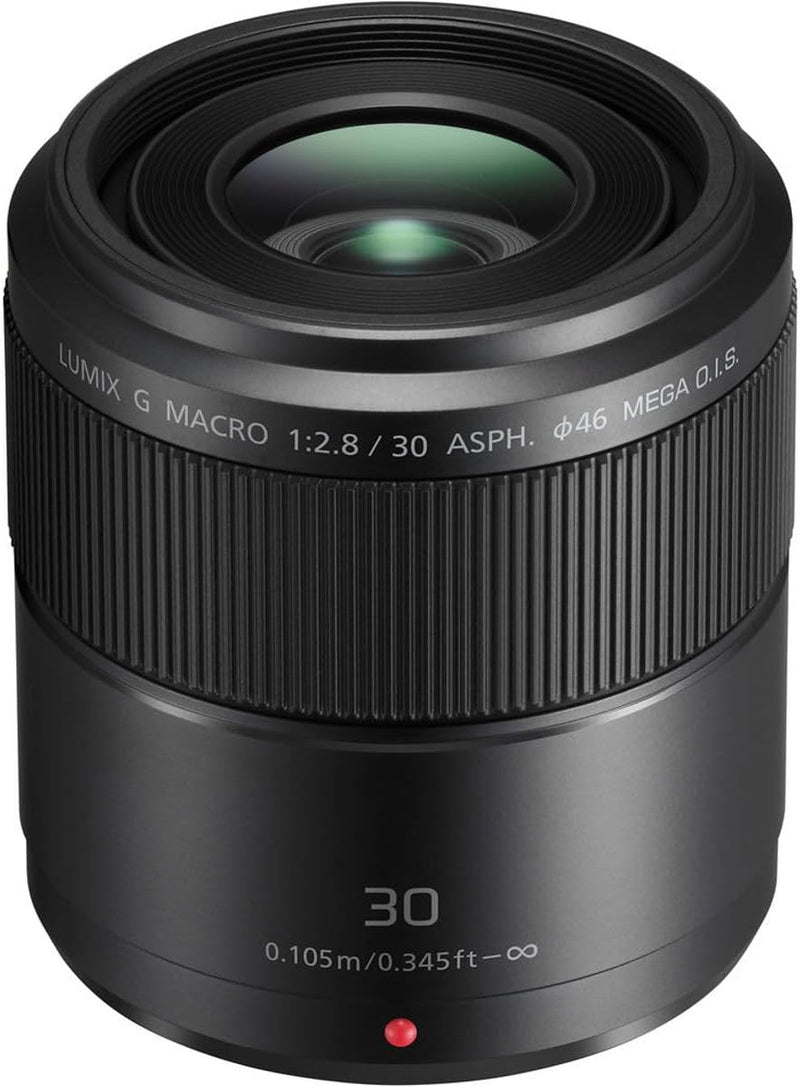
Panasonic H-HS030 LUMIX G 30mm Macro Lens
★★★★★
Unlock true 1:1 macro reproduction and corner-to-corner sharpness for Micro Four Thirds shooters with the Panasonic LUMIX G 30mm F2.8.
$397.99*$499.99Save 20%
View on Amazon
✓ In Stock on Amazon.com
Price history
*Price sourced from Amazon.com. Last updated:Jul 15, 2026.Price and availability are subject to change.
Affiliate Disclosure: Studio Supplies may earn a commission from qualifying purchases made through links on this page, at no additional cost to you. This helps support our editorial team.
Notice a mistake? Let Us Know
Overview
Key Features
Approx. 1.0x / 2.0x (35mm camera equiv.) Magnification
High Descriptiveness Corner to Corner / Beautiful Bokeh Expression
240 fps Drive AF / MEGA O.I.S. (Optical Image Stabilizer)
Specifications
Brand
Panasonic
Model
H-HS030
Focal Length
30mm (60mm equivalent, full frame)
Maximum Aperture
F2.8
Lens Type
Macro
Mount
Micro Four Thirds
Magnification
1.0x (2.0x full-frame equivalent)
Image Stabilization
MEGA O.I.S. (Optical Image Stabilizer)
AF Drive Speed
240 fps
Lens Construction
9 elements in 9 groups (1 aspherical lens)
Dimensions
3.23 x 3.23 x 4.41 inches
Weight
8 ounces
Pros & Cons
👍 Pros
- True 1:1 magnification (2x equivalent on full frame) reveals detail in small subjects that no standard kit lens can capture — insects, textures, small product details come alive.
- Corner-to-corner sharpness is a genuine strength — flat subjects like stamps, fabric, or product labels render with consistent clarity across the entire frame.
- MEGA O.I.S. provides usable stabilization for handheld macro work, reducing the number of throwaway shots when a tripod isn't practical.
- Compact and lightweight for a macro lens, making it an easy addition to a travel or street kit when you want close-focus capability without a dedicated macro rig.
- The F2.8 aperture produces smooth, pleasing bokeh that isolates macro subjects beautifully against soft, defocused backgrounds.
👎 Cons
- At 1:1 magnification, depth of field at F2.8 becomes razor-thin — even with O.I.S., achieving front-to-back sharpness on three-dimensional subjects requires stopping down and often a tripod.
- The 30mm focal length (60mm equivalent) means you need to be quite close to your subject at 1:1 — potentially close enough to shadow it or startle live subjects like insects.
- No weather sealing limits its use in light rain or dusty environments that Micro Four Thirds shooters might otherwise expect their compact kit to handle.
- Autofocus can hunt at extreme close-focusing distances in low-contrast or low-light conditions, requiring a shift to manual focus for precision work.
Frequently Asked Questions
What camera systems is the Panasonic H-HS030 compatible with?
This lens uses the Micro Four Thirds mount, making it compatible with Panasonic LUMIX G and GH series bodies as well as Olympus/OM System cameras that use the same mount standard.
What is the effective magnification on a Micro Four Thirds sensor?
The lens delivers 1:1 magnification on Micro Four Thirds, which is equivalent to 2:1 (2x) on a full-frame 35mm camera — meaning subjects appear larger in the frame than they would with a macro lens designed for full frame. This makes it particularly useful for very small subjects like insects, jewelry, or product details.
Does the MEGA O.I.S. optical stabilization help with handheld macro shooting?
Significantly. At close focusing distances, camera shake is amplified, and MEGA O.I.S. provides meaningful stabilization for handheld shots. That said, for critical sharpness at 1:1 magnification, a tripod and remote shutter release will yield the most reliable results.
How fast is the autofocus, and is it reliable for moving subjects at close range?
The 240 fps drive AF is fast for a macro lens and handles slow-moving or stationary subjects confidently. Tracking fast-moving insects or erratic subjects at extreme close range remains challenging — as it is with any macro lens — and manual focus fine-tuning is often preferable for critical work.
Is the F2.8 aperture useful at macro distances, or does depth of field become too shallow?
At 1:1 magnification, F2.8 produces an extremely thin depth of field — often just millimeters — which creates beautiful subject isolation but requires precise focusing. Most macro photographers stop down to F8–F11 for sharpness across a subject, using F2.8 for deliberate artistic blur effects.
Related Products


