

Panasonic
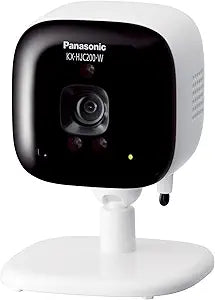
Panasonic KX-HJC200-W @Home Indoor Network Camera
★★★★★
Monitor your home with peace of mindThe Panasonic Network Camera Smartphone “@Home Indoor Camera” allows you to remotely monitor your home directly from your smartphone with a built in microphone and speaker for two-way audio and simple set-up
$204.00*
Check availability
*Price sourced from Amazon.com. Last updated:Jul 15, 2026.Price and availability are subject to change.
Affiliate Disclosure: Studio Supplies may earn a commission from qualifying purchases made through links on this page, at no additional cost to you. This helps support our editorial team.
Notice a mistake? Let Us Know
Overview
Monitor your home with peace of mind
The Panasonic Network Camera Smartphone “@Home Indoor Camera” allows you to remotely monitor your home directly from your smartphone with a built in microphone and speaker for two-way audio and simple set-up
Key Features
Power Supply: AC 100 V (50 Hz/60 Hz) (DC 6.5 V) (1 A)
Power Consumption: Standby Time: Approx. 1.1 W; Operating: Approx. 2.1 W
Wireless communication system: DECT: 1.9 GHz TDMA-WB
Image Sensor: CMOS 300,000 pixels
Focal Length: Fixed (0.5 m to ∞)
Specifications
Power Supply
AC 100 V (DC 6.5 V)
Standby Power Consumption
Approx. 1.1 W
Operating Power Consumption
Approx. 2.1 W
Wireless Communication System
DECT: 1.9 GHz TDMA-WB
Image Sensor
CMOS 300,000 pixels
Focal Length
Fixed (0.5 m to ∞)
Pros & Cons
👍 Pros
- Operates wirelessly using the DECT 1.9 GHz TDMA-WB communication system, providing a stable and secure connection within the home.
- Features a CMOS 300,000 pixels image sensor, suitable for capturing clear surveillance footage for home monitoring.
- Offers a fixed focal length, ensuring a consistent field of view for straightforward placement and monitoring without needing adjustment.
- Designed for indoor use, making it an appropriate solution for monitoring specific areas inside your home or office.
- The camera has a relatively low power consumption, with a standby time of approximately 1.1W and operating at about 2.1W.
👎 Cons
- The image sensor resolution of CMOS 300,000 pixels is quite low by modern standards, potentially resulting in less detailed video quality.
- The fixed focal length means the viewing angle cannot be adjusted digitally, which limits flexibility once the camera is positioned.
- The camera is specified for indoor use only, meaning it cannot be deployed outdoors for external surveillance.
- There is no mention of night vision capabilities, which could be a significant limitation for monitoring in low-light conditions.
- The absence of pan and tilt functionality means the camera's field of view is static, requiring careful placement to cover desired areas.
Frequently Asked Questions
What type of image sensor does the Panasonic KX-HJC200-W camera use?
The camera uses a CMOS 300,000 pixels image sensor, suitable for capturing standard resolution video for home monitoring.
How does this indoor network camera connect wirelessly?
It uses a DECT: 1.9 GHz TDMA-WB wireless communication system, designed for a reliable and secure connection within your home network.
What are the power consumption levels for this camera?
The camera has a standby power consumption of approximately 1.1 W and an operating power consumption of approximately 2.1 W.
Is the focal length adjustable on this camera?
No, the camera features a fixed focal length, meaning its field of view is constant and does not require manual adjustment after installation.
Can this camera be used for outdoor surveillance?
No, the Panasonic KX-HJC200-W is an @Home Indoor Network Camera and is specifically designed for indoor use.
What is the power supply requirement for this camera?
The camera requires an AC 100 V (50 Hz/60 Hz) power supply, which is converted to DC 6.5 V at 1 A.
Related Products


