



Phottix
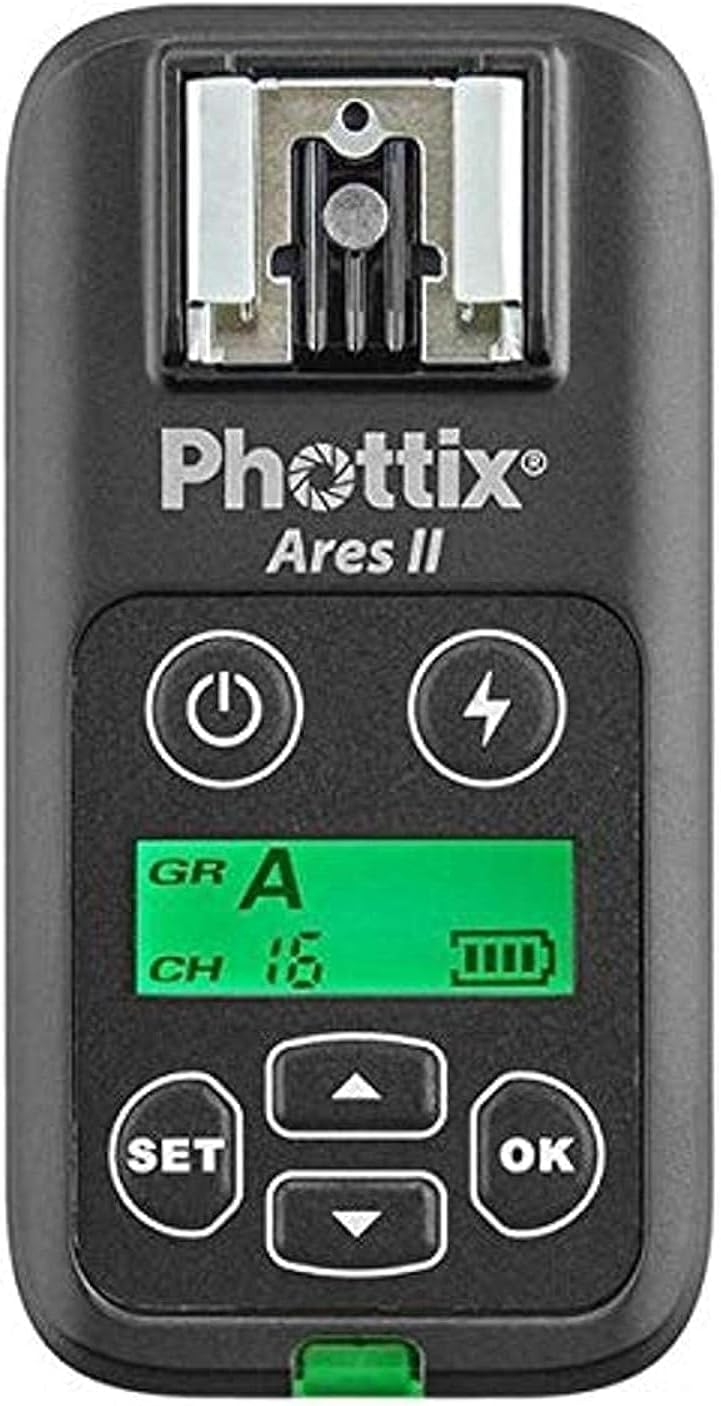
Phottix 89553 Ares II Flash Trigger Remote Receiver
Lock in reliable off-camera flash at up to 150 meters — the Phottix Ares II receiver puts four independently controllable groups in the palm of your hand.
$49.95*
Check availability
*Price sourced from Amazon.com. Last updated:Aug 28, 2026.Price and availability are subject to change — details.
Affiliate Disclosure: As an Amazon Associate, Studio Supplies earns from qualifying purchases made through links on this page, at no additional cost to you. This helps support our editorial team.
Notice a mistake? Let Us Know
Overview
Key Features
2.4 GHz radio triggering
Easy to use LCD screen
4 groups and 16 channels
Specifications
Brand
Phottix
Model
89553
Type
Flash Remote Receiver
Frequency
2.4GHz Radio
Channels
16 (Strato II compatible on channels 1–4)
Groups
4 (A–D)
Digital ID Codes
0000–9999
Range
150 meters
Display
LCD Screen
Hot Shoe
Universal
Color
Black
Weight
0.15 kg
Frequently Asked Questions
This is listed as a receiver — does the Ares II come with a transmitter, or do I need to purchase one separately?
This SKU is the receiver only. To trigger your flash wirelessly, you'll need a compatible Ares II transmitter (or the Strato II transmitter for channels 1–4). The receiver mounts to your flash's hot shoe; the transmitter sits on your camera's hot shoe. Budget for both pieces if you're building a new system.
How do the 4 groups (A–D) work in a multi-light setup — can I fire them independently or only together?
Each group can be assigned a different flash unit, and the transmitter allows you to selectively fire any combination of groups independently. In a three-light portrait setup, for example, you can turn the background light (Group C) on or off from the transmitter without touching the flash itself — useful for quickly comparing lighting ratios during a session.
What do the digital ID codes (0000–9999) do, and do I need to configure them?
The ID codes act as a digital lock — only a transmitter and receiver sharing the same ID code will communicate, even on the same channel. In a busy studio or event environment where other photographers may be using Ares II systems, setting a unique ID prevents accidental triggering of your flashes. Default code is 0000; changing it takes about 30 seconds via the LCD menu.
Does the Ares II receiver support TTL flash metering, or is it manual only?
The Ares II is a manual trigger system — it fires the flash at whatever power level you've set on the flash unit itself. There is no TTL pass-through. For photographers who prefer manual control for consistency (studio work, controlled event lighting), this is ideal. For TTL-dependent workflows like fast-moving documentary or wedding candids, you'd need a TTL-capable trigger system.
What is the Strato II compatibility mentioned for channels 1–4?
The Ares II receiver is backward-compatible with Phottix Strato II transmitters on channels 1 through 4. If you already own a Strato II transmitter, you can use this receiver without replacing your trigger. Beyond channel 4, you'll need the Ares II transmitter for full 16-channel access.
Related Products


