



PreSonus
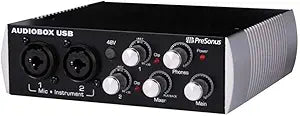
PreSonus AUDIOBOX USB 96K BLK Audio Interface - Black
USB 2.0
Class A preamps, 24-bit/96kHz converters, and bus-powered USB operation make the AudioBox USB 96 a studio-grade signal chain in a sub-$100 package.
$99.99*
Check availability
*Price sourced from Amazon.com. Last updated:Aug 28, 2026.Price and availability are subject to change — details.
Affiliate Disclosure: As an Amazon Associate, Studio Supplies earns from qualifying purchases made through links on this page, at no additional cost to you. This helps support our editorial team.
Notice a mistake? Let Us Know
Overview
Key Features
Bus-powered USB 2.0 audio interface with MIDI I/O
Compatible with almost all recording software for Mac and Windows
24-bit resolution; 44.1, 48, 88.2, and 96 kHz sampling rates
2 combo mic/instrument inputs with high-performance, low-noise, high-headroom mic preamplifiers
Includes Studio One Artist DAW software and 6+ GB of third-party resources
Specifications
Interface Type
USB 2.0 (bus-powered)
Inputs/Outputs
2-in / 2-out
Microphone Preamps
2x Combo Mic/Instrument (Class A)
Resolution
24-bit
Sampling Rates
44.1, 48, 88.2, 96 kHz
MIDI I/O
Yes
Phantom Power
48V
Bundled Software
Studio One Artist (Mac/Windows)
OS Compatibility
Mac and Windows
Color
Black
Frequently Asked Questions
How clean are the preamps at high gain settings, and is there enough headroom for dynamic microphones?
The Class A preamps in the AudioBox USB 96 provide sufficient gain for dynamic microphones like the SM7B or SM58, though you will be pushing the gain knob further than with condensers. Self-noise is acceptable for home studio work, but high-sensitivity ribbon microphones may reveal the noise floor at maximum gain. For ribbon mics or high-impedance dynamics requiring 60+ dB of clean gain, a dedicated inline preamp is worth considering.
Does this interface require phantom power for condenser microphones, and is it switchable per channel?
Yes, the AudioBox USB 96 supplies 48V phantom power for condenser microphones. The specifications do not confirm per-channel switching — phantom power configuration should be verified in the product documentation before connecting ribbon microphones, which can be damaged by phantom power.
What is the highest sample rate this interface supports, and does it actually benefit recording quality?
The AudioBox USB 96 supports 44.1, 48, 88.2, and 96 kHz sampling rates at 24-bit depth. For most tracking and mixing applications, 44.1 or 48 kHz at 24-bit delivers professional results. Recording at 96 kHz provides headroom for pitch manipulation and time-stretching in post-production without aliasing artifacts — it doubles the file size and CPU load of your DAW session in exchange.
Is bus power reliable enough for studio use, or will USB power cause noise or dropouts?
Bus-powered operation via USB 2.0 is the sole power source — there is no external power supply. On a clean USB port connected directly to a laptop or desktop, noise floor performance is generally acceptable. USB hubs, particularly unpowered ones, can introduce ground noise or cause power instability. For critical sessions, connect directly to a motherboard or laptop USB port.
Does the AudioBox USB 96 have a direct monitoring path, and what is its latency?
Yes, the interface supports direct hardware monitoring, routing the input signal to the headphone and monitor outputs with near-zero latency — bypassing the DAW's buffer entirely. This is essential for tracking vocals or instruments where DAW-induced latency would make real-time monitoring unusable.
Related Products


