



PreSonus
PreSonus Eris-E3.5_K4 3.5-Inch Studio Reference Monitor Bundle
★★★★★
Honest, flat reference monitoring with a 3.5-inch Kevlar woofer and 25W Class AB amplification — a complete bundle that anchors a bedroom studio's mix position without breaking the budget.
$129.99*
View on Amazon
✓ In Stock on Amazon.com
*Price sourced from Amazon.com. Last updated:Jul 14, 2026.Price and availability are subject to change.
Affiliate Disclosure: Studio Supplies may earn a commission from qualifying purchases made through links on this page, at no additional cost to you. This helps support our editorial team.
Notice a mistake? Let Us Know
Overview
Key Features
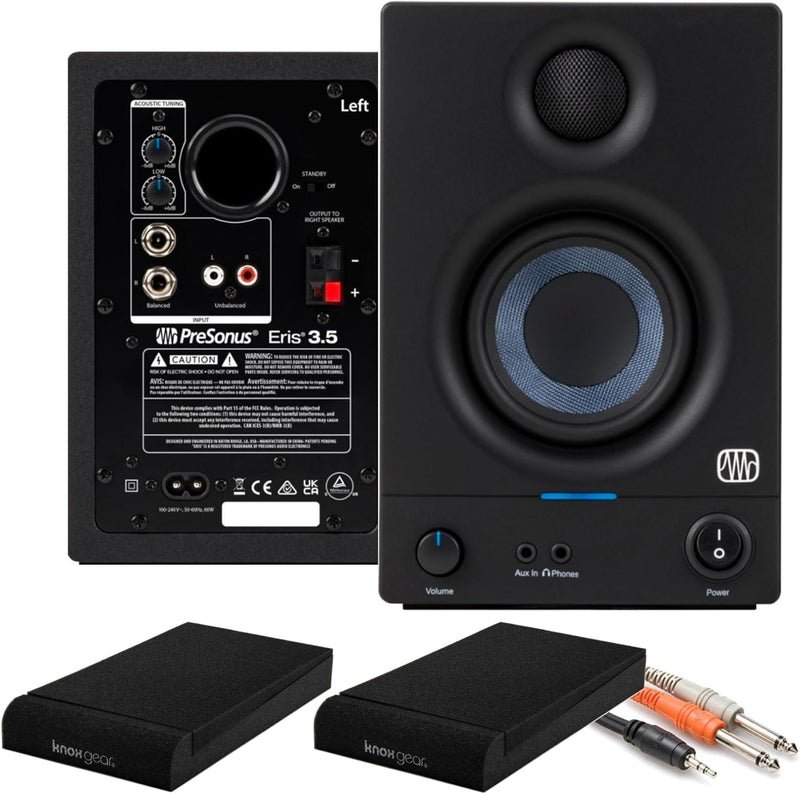
Bundle Includes: PreSonus Eris 3.5 3.5-Inch Low-Frequency Driver Media Reference Monitor with RF Interference, Studio Monitor Isolation Pads Suitable for 3-4" Speakers (2-Pack), and 3.5mm TRS to Dual 1/4-inch TS Stereo Breakout Cable
Low-Frequency Transducer: 3.5-inch (89 mm) Kevlar low-frequency transducer
High-Frequency Transducer: 1-inch (25 mm), ultra-low-mass, silk-dome, high-frequency transducer
Acoustic Port: Rear-firing acoustic port for superior bass-frequency reproduction
Volume Control: Front-panel volume control for speakers and headphone amplifier
Specifications
Low-Frequency Transducer
3.5-inch (89mm) Kevlar
High-Frequency Transducer
1-inch (25mm) ultra-low-mass silk-dome
Amplifier Power
25W per side, Class AB
Acoustic Port
Rear-firing
Inputs
1/4-inch balanced TRS, RCA, 1/8-inch stereo
Bundle Includes
Studio Monitor Isolation Pads (2-pack, for 3–4" speakers), 3.5mm TRS to Dual 1/4-inch TS Stereo Breakout Cable
Brand
PreSonus
Model
Eris-E3.5_K4
Pros & Cons
👍 Pros
- 3.5-inch Kevlar low-frequency driver provides controlled, accurate bass reproduction without the resonance peaks found in cheaper paper-cone designs — translating to more reliable low-midrange decisions at the mix position.
- 1-inch silk-dome tweeter with ultra-low mass delivers extended high-frequency response and smooth transient reproduction, audible on cymbals, sibilance, and room reverb tails.
- 25W Class AB amplification per side provides clean headroom at near-field listening levels, avoiding compression artifacts that obscure mix dynamics.
- Balanced 1/4-inch TRS input accepts studio-grade signal connections, reducing noise floor compared to unbalanced consumer connections at equivalent cable lengths.
- Bundle includes isolation pads and breakout cable — practical additions that address the two most common setup friction points (desk resonance and source connectivity) without additional purchases.
👎 Cons
- The 3.5-inch woofer's physical size limits meaningful low-frequency extension; sub-bass frequencies below approximately 80Hz are not reliably reproduced, requiring headphone cross-referencing for any bass-heavy mix work.
- The rear-firing acoustic port design demands careful placement — monitors need 15+ cm clearance from the back wall to prevent bass buildup that compromises the reference accuracy the driver delivers.
- At 25W into a small enclosure, maximum SPL is limited; for a large room or any session where the monitors need to fill significant space, the Eris 3.5 will run out of clean headroom before it runs out of room.
- The included 3.5mm TRS to dual 1/4-inch TS cable is an unbalanced TS connection on the monitor end, not a balanced TRS-to-TRS run — users with a proper audio interface should connect directly via balanced 1/4-inch cables for best noise rejection.
- No built-in acoustic EQ room correction beyond the basic high and low trim controls — complex room problems require external treatment or a dedicated monitor controller.
Frequently Asked Questions
Are these monitors accurate enough for mixing decisions, or are they more suited to casual listening?
The Eris 3.5 is a genuine near-field reference monitor with a flat-response design philosophy — the Kevlar low-frequency driver and silk-dome tweeter are tuned for translation, not consumer-style bass enhancement. At 3.5 inches, the low-frequency extension has physical limits (the rear-firing port compensates partially), but for mix decisions in the midrange and high frequencies — where most critical listening happens — the response is honest and usable. Don't expect sub-bass representation; pair with headphones for low-end verification.
What input connections does the Eris 3.5 accept, and does the bundle cable cover them?
The Eris 3.5 accepts balanced 1/4-inch TRS, unbalanced RCA, and 1/8-inch stereo (3.5mm) inputs. The included 3.5mm TRS to dual 1/4-inch TS breakout cable connects the headphone output of a laptop, interface, or audio device to the balanced TRS inputs on the monitors — a practical solution for setups without a dedicated audio interface.
Does the rear-firing acoustic port cause problems if the monitors are placed close to a wall?
Yes — this is the most important placement consideration for the Eris 3.5. The rear-firing port interacts with the wall behind the speakers; placing them within 10–15cm of a wall produces audible bass buildup that muddies the low-frequency response. The included isolation pads elevate and slightly angle the monitors, which helps decouple them from desk resonance but doesn't solve wall proximity. Pull them forward, or use the high/low EQ trim controls to compensate.
Does the Eris 3.5 bundle include a headphone amplifier output?
Yes. The front panel of the Eris 3.5 includes a headphone output with its own volume control, driven by the built-in headphone amplifier. This lets you switch between speaker monitoring and headphone monitoring from the same volume knob position — useful in shared spaces or for late-night sessions.
What is the power output, and is Class AB amplification relevant at this size?
The Eris 3.5 delivers 25 watts per side via a Class AB amplifier. Class AB is the correct topology for reference monitors because it avoids the switching artifacts inherent in Class D designs, maintaining cleaner transient reproduction at low listening levels — which is where critical mixing decisions are typically made. At 25W into a 3.5-inch driver, the amplifier has enough headroom to avoid compression at reasonable listening volumes without the thermal inefficiency of pure Class A.
Related Products


