



PreSonus
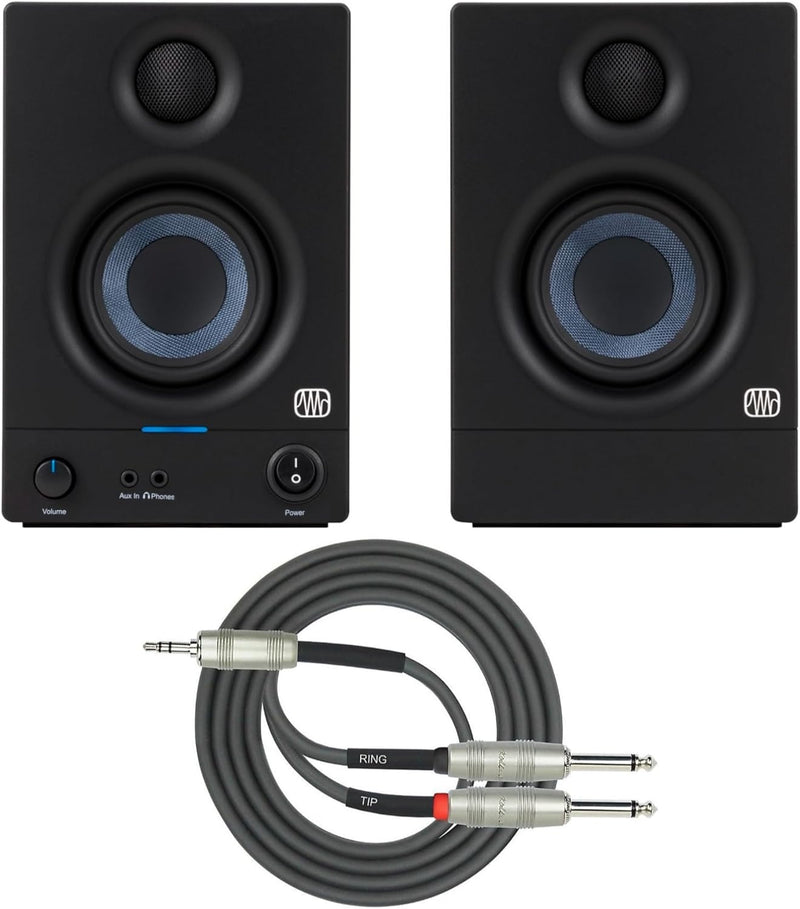
PreSonus part_B07KYCTN8H Eris 3.5-Inch Studio Monitor Pair
4 inch
Reference-grade monitoring at a bedroom studio price — the Eris 3.5 pair delivers honest, balanced sound for mixing decisions that hold up outside the room.
$126.48*
View on Amazon
✓ In Stock on Amazon.com
*Price sourced from Amazon.com. Last updated:Aug 30, 2026.Price and availability are subject to change — details.
Affiliate Disclosure: As an Amazon Associate, Studio Supplies earns from qualifying purchases made through links on this page, at no additional cost to you. This helps support our editorial team.
Notice a mistake? Let Us Know
Overview
Key Features
Bundle Includes: PreSonus Eris 3.5 3.5-Inch Low-Frequency Driver Media Reference Monitor with RF Interference, and 3.5 mm TRS to Dual 1/4 inch TS Stereo Breakout Cable
Compact Studio-Quality Sound: The Eris 3.5 media reference monitors offer studio-quality sound in a compact design, with a 3.5-inch woven-composite woofer and a 1-inch silk-dome tweeter
Versatile Connectivity: These monitors offer a range of input options, including 1/4-inch balanced TRS, RCA, and 1/8-inch stereo unbalanced line inputs
Enhanced Low-End and Crossover Transition: With 25 watts of power per side, the Eris 3.5 reference monitors provide a powerful low-end response while maintaining clear and accurate audio
Frequency Control: High- and low-frequency controls make it easy to adjust the monitors' frequency response to suit different listening environments, ensuring optimal performance
Specifications
Woofer Size
3.5-inch
Woofer Material
Woven-composite
Tweeter Size
1-inch
Tweeter Material
Silk-dome
Power Output
25 watts per side
Input Options
1/4-inch balanced TRS, RCA, 1/8-inch stereo unbalanced line
Frequently Asked Questions
Are the balanced TRS inputs sufficient for connecting directly to an audio interface?
Yes — the 1/4-inch balanced TRS inputs are the correct connection for most two-channel interfaces. The included 3.5mm TRS to dual 1/4-inch TS breakout cable also lets you connect directly from a laptop headphone output or consumer interface, though an unbalanced connection will be more susceptible to interference over longer cable runs.
How useful are the high- and low-frequency trim controls in practice?
They're genuinely valuable for room correction. If your desk placement causes low-end buildup near a wall, pulling the low shelf down by a few dB tightens the low-mid response noticeably. The high-frequency trim helps if your listening environment has reflective surfaces adding harshness. These aren't substitute for acoustic treatment, but they help calibrate the monitors to your specific space.
Is 25 watts per side enough headroom for critical mixing work?
For near-field monitoring at desktop distances — which is the intended use — 25 watts per side is sufficient to reach reference levels without clipping the amplifier. These monitors are not designed for large-room playback; at 3.5-inch driver size, they're optimized for 1–3 foot listening distances where the stereo image and frequency response are most accurate.
Does the integrated headphone output share the monitor signal, or is it a separate path?
The front-panel headphone output routes the same signal as the monitors, making it easy to switch between speaker and headphone monitoring without recabling at the interface. It functions as a convenience output for quick checks rather than a dedicated headphone amp stage.
How low does the frequency response extend on the 3.5-inch woofer?
The product is specified as a media reference monitor with a 3.5-inch woven-composite woofer. Bass extension at this driver size is limited — expect meaningful output down to approximately 80Hz. Sub-bass content below that range is not accurately reproduced, which is important to account for when mixing low-end-heavy material.
Related Products


