



Radial Engineering
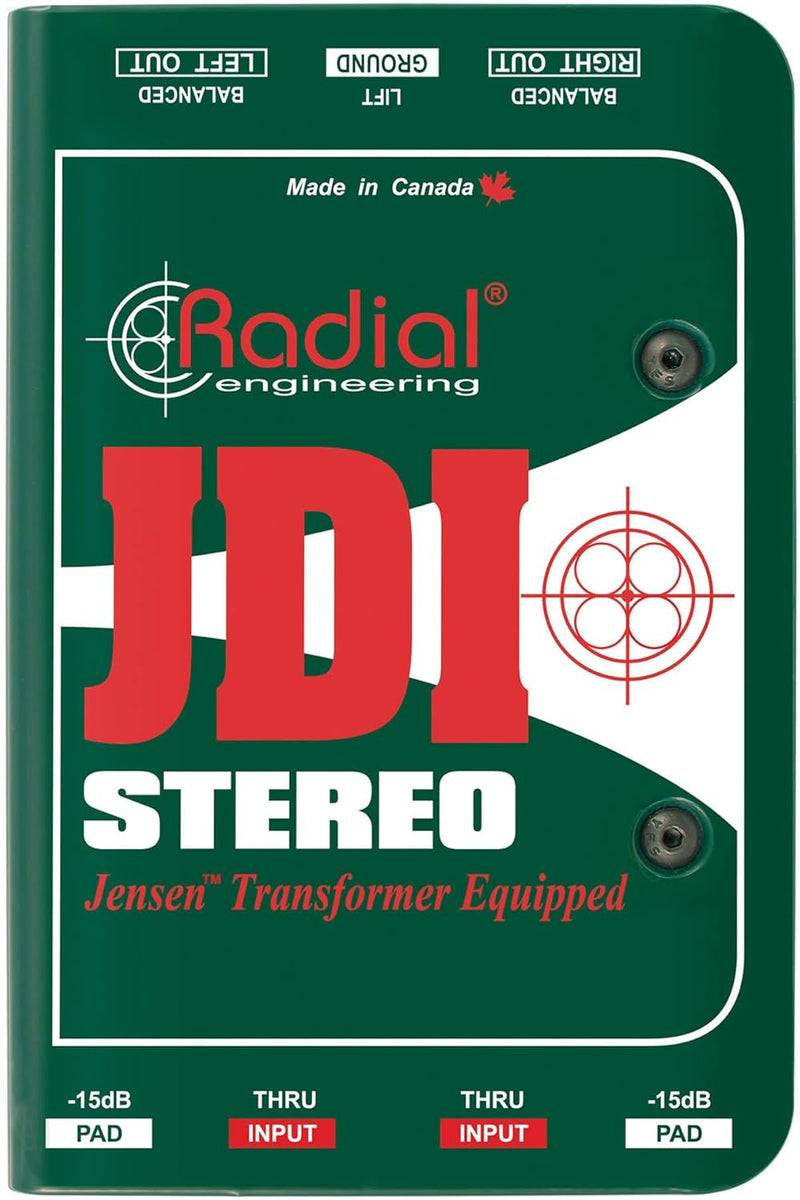
Radial Engineering JDI STEREO Premium Passive DI Box
The Radial JDI Stereo delivers transparent, noise-free passive DI performance for keyboards, laptops, and stereo sources on stage or in the studio.
$399.99*
View on Amazon
✓ In Stock on Amazon.com
*Price sourced from Amazon.com. Last updated:Aug 27, 2026.Price and availability are subject to change — details.
Affiliate Disclosure: As an Amazon Associate, Studio Supplies earns from qualifying purchases made through links on this page, at no additional cost to you. This helps support our editorial team.
Notice a mistake? Let Us Know
Overview
Key Features
DI-Boxen
Studio Hardware
Pro Audio
We emphasise a balanced combination of careful workmanship and selected materials.
OUR GOAL - Your satisfaction is our top priority and takes centre stage.
Specifications
Type
Passive DI Box
Channels
Stereo (2-channel)
Transformer
Jensen
Outputs
Balanced XLR
Power
None required (passive)
Construction
Rugged all-steel enclosure
Color
Green
Dimensions (L x W x H)
3 x 8 x 10 inches
Weight
0.031 ounces
Frequently Asked Questions
What makes the Radial JDI Stereo a passive DI box rather than an active one?
The JDI Stereo uses high-quality Jensen transformers to convert unbalanced signals to balanced without requiring batteries or phantom power, which eliminates the potential for active-circuit noise and ensures reliable operation with zero power dependencies.
Can the Radial JDI Stereo handle two separate mono instruments at the same time?
Yes, the stereo design provides two independent DI channels in a single enclosure, so you can run two mono sources or one stereo source simultaneously through balanced XLR outputs.
Does the JDI Stereo require phantom power or batteries to operate?
No. As a fully passive DI box, it draws no power at all. It works purely through transformer isolation, making it completely reliable with no batteries to replace or phantom power to configure.
Is the Radial JDI Stereo built to withstand touring and live use?
Yes, it features Radial's trademark rugged steel construction designed to survive the demands of professional touring, stage use, and repeated transport.
What types of sources work best with the JDI Stereo?
It excels with keyboards, DJ mixers, laptop audio interfaces, acoustic instruments with pickups, and any stereo line-level source that needs clean signal conversion to balanced XLR for a mixing console or recording interface.
Related Products


