



Radial Engineering
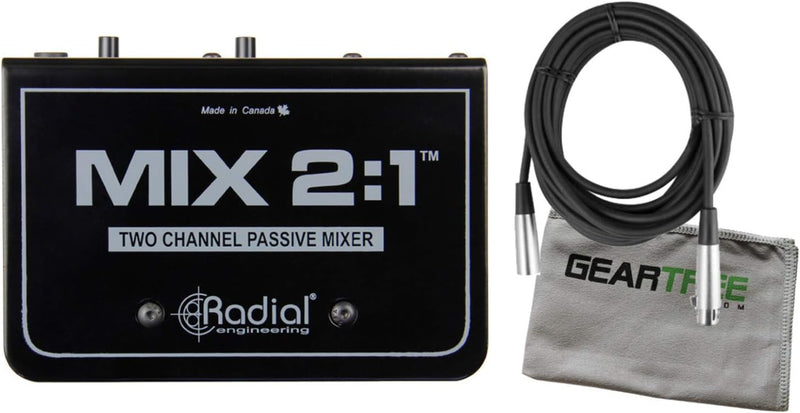
Radial Engineering Mix 2:1 Passive Summing Mixer
★★★★★
XLR
A zero-coloration passive summing solution that combines two channels to mono without adding noise, power, or anything to the signal path that wasn't already there.
View price on Amazon
Affiliate Disclosure: Studio Supplies may earn a commission from qualifying purchases made through links on this page, at no additional cost to you. This helps support our editorial team.
Notice a mistake? Let Us Know
Overview
Key Features
TRS and XLR inputs
Completely passive, no need for power
Individual level controls can be bypassed when not in use
Mixes two channels to a single mono output
Polarity Inverter on Input 2
Specifications
Type
Passive Mono Summing Mixer
Input Channels
2
Input Connectors
TRS and XLR
Output
Mono XLR
Power Required
None (fully passive)
Features
Ground lift switches, individual level controls (bypassable), polarity invert on Input 2
Pros & Cons
👍 Pros
- Fully passive circuit adds zero self-noise and zero coloration — the summed output is sonically identical to the source signal, just combined.
- The polarity invert on Input 2 makes it genuinely useful for M-S summing, parallel processing combination, and phase troubleshooting, not just basic level mixing.
- Ground lift switches provide a hardware solution to ground loop hum without introducing additional active stages that could affect signal quality.
- Individual level controls allow precise trim balancing between sources before the sum, and can be bypassed when not needed to keep the path short.
- Compact, passive design means it can live anywhere in a rack or on a desk — no power outlet, no warm-up time, no failure modes related to active components.
👎 Cons
- Passive summing introduces approximately 6dB of insertion loss — you will need to make up gain downstream, which may not be available on every interface or console input.
- With only two input channels, the Mix 2:1 is purpose-built for specific summing tasks, not a general-purpose mixer — it cannot consolidate three or more sources.
- The single mono output means any stereo width in either source signal is lost at the output stage — by design, but a limitation for workflows that need to preserve stereo imaging.
- Passive circuitry can be susceptible to RF interference in electrically noisy environments, such as stages with large LED lighting rigs, if cables are not well-shielded.
Frequently Asked Questions
What does "passive" mean for this mixer's sonic character?
Passive means there is no active gain stage — no op-amps, no power supply, nothing in the circuit that can add noise, harmonic distortion, or its own coloration. The Mix 2:1 simply combines two signals through a resistor network, so what you hear at the output is your source summed, not the mixer's interpretation of it. This is the right choice when you want signal path transparency above all else.
How does the polarity invert on Input 2 affect summing two channels?
The polarity invert flips the phase of Input 2 by 180 degrees, which is essential when summing a mid-side (M-S) decoded pair, combining parallel processed signals that may be out of phase, or troubleshooting phase cancellation issues when two sources share acoustic space. Without it, summing two out-of-phase signals would cause frequency cancellation — particularly damaging to low-end content.
Does using the individual level controls affect the passive signal integrity?
The level controls are attenuating pots in the passive circuit — they reduce signal level rather than amplifying it, so they stay within the passive paradigm and add no active noise. When a channel isn't in use, the controls can be bypassed entirely to keep the signal path as short as possible.
Will the Mix 2:1 cause level loss when summing two signals to mono?
Yes — passive summing through a resistor network introduces insertion loss, typically around 6dB when both inputs are active. You'll need to make up that gain at the next stage in your chain (your interface preamp, a clean line amp, or your DAW input trim). This is expected behavior for passive summing and is not a flaw.
Can this unit resolve ground loop hum between two sources fed from different equipment?
Yes — the Mix 2:1 includes ground lift switches, which break the shield connection between source and destination to interrupt the ground loop path. This is a direct, signal-clean solution to hum caused by differing ground potentials across equipment in the same rig.
Related Products


