



Radial Engineering
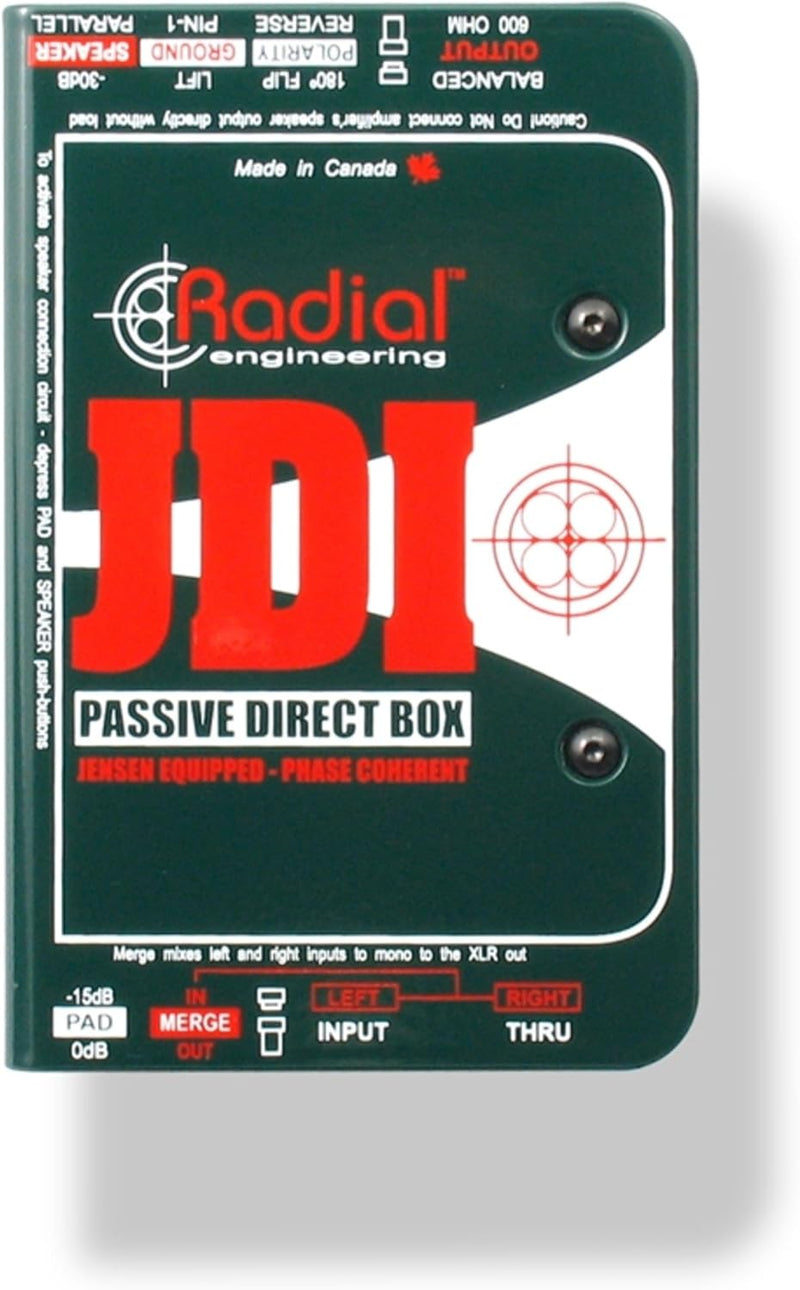
Radial Engineering R8001010 JDI Passive Direct Box Jensen Transformer
Studio-grade passive DI with a Jensen transformer for noise-free, zero-distortion signal conversion on stage and in the studio.
$259.99*
View on Amazon
✓ In Stock on Amazon.com
*Price sourced from Amazon.com. Last updated:Oct 11, 2026.Price and availability are subject to change — details.
Affiliate Disclosure: As an Amazon Associate, Studio Supplies earns from qualifying purchases made through links on this page, at no additional cost to you. This helps support our editorial team.
Notice a mistake? Let Us Know
Overview
Key Features
Equipped with Jensen transformer
Eliminates buzz and hum from ground loops
Virtually zero phase and harmonic distortion
Specifications
Brand
Radial Engineering
Model
R8001010
Type
Passive Direct Box
Channels
Single-Channel
Transformer
Jensen
Features
Ground Loop Isolation, Virtually Zero Phase and Harmonic Distortion
Color
Green
Frequently Asked Questions
Why does the JDI use a passive design instead of an active one?
A passive design requires no batteries or phantom power, making the JDI completely self-contained and reliable. The Jensen transformer handles impedance matching and signal balancing without introducing active-circuit noise.
How does the JDI eliminate ground loop hum and buzz?
The Jensen transformer provides galvanic isolation between the input and output, breaking the electrical connection that causes ground loops while still passing the audio signal cleanly.
What instruments and sources work best with the Radial JDI?
It handles a wide range of sources including bass guitars, acoustic guitars with pickups, keyboards, and other line-level instruments. The Jensen transformer performs well across the full audio spectrum with virtually zero phase distortion.
Does the JDI require phantom power or batteries to operate?
No. As a fully passive direct box, the JDI operates without any external power source, making it dependable for both live gigs and studio sessions.
What type of connectors does the JDI use?
It accepts a standard 1/4-inch instrument-level input and outputs a balanced signal via an XLR connector for connection to mixing consoles and audio interfaces.
Related Products


