



Radial Engineering
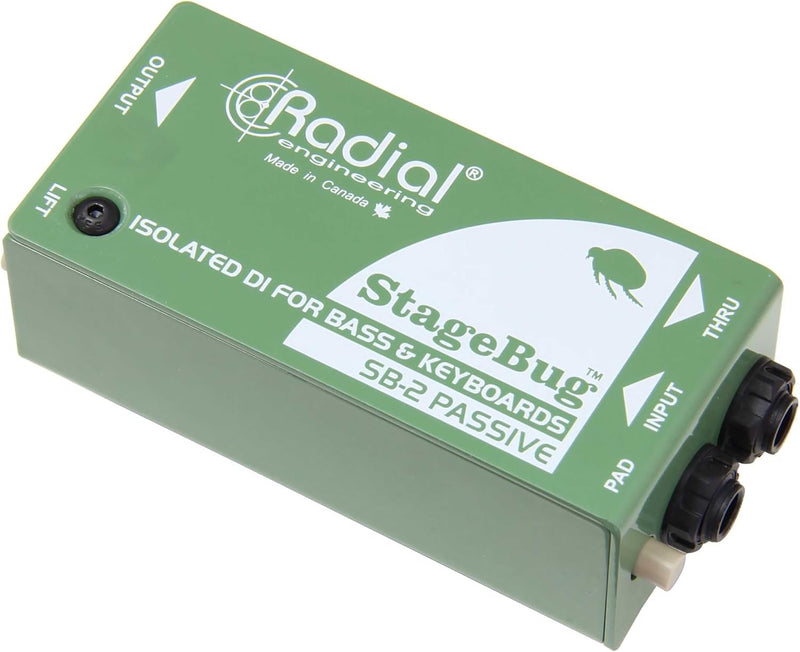
Radial Engineering SB2 StageBug Passive Instrument DI Box
Compact DI Box for Studio or StageThe Radial StageBug SB-2 is a passive direct box that allows you to connect your instrument directly to a mixing console. Get warm, vintage-flavored direct sound from your bass, keyboard, or acoustic guitar. Type: Passive Direct Box Transformer: Eclips...
$94.99*
View on Amazon
✓ In Stock on Amazon.com
*Price sourced from Amazon.com. Last updated:Aug 28, 2026.Price and availability are subject to change — details.
Affiliate Disclosure: As an Amazon Associate, Studio Supplies earns from qualifying purchases made through links on this page, at no additional cost to you. This helps support our editorial team.
Notice a mistake? Let Us Know
Overview
Compact DI Box for Studio or Stage
The Radial StageBug SB-2 is a passive direct box that allows you to connect your instrument directly to a mixing console. Get warm, vintage-flavored direct sound from your bass, keyboard, or acoustic guitar.
- Type: Passive Direct Box
- Transformer: Eclipse ET-DB3
- Applications: Bass, keyboards, and acoustic guitar
- Attenuation: 15dB Pad
- Feature: Stereo-to-mono Merge
Key Features
Passive Direct Box with Eclipse ET-DB3 Transformer
Stereo-to-mono Merge
15dB Pad
Specifications
Type
Passive Direct Box
Transformer
Eclipse ET-DB3
Signal Feature
Stereo-to-mono Merge
Attenuation Pad
15dB
Frequently Asked Questions
What type of transformer is used in the Radial Engineering SB2 StageBug?
The Radial Engineering SB2 StageBug Passive Instrument DI Box incorporates an Eclipse ET-DB3 Transformer, designed for high-quality signal conversion.
Can this DI box combine a stereo signal into a mono output?
Yes, the SB2 StageBug features a stereo-to-mono merge function, allowing it to combine stereo instrument signals into a single mono output.
Is there a way to reduce the input signal level when using high-output instruments?
Yes, the unit includes a 15dB pad, which can be activated to attenuate hot signals from instruments, preventing input overload.
Does the Radial Engineering SB2 require external power to operate?
No, the SB2 is a passive direct box, meaning it does not require any external power source or batteries for its operation.
Is this DI box suitable for use with multiple instruments simultaneously?
The SB2 StageBug is a single instrument DI box, designed to process one instrument's signal at a time, making it ideal for individual inputs rather than multiple concurrent sources.
Related Products


