



Razer
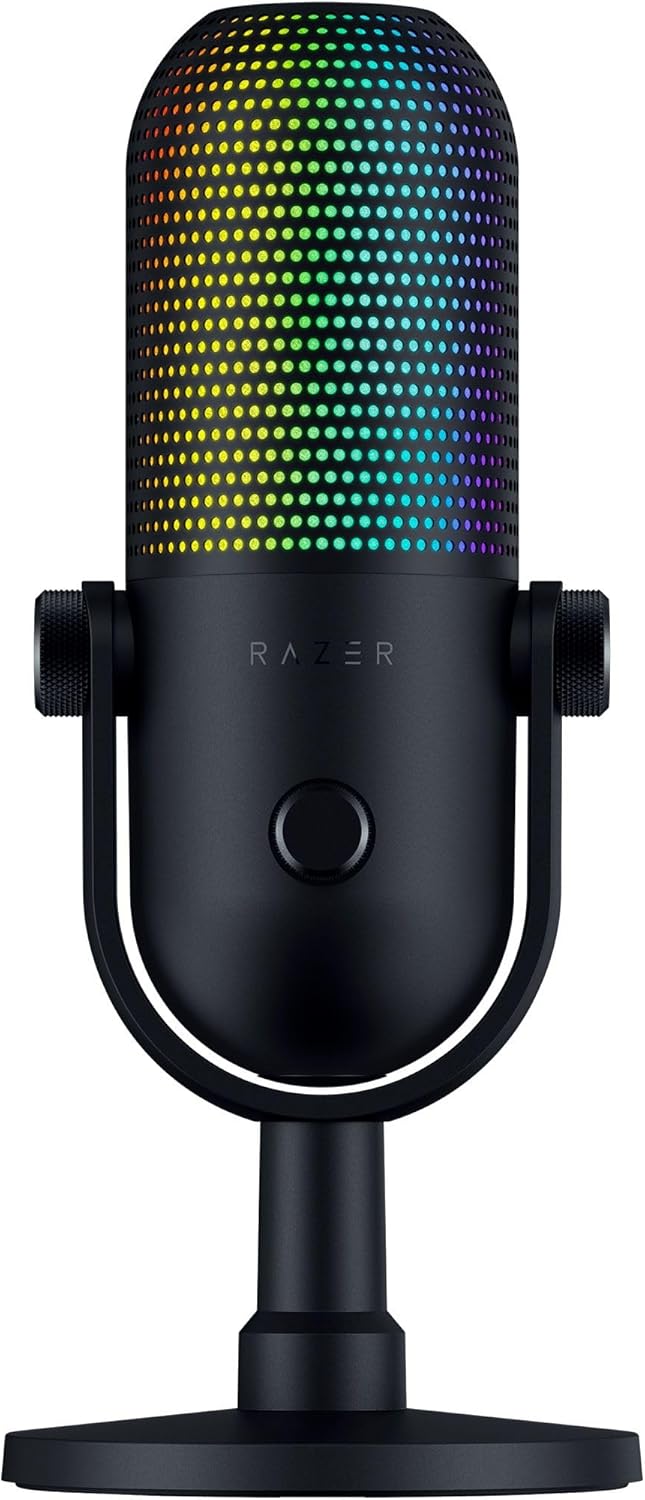
Razer Seiren V3 Chroma RGB USB Microphone Renewed
Supercardioid USB precision with stream-reactive RGB — desktop broadcast audio with a noise floor that keeps up with professional standards.
$84.99*$92.97Save 8%
View on Amazon
✓ In Stock on Amazon.com
*Price sourced from Amazon.com. Last updated:Aug 30, 2026.Price and availability are subject to change — details.
Affiliate Disclosure: As an Amazon Associate, Studio Supplies earns from qualifying purchases made through links on this page, at no additional cost to you. This helps support our editorial team.
Notice a mistake? Let Us Know
Overview
Specifications
Microphone Type
Condenser
Polar Pattern
Supercardioid
Connectivity
USB Type-A
Lighting
Stream and Game Reactive RGB
Special Features
Tap-to-Mute Sensor, Digital Gain Limiter, Built-in Shock Absorber
Compatibility
PC, Laptop (Mac and Windows)
Condition
Renewed
Frequently Asked Questions
What does the supercardioid polar pattern mean for my recording setup, and is it better for streaming than cardioid?
A supercardioid pattern has a tighter frontal acceptance angle than cardioid — it captures less of the room on the sides, which translates directly to better isolation from mechanical keyboard clatter, fan noise, and room reflections in a typical desktop environment. The trade-off is a small rear lobe: position the back of the mic away from your loudest ambient noise source. For streaming and voiceover in a treated or semi-treated space, the tighter pattern is a genuine sonic advantage.
The mic has a digital gain limiter — what does that actually do to my signal?
The digital gain limiter acts as a soft ceiling on the input signal before it reaches your recording chain, preventing sudden loud transients — a shout, a desk knock, a laugh — from clipping the USB audio stream. Rather than distorting, it catches peaks and attenuates them before they saturate. In practice, this means your stream or recording stays clean through unexpected loud moments without you manually riding the gain.
Does the built-in shock absorber replace the need for an external boom arm shock mount?
The internal shock absorber reduces low-frequency mechanical vibration — desk bumps, keyboard impacts transmitted through the desk surface — from reaching the capsule. It meaningfully cleans up the noise floor compared to a direct-coupled desktop mic, but for broadcasting setups where heavy typing is continuous, a boom arm with a dedicated elasticated shock mount still provides superior isolation at the capsule level.
Does this mic require any driver installation to work on PC or Mac?
The Seiren V3 Chroma connects via USB Type-A and is class-compliant, meaning it registers as a standard audio device on both PC and Mac without driver installation. Razer Synapse software is optional — it's only required if you want to customize the RGB lighting profiles or access advanced digital settings beyond the default configuration.
What gain staging approach works best for streaming with this mic?
Set your input level in your OS or DAW so that a normal speaking voice peaks around -12 to -18 dBFS — this leaves adequate headroom for the digital gain limiter to catch louder moments without the limiter working constantly. Keep the mic 15–20 cm from your mouth at roughly a 45° angle to balance proximity warmth with off-axis rejection. Avoid pushing input gain high to compensate for distance — bring the mic closer instead, and let the supercardioid pattern do the isolation work.
Related Products


