

RME Audio
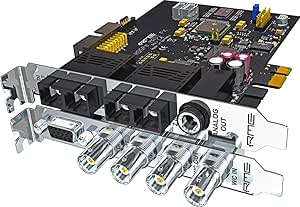
RME Audio RME-HDSPMADI-FX 390-Channel MADI PCI Express Card
390 channels of pristine MADI I/O on a single PCIe card — the backbone for large-format studio and broadcast audio routing.
$1,999.00*
View on Amazon
✓ In Stock on Amazon.com
*Price sourced from Amazon.com. Last updated:Aug 28, 2026.Price and availability are subject to change — details.
Affiliate Disclosure: As an Amazon Associate, Studio Supplies earns from qualifying purchases made through links on this page, at no additional cost to you. This helps support our editorial team.
Notice a mistake? Let Us Know
Overview
Key Features
PCI Express Interface
194 input- / 196 output channels = 390 channels
3 x MADI I/O (2 x optical + 1 x coaxial)
AES/EBU I/O (via breakout cable)
3 x virtual MIDI I/O over MADI
Specifications
Brand
RME Audio
Model
RME-HDSPMADI-FX
Interface
PCI Express (1-lane)
Input Channels
194
Output Channels
196
Total Channels
390
MADI I/O
3 (2 x Optical, 1 x Coaxial)
AES/EBU I/O
Yes (via breakout cable)
Analog Output
Stereo
MIDI I/O
1 x physical (via 5-pin DIN breakout cable), 3 x virtual over MADI
Word Clock I/O
Yes
Bit Depth
24-bit
Max Sample Rate
192 kHz
Effects Engine
TotalMix FX with 192 kHz processing
Clock Technology
SteadyClock
Sync Sources
MADI Coaxial, MADI Optical, AES/EBU, Word Clock, Internal
Frequently Asked Questions
How does the triple MADI connectivity break down in terms of channel count at different sample rates?
At 48kHz, each MADI port carries 64 channels, giving you 192 channels across the three ports (2 optical, 1 coaxial). At 96kHz the channel count per port halves to 32 (96 total MADI channels), and at 192kHz it drops to 16 per port (48 total). The remaining channels come from AES/EBU and the analog stereo output, bringing the full total to 194 in and 196 out at base sample rate.
What are the system requirements for running this card reliably at full channel count?
The HDSP MADI FX requires a single-lane PCI Express slot (x1 or larger). RME's drivers are known for extremely low latency and CPU efficiency, but running 390 channels simultaneously benefits from a modern multi-core processor and sufficient PCIe bandwidth. It is compatible with Windows and macOS, with RME providing long-term driver support for both platforms.
Can TotalMix FX handle monitor mixes and routing for all 390 channels simultaneously?
Yes. TotalMix FX is a hardware-assisted DSP mixer running on the card itself, not your CPU. It provides a full routing matrix for all input and output channels with per-channel EQ, dynamics, and effects processing at up to 192kHz. This means you can create independent monitor mixes, route any input to any output, and apply processing without adding latency or CPU load.
How does the word clock synchronization work across multiple MADI sources?
The card offers intelligent automatic master/slave clock control. It can lock to incoming word clock, any of the three MADI streams, or AES/EBU as a sync source, and it also generates its own word clock output. RME's SteadyClock technology ensures sub-nanosecond jitter performance regardless of which external source you lock to, keeping all 390 channels sample-accurate.
Can I use the virtual MIDI ports over MADI for DAW control and machine control?
Yes. The three virtual MIDI I/O ports are transmitted over the MADI stream itself, which means you can send MIDI data — including timecode, DAW control, and machine control — between connected MADI devices without additional MIDI cabling. The physical MIDI I/O via the breakout cable provides a fourth traditional MIDI connection.
Related Products


