



Rode
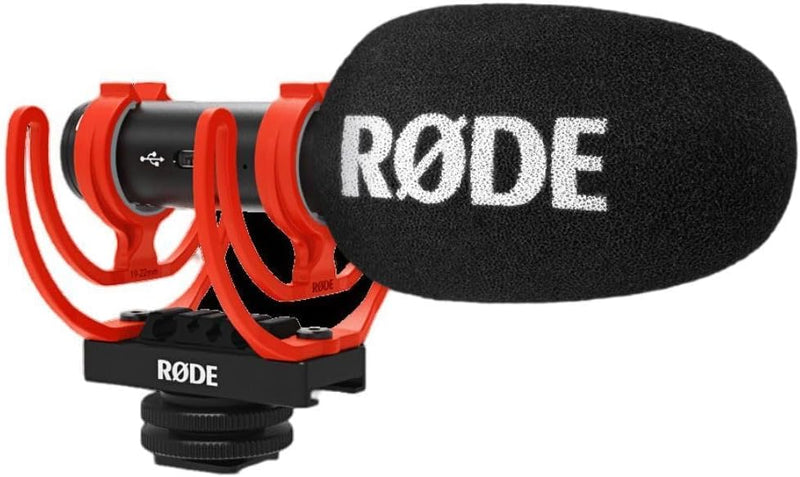
Rode VideoMic GO II On-Camera Shotgun Microphone
USB-C
Dual analog and USB-C outputs let the Rode VideoMic GO II feed a camera, an interface, or a laptop without compromise — clean directional audio that scales with your workflow.
$99.00*$109.00Save 9%
Check availability
*Price sourced from Amazon.com. Last updated:Sep 04, 2026.Price and availability are subject to change — details.
Affiliate Disclosure: As an Amazon Associate, Studio Supplies earns from qualifying purchases made through links on this page, at no additional cost to you. This helps support our editorial team.
Notice a mistake? Let Us Know
Overview
Key Features
Shotgun Microphone with Helix Isolation Mount
3.5mm TRS Output
USB-C Output
Specifications
Form Factor
Shotgun Microphone
Polar Pattern
Unidirectional (Supercardioid/Shotgun)
Outputs
3.5mm TRS (Analog), USB-C (Digital)
Power
Bus-powered (USB-C) / Plug-in power (3.5mm)
Mount
Helix Isolation Mount (Cold Shoe)
Compatible Devices
Camera, Computer, Mobile (iOS/Android)
Weight
6.08 oz
Dimensions
7.25 x 3.55 x 3.25 inches
Frequently Asked Questions
How does the VideoMic GO II's dual-output design affect gain staging when running into a camera versus a computer?
The analog 3.5mm TRS output feeds directly into a camera's mic input and benefits from the camera's onboard preamp — set camera gain conservatively and let the mic's output level do the lifting. The USB-C output delivers a digital signal with its own onboard conversion, bypassing the camera preamp entirely and delivering a cleaner, lower-noise floor when recording directly to a laptop or iOS device.
Does the VideoMic GO II require phantom power or batteries?
Neither — when connected via USB-C, the microphone draws bus power from the connected device. In analog mode via the 3.5mm TRS output connected to a camera, the mic draws plug-in power from the camera's mic jack. No batteries or external phantom power supply required.
How effective is the Helix isolation mount at rejecting handling and camera-body noise?
The Helix mount uses a suspension system that mechanically decouples the capsule assembly from the shoe mount. In practice, it significantly reduces the low-frequency rumble from camera handling, IBIS activation, and motor noise that would otherwise travel directly into a rigid-mounted mic. It's a meaningful improvement over a standard cold shoe adapter for handheld work.
What polar pattern does the VideoMic GO II use, and how tight is the rejection off-axis?
The capsule is a unidirectional (supercardioid/shotgun) pattern designed to favor sources directly in front of the microphone. It provides useful off-axis rejection for ambient room noise and side-spill, though it is not as narrowly focused as a longer interference-tube shotgun. For typical camera-to-subject distances of one to three feet, on-axis capture is clean and focused.
Can the VideoMic GO II be used as a USB audio interface for podcast or voice-over recording into a DAW?
Yes — the USB-C output presents the mic as a class-compliant USB audio device. It will appear as an input source in any DAW or audio application on Mac, Windows, or compatible iOS/Android devices without driver installation. It is a single-channel input, so it functions as a simple, portable recording source rather than a full-featured interface.
Related Products


