



Rode
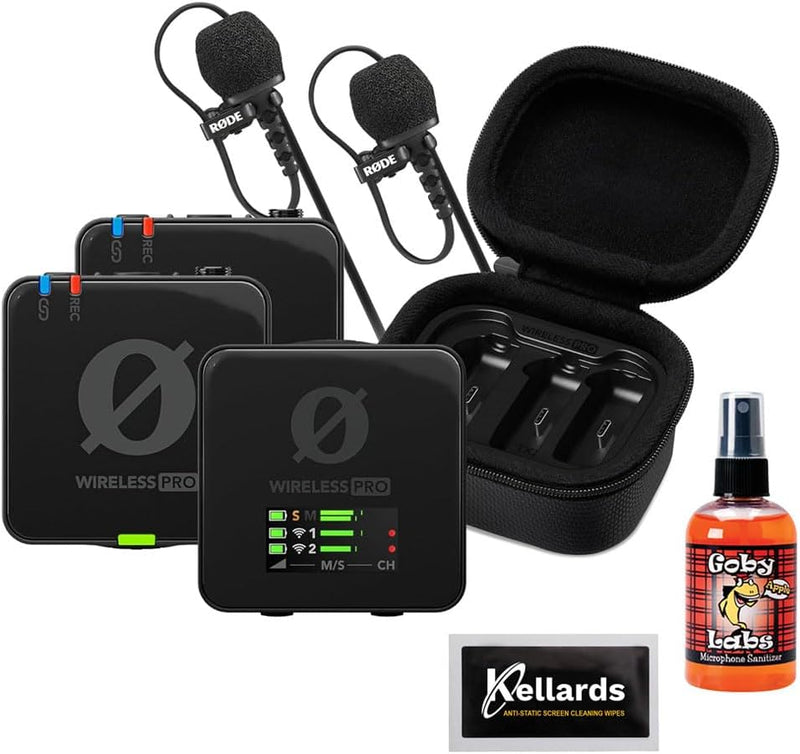
Rode WIPRO Wireless Microphone System - Lavaliers, Cleaner Bundle
Broadcast-grade wireless audio with 32-bit float safety net — the Rode Wireless PRO keeps your dialogue clean from run-and-gun shoots to sit-down interviews.
$299.00*
Check availability
*Price sourced from Amazon.com. Last updated:Aug 30, 2026.Price and availability are subject to change — details.
Affiliate Disclosure: As an Amazon Associate, Studio Supplies earns from qualifying purchases made through links on this page, at no additional cost to you. This helps support our editorial team.
Notice a mistake? Let Us Know
Overview
Key Features
RODE’s state-of-the-art Series IV 2.4 GHz digital transmission with 128-bit encryption for crystal-clear, incredibly stable audio with best-in-class range.
Universal compatibility with cameras, smartphones (iOS and Android)
Over 40 hours of 32-bit float on-board recording allows you to recover clipped or quiet audio files.
Advanced timecode capability for quick-and-easy audio sync in post-production.
Complete accessory kit, including smart charging case, two Lavalier II microphones, cables, MagClip GO magnetic mounting clips and accessory case
Specifications
Transmission
RODE Series IV 2.4 GHz digital
Encryption
128-bit
On-Board Recording Format
32-bit float
On-Board Recording Capacity
Over 40 hours
Microphones Included
2× RODE Lavalier II (omnidirectional)
Compatibility
Cameras, iOS devices, Android devices
Timecode Support
Yes
Included Accessories
Smart charging case, 2× Lavalier II, cables, MagClip GO clips, accessory case
System Configuration
2-person (2 transmitters, 1 receiver)
Frequently Asked Questions
What does 32-bit float on-board recording actually mean for my workflow?
It means the transmitters are continuously recording audio internally at 32-bit float resolution — a dynamic range so wide that there is effectively no clipping ceiling and no noise floor problem at typical voice levels. If your camera input gets slammed by a sudden loud moment, you pull the on-board recording in post and the audio is clean. It's a genuine safety net, not a marketing term.
How does the Series IV 2.4 GHz transmission handle RF-congested environments like event venues or conferences?
The Series IV system uses adaptive frequency hopping across the 2.4 GHz band with 128-bit encryption, which gives it significantly better interference rejection than older systems operating on fixed channels. In real-world use at busy venues, it holds signal where cheaper 2.4 GHz systems drop out — though no wireless system is immune to severe RF saturation.
Does the GainAssist technology eliminate the need to manually set transmitter gain?
GainAssist actively manages gain in real time, which removes most of the manual gain-staging anxiety for run-and-gun work. In automatic mode it responds to dynamic speakers and varying distances effectively. That said, professional audio engineers working controlled interview setups often prefer to lock gain manually for consistent, predictable headroom across a long recording.
What is the maximum usable range of the Wireless PRO system?
Rode rates the system at up to 260 meters line-of-sight under ideal conditions. Practically, in real shooting environments with bodies, walls, and competing RF, expect reliable performance in the 30–80 meter range for most documentary and event work — still best-in-class for 2.4 GHz clip-on systems at this price point.
Are the included Lavalier II microphones omnidirectional, and how does that affect placement?
Yes — the Lavalier II capsules are omnidirectional, which picks up sound from all directions equally. This makes precise chest placement less critical than with a directional lav, but it also means the mic will capture ambient room noise and clothing rustle more readily. Clean placement and a good clip position remain important for minimizing handling noise.
Related Products


