

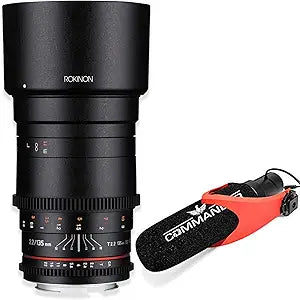


Rokinon
Rokinon 135mm T2.2 Cine DS Lens Micro Four Thirds
Condenser
Pull cinematic telephoto focus on Micro Four Thirds with a geared T2.2 lens built to full cine-rig standards.
$569.00*
Check availability
*Price sourced from Amazon.com. Last updated:Oct 25, 2026.Price and availability are subject to change — details.
Affiliate Disclosure: As an Amazon Associate, Studio Supplies earns from qualifying purchases made through links on this page, at no additional cost to you. This helps support our editorial team.
Notice a mistake? Let Us Know
Overview
Key Features
The Premium lens from Rokinon comes with a 1-Year Seller Warranty
Rokinon 135mm T2.2 Cine DS Lens : 135mm Lens - Full-Frame Coverage - Multi-Layer Coating to Reduce Flare - Standard Gearing for Focus and Iris - Low light shooting
Industry-standard gearing for focus and aperture rings. Each lens in the Rokinon DS series share common focus and iris gear ring positions, which speeds up lens changes as accessories such as follow focus units or iris motors don't have to be re-positioned.
Commander Optics V30 Professional Directional Condenser Shotgun Video Microphone: Super Cardioid Ploar Pattern - Low-cut Filter - 10dB Adjustable Sensitivity - Low Self-Noise - Super Anti-Interference - Special Design for excellent shock absorbing - Includes a wind screen and a wind muff - Cold-shoe Design with 1/4 Thread at Bottom
Compatible Cameras: Nikon D3200, D3300 D3400, D3500, D500, D5200, D5300, D5500, D5600, D7100, D7200, D7500, D4s, D5, D610 D750, D800E, D810, D810A, D850, Df
Specifications
Focal Length
135mm (270mm full-frame equivalent on MFT)
Aperture
T2.2
Mount
Micro Four Thirds
Image Circle
Full-frame coverage
Focus Type
Manual
Focus Ring
Geared, industry-standard position
Iris Ring
Geared, industry-standard position
Scale Markings
Dual-sided (focus and iris)
Coating
Multi-layer
Frequently Asked Questions
What is the effective field of view of the 135mm focal length on a Micro Four Thirds sensor?
On a Micro Four Thirds body, the 2× crop factor makes the 135mm focal length equivalent to 270mm full-frame — a strong telephoto reach that compresses backgrounds dramatically and isolates subjects at distance. For narrative film work this is a specialized focal length suited to close-up inserts, over-the-shoulder dialogue shots with heavy compression, and wildlife or sports scenarios where physical distance from subject is required.
What does the T2.2 rating mean compared to an f/2.2 rating?
T-stops measure actual light transmission through the lens elements, accounting for glass absorption and coating losses, while f-stops are purely geometric. T2.2 on the Rokinon Cine DS represents the true exposure value — critical for cinematographers matching exposure across multiple lenses on the same shoot without recalibrating between cuts.
How does the industry-standard gearing benefit a cine rig setup?
All lenses in the Rokinon DS series share common focus and iris gear ring positions. In practice, this means a follow focus unit or iris motor mounted on one DS lens can be transferred to another DS lens without repositioning the gear — a significant time-saver during multi-lens narrative shoots where lens changes need to happen quickly between setups.
Does this lens cover the full Micro Four Thirds sensor without vignetting?
Yes. The lens is specified for full-frame coverage, meaning it produces an image circle larger than the Micro Four Thirds sensor. There is no vignetting, and the lens retains its full resolving power to the corners of the frame.
Are the focus and aperture scales readable from both sides of the camera?
Yes. The Cine DS series features dual-sided engraved scales on both the focus and iris rings, so a focus puller or camera assistant working from either side of a shoulder-mounted or studio rig can read focus distance and aperture without repositioning.
Related Products


