



Rokinon
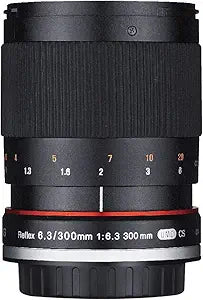
Rokinon 300M-MFT-BK 300mm F6.3 Mirror Lens - Micro Four Thirds
Ultra-compact Rokinon 300mm mirror lens delivers 600mm equivalent reach on Micro Four Thirds cameras.
$299.00*
View on Amazon
✓ In Stock on Amazon.com
*Price sourced from Amazon.com. Last updated:Aug 28, 2026.Price and availability are subject to change — details.
Affiliate Disclosure: As an Amazon Associate, Studio Supplies earns from qualifying purchases made through links on this page, at no additional cost to you. This helps support our editorial team.
Notice a mistake? Let Us Know
Overview
Key Features
300mm Mirror Lens with F6.3 Aperture
Constructed of 9 elements in 9 groups
Designed for mirrorless interchangeable lens cameras
Minimum focusing distance 2.95 feet; angle of view 5.4 degrees on Canon M, Fuji X and Sony NEX, 4.2 degrees for MFT
Specifications
Brand
Rokinon
Model
300M-MFT-BK
Focal Length
300mm
Maximum Aperture
f/6.3 (Fixed)
Lens Mount
MFT (Micro Four Thirds)
Optical Construction
9 Elements in 9 Groups
Lens Type
Catadioptric (Mirror)
Focus
Manual
Compatible Cameras
Olympus Pen, Panasonic Lumix (MFT mount)
Frequently Asked Questions
What is the effective focal length of this lens on a Micro Four Thirds camera?
With the 2x crop factor of Micro Four Thirds sensors, this 300mm lens provides a 600mm equivalent field of view.
Is the aperture adjustable on this lens?
No, this is a mirror (reflex) lens with a fixed f/6.3 aperture — there is no aperture ring to adjust.
Does this lens support autofocus?
No, this is a fully manual focus lens. You will need to focus manually using the focus ring.
What causes the distinctive donut-shaped bokeh in photos from this lens?
The mirror (catadioptric) optical design uses a central mirror obstruction, which creates the characteristic ring-shaped out-of-focus highlights unique to mirror lenses.
Which cameras is this lens compatible with?
It is designed for Micro Four Thirds mount cameras, including Olympus Pen series and Panasonic Lumix bodies.
Related Products


