

Roland
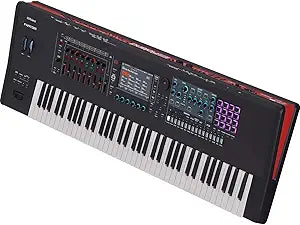
Roland FANTOM-7 76-Key Music Workstation Keyboard
The Roland FANTOM-7 fuses PCM realism, virtual analog synthesis, and a hardware analog filter into a 76-key workstation built for composers who refuse to compromise between studio depth and live performance.
$3,329.99*
View on Amazon
✓ In Stock on Amazon.com
*Price sourced from Amazon.com. Last updated:Aug 28, 2026.Price and availability are subject to change — details.
Affiliate Disclosure: As an Amazon Associate, Studio Supplies earns from qualifying purchases made through links on this page, at no additional cost to you. This helps support our editorial team.
Notice a mistake? Let Us Know
Overview
Key Features
Fantom Series Limited Edition T-Shirt with Product Registration
Acclaimed 76-note semi-weighted keyboard with aftertouch
Seamless workflow with no confusing modes
Expandable sound engine delivers authentic electronic and acoustic sounds
Fresh hybrid sounds combining modern PCM, virtual analog, and a routable analog filter
V-piano technology for stunning realism and expression
Specifications
Keyboard Size
76-note
Keyboard Type
Semi-weighted with aftertouch
Sound Engine
Expandable (PCM, virtual analog, analog filter)
Piano Technology
V-piano
Frequently Asked Questions
What does the hybrid sound engine actually mean for the sounds you can program on the FANTOM-7?
The FANTOM-7's engine combines three distinct synthesis architectures simultaneously: high-resolution PCM sample playback for acoustic instruments and complex textures, a virtual analog oscillator for classic synth waveforms, and a routable hardware analog filter — a real discrete circuit in the signal path, not a digital model of one. You can blend all three sources within a single patch, meaning a pad can be built from a PCM string layer running through the analog filter with a virtual analog sub-oscillator underneath it. The result is sonic layering that a pure sample playback or pure VA synth can't match.
How does the 76-key semi-weighted keyboard with aftertouch compare to a full weighted action for studio and live use?
The FANTOM-7's semi-weighted action sits between a synth-action keyboard (light, springy) and a weighted hammer-action (piano-like resistance). For synthesis, lead playing, and layered performance, semi-weighted is preferred — it gives expressive control with faster response than weighted keys. The aftertouch adds continuous pressure sensitivity after a key is fully depressed, useful for modulating vibrato, filter cutoff, or expression without a separate controller. For pianists transitioning from weighted instruments, the action will feel lighter than expected.
What does 'seamless workflow with no confusing modes' mean in practice for session work?
The FANTOM-7 uses a single unified Scene-based structure — sounds, sequences, and settings all live in one context without toggling between separate Performance, Song, and Pattern modes as found on many legacy workstations. This means you're not navigating mode menus mid-session. You can move from sketching a chord progression to building a sequence to tweaking a patch without losing context. For live use, Scene switching is gapless — no audio dropout between Scene changes.
Can the FANTOM-7 function as a MIDI controller for a DAW, and does it support USB audio?
The FANTOM-7 sends MIDI over USB and can control software instruments in any DAW that accepts standard MIDI input. It also supports audio transfer over USB. For complex studio setups, the analog outputs can feed directly into an audio interface for the warmest analog filter signal path.
Is the sound engine expandable after purchase?
Yes — the description explicitly lists an expandable sound engine. Roland's V-Piano technology is built in for piano modeling, and the architecture supports expansion beyond the factory content for additional sounds and capabilities.
Related Products


