



Roland
Canon CRTCN100400ISLII EF 100-400mm Renewed Lens
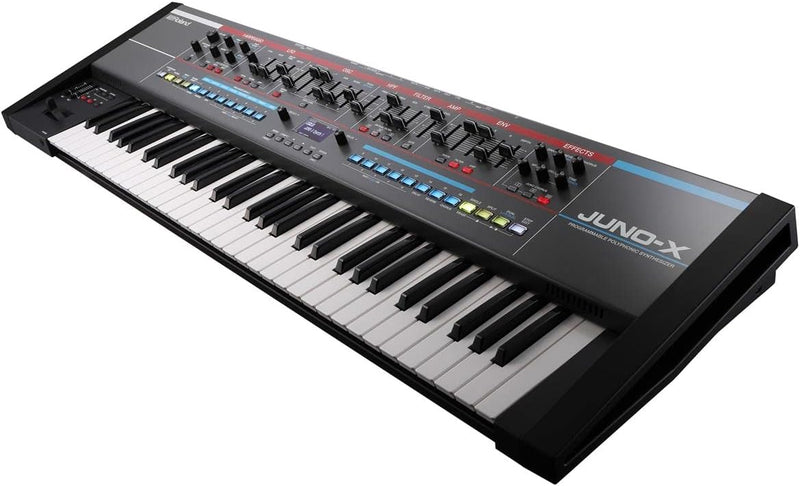
The Roland JUNO-X brings authentic 1980s analog character and modern ZEN-Core versatility to a single keyboard built for professional production.
$2,199.99*
View on Amazon
✓ In Stock on Amazon.com
*Price sourced from Amazon.com. Last updated:Aug 28, 2026.Price and availability are subject to change — details.
Affiliate Disclosure: As an Amazon Associate, Studio Supplies earns from qualifying purchases made through links on this page, at no additional cost to you. This helps support our editorial team.
Notice a mistake? Let Us Know
Overview
Key Features
The legendary JUNO synthesizer experience reimagined with the power of the ZEN-Core Synthesis System
Newly developed JUNO-X Model with Super Saw oscillator, velocity sensitivity, Chorus III effect, and more
Authentic Models of the JUNO-60 and JUNO-106 synths from the 1980s
Versatile sounds from the XV-5080, RD-series pianos, and Roland’s classic vocoder
User slot for loading Model Expansions such as the JUPITER-8, JD-800, Vocal Designer, and others from Roland Cloud
Fast and intuitive workflow based on Scenes
Instant sound creation with a hands-on panel inspired by historic JUNO synths
High-resolution knobs and sliders for precision control
Traditional arpeggiator and advanced I-Arpeggio driven by intelligent algorithms
10 free Sound Packs available from Roland Cloud with purchase
Specifications
Brand
Roland
Model
JUNO-X
Type
Programmable Polyphonic Keyboard Synthesizer
Synthesis System
ZEN-Core
Included Models
JUNO-X, JUNO-60, JUNO-106
Additional Sound Sources
XV-5080, RD-series pianos, Roland Vocoder
Expansion Slot
1 user slot for Roland Cloud Model Expansions
New Oscillator Type
Super Saw (JUNO-X Model)
Arpeggiator
Traditional + I-Arpeggio (intelligent algorithm)
Included Sound Packs
10 (via Roland Cloud)
Frequently Asked Questions
What does the ZEN-Core Synthesis System actually mean for sound quality?
ZEN-Core is Roland's unified synthesis architecture — it means the JUNO-X can run multiple authentic hardware Models (JUNO-60, JUNO-106, XV-5080) at full resolution within the same instrument. You're not getting simplified emulations; you're getting Roland's high-fidelity digital reconstruction of each synth's specific filter character, oscillator behavior, and chorus circuit.
How accurate are the JUNO-60 and JUNO-106 models compared to the hardware?
Roland developed these Models from the original hardware schematics and component measurements. The JUNO-106's characteristic DCO warmth and chorus wash are immediately recognizable, and the JUNO-60's slightly darker filter character translates convincingly. Players who own the original hardware report the JUNO-X captures the essential sonic personality, though analog unit-to-unit variation is impossible to fully replicate.
Can I load additional synth models beyond the two JUNOs included?
Yes. The JUNO-X has a dedicated user slot for Roland Cloud Model Expansions, including the JUPITER-8, JD-800, and Vocal Designer. These are purchased separately through Roland Cloud, though 10 free Sound Packs are included with purchase to give you an immediate library to work from.
How does the I-Arpeggio differ from a standard arpeggiator?
The traditional arpeggiator runs patterns in fixed modes (up, down, order). I-Arpeggio uses intelligent algorithms to generate musically responsive patterns based on the chords and notes you play — the result adapts to your playing in ways a standard step arpeggiator doesn't, which makes it useful for live performance and compositional sketching.
Is the JUNO-X suited for live performance as well as studio production?
Yes. The Scene-based workflow lets you store and recall complete setups instantly, and the panel layout — high-resolution knobs and sliders — is designed for tactile real-time control. The keyboard and overall build feel stable enough for regular touring use.
Related Products


