

Rupert Neve Designs
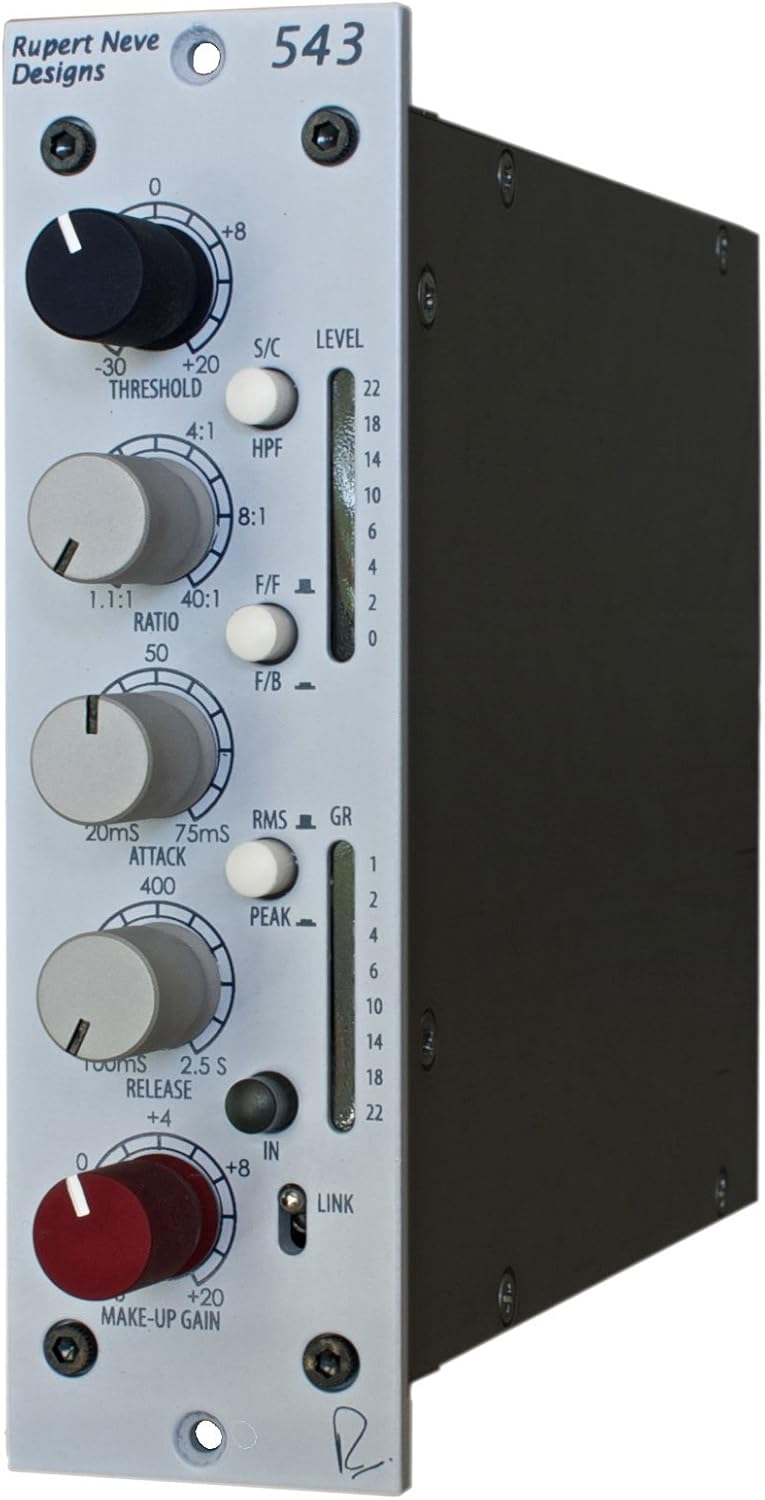
Rupert Neve Designs 543 500-Series Compressor/Limiter
Legendary Neve compression in a 500-series format with feed-forward/feed-back switching and transformer-coupled output.
$999.00*
View on Amazon
✓ In Stock on Amazon.com
*Price sourced from Amazon.com. Last updated:Aug 27, 2026.Price and availability are subject to change — details.
Affiliate Disclosure: As an Amazon Associate, Studio Supplies earns from qualifying purchases made through links on this page, at no additional cost to you. This helps support our editorial team.
Notice a mistake? Let Us Know
Overview
Key Features
500 Series Mono VCA Compressor
Specifications
Type
500-Series Mono VCA Compressor/Limiter
Controls
Threshold, Attack, Release, Makeup Gain, Ratio
Detection Modes
Peak / RMS (Selectable)
Compression Modes
Feed-Forward / Feed-Back (Selectable)
Sidechain
Highpass Filter
Output Stage
Transformer-Coupled Line Amplifier
Format
500 Series (Single Slot)
Frequently Asked Questions
Is the Rupert Neve Designs 543 based on another Neve compressor?
Yes. The 543 is derived from the Portico 5043 compressor/limiter, adapted into the 500 Series single-slot format while retaining the same core circuit topology and sonic character.
What is the difference between the feed-forward and feed-back compression modes?
Feed-forward mode provides more precise, modern-sounding gain reduction, while feed-back mode delivers a smoother, more vintage-style compression characteristic with a gentler response to transients.
Does the 543 have a sidechain filter?
Yes, it includes a sidechain highpass filter that lets you reduce the compressor's sensitivity to low-frequency content, which is useful for preventing bass-heavy material from triggering excessive gain reduction.
What is the difference between the feed-forward and feed-back modes on the 543?
Feed-forward mode provides tighter, more precise compression with a more assertive response to transients. Feed-back mode delivers a smoother, more vintage-style compression character with a gentler response, as the detector circuit monitors the output rather than the input signal.
Does the 543 have a sidechain high-pass filter?
Yes. The 543 includes a sidechain high-pass filter that reduces the compressor's sensitivity to low-frequency energy, helping prevent bass-heavy content from triggering excessive gain reduction.
Is this compressor derived from another Rupert Neve Designs unit?
Yes, the 543 is based on the full-sized Portico 5043 compressor, adapted into the 500-series form factor while retaining its core circuit topology and sonic character.
What type of gain reduction does the 543 use?
It uses a VCA (Voltage Controlled Amplifier) topology for its gain reduction element, which provides fast, accurate dynamic control.
What type of gain stage does the 543 use on its output?
The 543 features a transformer-coupled line amplifier on its output, which contributes to the warm, musical harmonic character associated with Neve designs.
Can the 543 operate as a limiter as well as a compressor?
Yes. With higher ratio settings and faster attack times, the 543 functions as a limiter, providing hard gain reduction to catch transient peaks while still benefiting from its musical VCA topology.
Can I switch between peak and RMS detection?
Yes, the 543 offers selectable peak and RMS detection modes, allowing you to choose between fast transient response and a more program-dependent, averaged compression behavior.
Related Products


