

Rupert Neve Designs
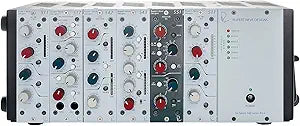
Rupert Neve Designs RND-R6 500-Series Rack Enclosure
48VPhantom Power
The RND R6 gives your 500-series modules a shielded, fully provisioned power environment with 150% current headroom — so the gear you trust sounds exactly as designed.
$699.00*
View on Amazon
✓ In Stock on Amazon.com
*Price sourced from Amazon.com. Last updated:Aug 27, 2026.Price and availability are subject to change — details.
Affiliate Disclosure: As an Amazon Associate, Studio Supplies earns from qualifying purchases made through links on this page, at no additional cost to you. This helps support our editorial team.
Notice a mistake? Let Us Know
Overview
Key Features
500 Series Chassis with LED Current Consumption Meter
Double-shielded Internal Power Supply
Variable-position Screw Holes
DB-25 I/O
XLR
Specifications
Module Slots
6
Power Supply
Robust
Phantom Power
Rugged +48V
Power Monitoring
Current Meter
Connectivity
Extensive Options
Module Connection
Link Jumper
I/O
Channel 7-8 Through
Power Input
Universal Voltage IEC
Frequently Asked Questions
What does "150% of required current" mean in practice for powering demanding modules?
It means the R6's internal supply is rated to deliver 50% more current than the theoretical maximum draw of six fully-loaded slots. In practice, this prevents the supply from running at its ceiling — a thermal and regulation advantage. Modules with high peak transient draws, like transformer-coupled preamps and discrete output stages, benefit most: there is no current compression event at the supply rail that could color the audio or introduce noise into adjacent modules.
How does the double-shielded power supply affect the noise floor of installed modules?
The double-shielded design significantly reduces magnetic field coupling from the transformer into nearby module circuits. This matters most for high-gain modules — a 60 dB mic preamp amplifies everything, including power supply hum. Users of sensitive RND preamp modules report noise floors that match or exceed what those modules achieve in reference-class racks, which validates the shielding design.
What I/O formats does the R6 support for integrating with a signal chain?
The R6 provides XLR, TRS, and DB-25 connector options, making it compatible with the full range of professional patch bay configurations. The channel 7–8 Through I/O allows signals to pass through independently of the 500-series module chain — useful for inserting the rack into a specific point in a console or DAW interface routing without committing all I/O to module processing.
Can I use the Link Jumper to connect adjacent modules — for example, for stereo linking of two mono preamps?
Yes. The Link Jumper is specifically designed to create electrical connections between adjacent module slots, which enables stereo-linked operation for modules that support it (such as the Shelford Channel or 5045 Primary Source Enhancer). Module compatibility for link functionality must be confirmed per module, but the R6 provides the physical and electrical infrastructure.
Does the LED current meter help prevent damage from overloading the supply?
Yes — it gives you real-time visibility into aggregate current draw across all six slots. If you are configuring a new module combination, you can verify the draw stays within the supply's capacity before full operation. It also helps diagnose abnormal draws that might indicate a module fault, which is particularly useful in live and touring contexts.
Related Products


