

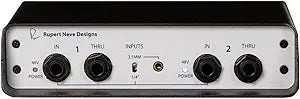
Rupert Neve Designs
Rupert Neve Designs RNDI-S Stereo Direct Box
Capture Every Nuance with Stereo Clarity Introducing the Rupert Neve Designs RNDI-S Stereo DI, engineered to deliver exceptional sonic performance for stereo and mono direct sources. Featuring custom Rupert Neve Designs transformers and class-A biased discrete FET amplifiers, this DI captures th...
$599.00*
Check availability
*Price sourced from Amazon.com. Last updated:Aug 28, 2026.Price and availability are subject to change — details.
Affiliate Disclosure: As an Amazon Associate, Studio Supplies earns from qualifying purchases made through links on this page, at no additional cost to you. This helps support our editorial team.
Notice a mistake? Let Us Know
Overview
Capture Every Nuance with Stereo Clarity
Introducing the Rupert Neve Designs RNDI-S Stereo DI, engineered to deliver exceptional sonic performance for stereo and mono direct sources. Featuring custom Rupert Neve Designs transformers and class-A biased discrete FET amplifiers, this DI captures the full harmonic depth of basses, guitars, keyboards, and more. Experience vibrant and powerful direct sound with unparalleled clarity.
Specifications:
- Type: Stereo Active Transformer DI
- Transformer: Custom Rupert Neve Designs
- Amplifier: Class-A biased, discrete FET
- Inputs: Stereo or Mono
- Applications: Basses, Guitars, Keyboards, Acoustic Instruments, Line-Level Sources
Specifications
Product Type
Stereo Direct Box
Transformers
Custom Rupert Neve Designs
Key Features
Transparent, linear frequency response, High headroom, Enhanced harmonic richness
Frequently Asked Questions
What is the primary function of the Rupert Neve Designs RNDI-S Stereo Direct Box?
The RNDI-S is a stereo direct box designed to convert high-impedance, unbalanced instrument signals into low-impedance, balanced signals for pristine transfer to a mixing console or audio interface.
How does the RNDI-S affect the sound quality of an instrument?
It provides a transparent, linear frequency response with high headroom, and its custom Rupert Neve Designs transformers add rich harmonics, enhancing the sonic character of the source signal.
Is this direct box suitable for live performance or primarily for studio use?
The RNDI-S is built with robust quality, making it suitable for both demanding live sound applications and critical studio recording environments.
Does the RNDI-S require phantom power to operate?
As a passive direct box, the Rupert Neve Designs RNDI-S does not require phantom power to operate, drawing power from the signal itself for its internal transformers.
Can the RNDI-S handle high-output signals from instruments like active bass guitars or keyboards?
Yes, the RNDI-S is designed with high headroom, allowing it to handle strong, dynamic signals from instruments effectively without introducing unwanted distortion.
Related Products


