



Samson
Samson 0809164024927 Expedition Express+ Bluetooth Speaker Mic
12 lbs
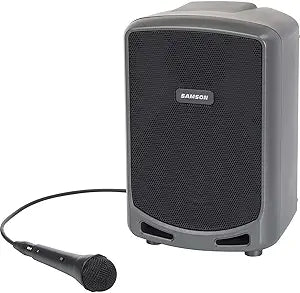
The Samson Expedition Express+ packs a 75-watt Class D PA, Bluetooth, 3-channel mixer, and 20-hour battery into an 11-pound self-contained system for anywhere audio.
$279.99*
View on Amazon
✓ In Stock on Amazon.com
*Price sourced from Amazon.com. Last updated:Aug 27, 2026.Price and availability are subject to change — details.
Affiliate Disclosure: As an Amazon Associate, Studio Supplies earns from qualifying purchases made through links on this page, at no additional cost to you. This helps support our editorial team.
Notice a mistake? Let Us Know
Overview
Key Features
All-In-One Portable Speaker System, Weighs Just Under 12 lbs, Internal Rechargeable Battery for up to 20 hrs of Continuous Use
Class D Amplifier Produces 75 Watts of Power, Bluetooth Connectivity to Connect Wireless Music Sources
3-Channel Mixer w/ Master Volume Control, 2-Way Speaker Enclosure w/ 6" Woofer & 1" Tweeter
USB Wireless Port for Use w/ Samson XPD Series USB Digital Wireless Systems (Sold Separately) & Phone Charging Rugged Polypropylene Enclosure w/ Integrated Carry Handle
Tilt-Back Design for Sideways Positioning, 1-3/8" Speaker Stand Mount
Specifications
Power Output
75W peak (Class D)
Speaker Configuration
2-way: 6" woofer + 1" tweeter
Battery Life
Up to 20 hours (moderate volume)
Weight
Under 12 lbs
Channels
3-channel mixer with master volume
Inputs
XLR/¼" combo (Mic/Line), ¼" Line, 1/8" Aux
Wireless
Bluetooth; USB port for Samson XPD series
Speaker Stand Mount
1-3/8" pole mount
Enclosure
Rugged polypropylene with integrated carry handle
Phantom Power
None
Frequently Asked Questions
What is the usable audio quality of the 6-inch woofer and 1-inch tweeter in this enclosure, and what SPL can it realistically deliver?
The 2-way configuration handles speech and acoustic music cleanly at modest levels — the 6-inch woofer covers the low-mid body of a voice while the tweeter extends presence into the 8–12kHz range. At 75W peak, expect usable output in spaces up to approximately 50 people outdoors or a small meeting room indoors. The system is optimized for speech intelligibility and moderate music reproduction, not for high-SPL music reinforcement.
How does the 3-channel mixer handle gain staging, and what inputs are available?
The mixer section offers an XLR/¼-inch combo input for mic or line-level sources, a ¼-inch line input, and a 1/8-inch aux input for consumer devices. The master volume is the primary level control. There is no individual channel EQ, so gain staging must be managed at the source. Driving the mic input with a line-level signal will result in distortion — use the appropriate input for each source.
How does Bluetooth connectivity perform in terms of latency and range?
Bluetooth is suitable for music playback from phones or tablets, but the inherent latency of Bluetooth audio (typically 100–250ms depending on codec) makes it unsuitable for live performance or video playback sync. Treat the Bluetooth input as a music streaming channel, not a performance routing path.
What is the USB wireless port, and which Samson systems is it compatible with?
The USB port is designed exclusively for Samson XPD Series USB digital wireless microphone and lavalier systems, which plug directly into the socket without a separate receiver. It is not a generic USB audio interface port and will not pass audio from USB storage devices or other manufacturers' wireless systems.
How long does the internal battery actually last in real-world use?
The 20-hour rating is at moderate volume levels. At sustained high volumes — above 50% output — expect substantially shorter runtime, typically in the 8–12 hour range. Battery life also degrades over charge cycles; older units may fall short of the original rating.
Related Products


