



Samson
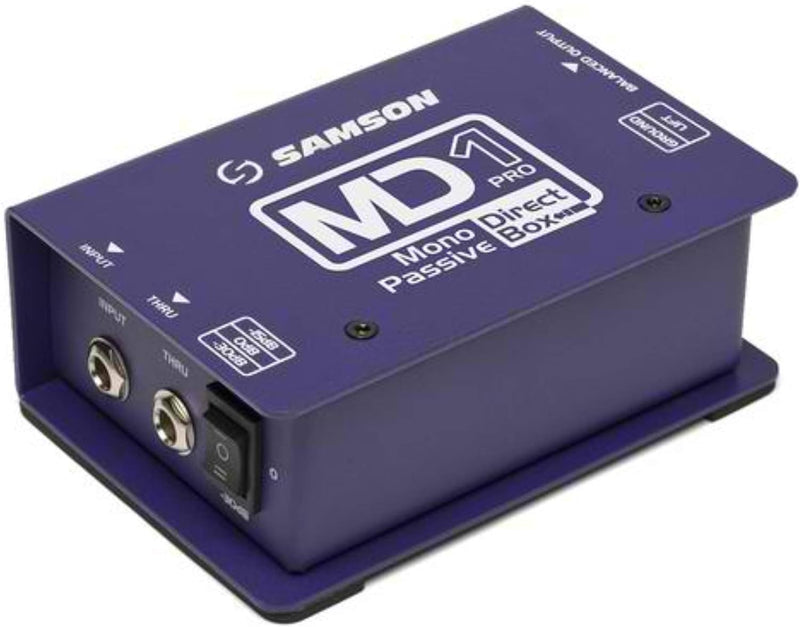
Samson MD1 PRO Mono Passive Direct Box
A rugged passive direct box with a shielded transformer and 3-position pad for clean signal transfer on stage and in the studio.
$89.99*
View on Amazon
✓ In Stock on Amazon.com
*Price sourced from Amazon.com. Last updated:Aug 28, 2026.Price and availability are subject to change — details.
Affiliate Disclosure: As an Amazon Associate, Studio Supplies earns from qualifying purchases made through links on this page, at no additional cost to you. This helps support our editorial team.
Notice a mistake? Let Us Know
Overview
Key Features
EASY CONNECTIONS: The MD1 Pro easily takes a 1/4" unbalanced line or instrument level signal source and outputs it as a balanced mic-level XLR signal, allowing for easy connections to mixing consoles or USB audio interfaces.
PREMIUM CIRCUITRY: Built with Samson’s STLX transformer and Mu-Metal shielding, the MD1 Pro’s premium circuitry provides a clean signal with ultra-low distortion.
PASSIVE OPERATION: The MD1 Pro’s signal path is entirely passive, requiring no phantom power or batteries to operate.
BUILT TO LAST: The MD1 Pro is housed in a 14-gauge steel chassis, built to withstand the rigors of the stage and studio alike.
SIGNAL SWITCHES: The MD1 Pro has a ground-lift to help fight buzz and hum, and a two-stage -15dB/-30dB pad for plugging into low-headroom inputs, both at the flick of a switch.
PASSIVE THRU OUTPUT: The MD1 Pro’s Thru output sends a dry copy of your signal to a 1/4” output for connecting to pedals or an amplifier, perfect for parallel tracking in studio spaces or using the amp as a monitor on stage.
Specifications
Model
Samson MD1 PRO
Type
Mono Passive Direct Box
Transformer
Samson STLX Mu-Metal Shielded
Attenuation Switch
3-Position (0dB / -15dB / -30dB)
Ground Lift
Yes
Input
1/4" (with Thru output)
Output
XLR Balanced
Construction
All-Metal, Impact Resistant
Power
None required (Passive)
Frequently Asked Questions
What does the 3-position attenuation switch on the MD1 Pro do?
It lets you set signal padding at 0dB, -15dB, or -30dB, allowing you to match the input level from instruments, line-level sources, or even speaker-level signals without distortion.
Does the Samson MD1 Pro require batteries or phantom power?
No, it is a fully passive direct box that uses a transformer to convert the signal. It requires no batteries, phantom power, or external power source to operate.
What is the ground lift switch used for on this DI box?
The ground lift switch disconnects the ground pin between the input and output, which helps eliminate ground loop hum and buzz that can occur when connecting equipment on different electrical circuits.
What type of output connector does the MD1 Pro use?
It outputs a balanced signal via an XLR connector, which connects directly to a mixer or audio interface mic input for long cable runs with minimal noise.
Can the MD1 Pro handle speaker-level signals?
Yes, with the attenuation switch set to -30dB, the MD1 Pro can accept speaker-level signals, making it useful for capturing amp tones directly without a microphone.
Related Products


