



Samson
Samson SACSMIC CS Series Capsule Select Microphone: Vocal & Instrument
★★★★★
XLR
Two professional-grade dynamic capsules in one body — switch between supercardioid vocal tuning and tight instrument isolation without pulling a second mic.
$89.99*
View on Amazon
✓ In Stock on Amazon.com
*Price sourced from Amazon.com. Last updated:Jul 14, 2026.Price and availability are subject to change.
Affiliate Disclosure: Studio Supplies may earn a commission from qualifying purchases made through links on this page, at no additional cost to you. This helps support our editorial team.
Notice a mistake? Let Us Know
Overview
Key Features
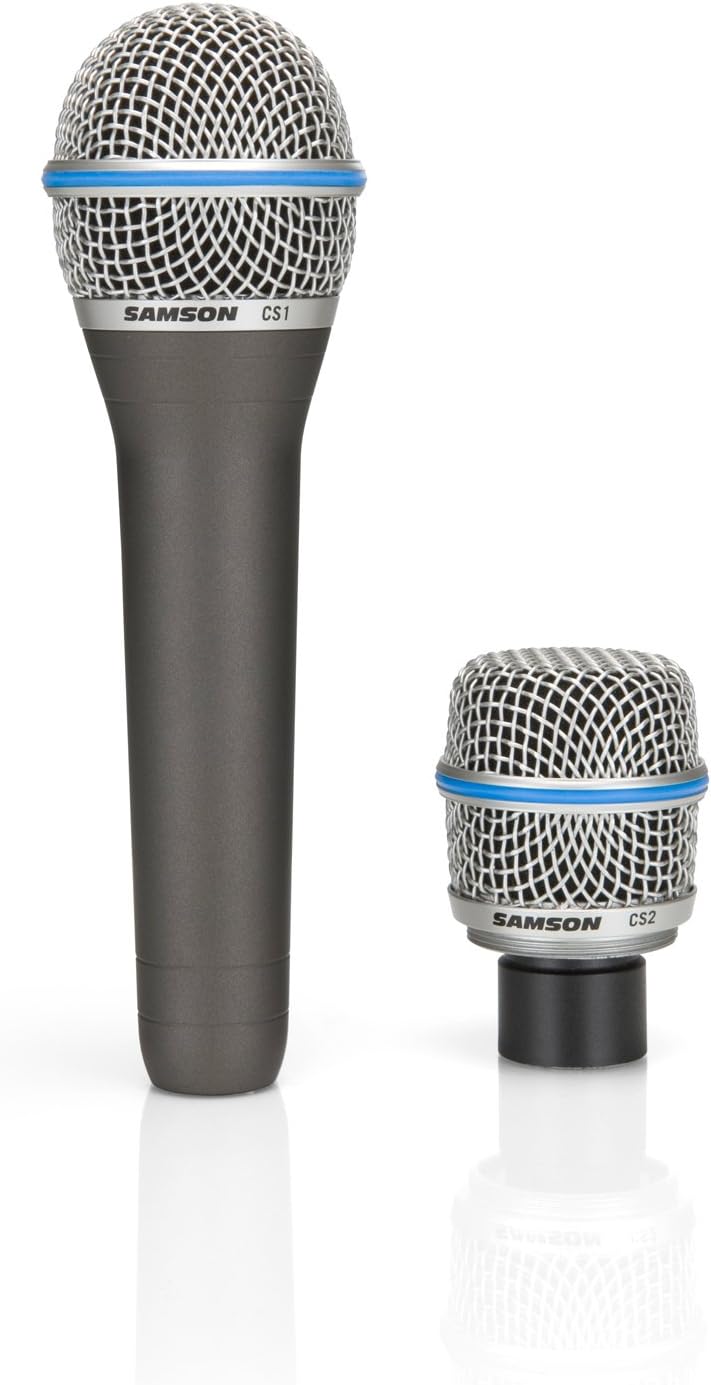
CS1 Vocal Microphone capsule - Neodymium capsule tuned for vocal performance. Super cardioid pickup pattern for excellent feedback rejection
CS2 Instrument Microphone capsule - Neodymium capsule tuned for drums, guitar cabinets, brass and other preferred instruments, tighter polar pattern for greater isolation
Threaded twist-off handle design
Gold-plated XLR connector
Also includes mic clip and carry case
Specifications
Brand
Samson
Model
SACSMIC
Capsule 1 (CS1)
Neodymium, supercardioid — vocal
Capsule 2 (CS2)
Neodymium, tighter polar pattern — instrument
Connector
Gold-plated XLR
Power Requirement
None (dynamic capsules)
Capsule Change
Threaded twist-off handle
Included Accessories
Mic clip, carry case, CS1 and CS2 capsules
Pros & Cons
👍 Pros
- The interchangeable CS1 and CS2 capsules deliver two purpose-tuned microphones from a single handle body, eliminating the need to carry and cable a second dedicated instrument mic.
- The CS1's neodymium supercardioid capsule provides measurably tighter off-axis rejection than standard cardioid dynamics, directly improving gain-before-feedback in loud stage environments.
- The CS2's tighter polar pattern reduces bleed from adjacent sound sources when close-miking drums or guitar cabinets in live or tracking scenarios.
- The twist-off capsule design allows tool-free swaps in seconds, making mid-session changes practical rather than disruptive.
- The gold-plated XLR connector resists oxidation at the pin contact surface, sustaining reliable signal transfer in high-humidity or touring conditions.
👎 Cons
- The CS1's supercardioid pattern requires more precise mic placement relative to the vocalist's mouth than a standard cardioid — small off-axis deviations produce more noticeable coloration.
- Neither capsule includes a pad switch, which limits the CS2's headroom when close-miking loud sources like kick drum or heavily driven guitar cabinets that can exceed 140 dB SPL.
- No frequency response or sensitivity specifications are published, making it difficult to predict exactly how these capsules will sit in a mix relative to known reference microphones.
- The lack of a low-cut filter switch means any proximity effect buildup on the CS1 must be managed at the console or interface, adding a step to the gain staging workflow.
- The twist-on capsule connection point is a wear surface — repeated capsule changes over years of touring will eventually introduce connector slop that affects signal reliability.
Frequently Asked Questions
Does the CS Series require phantom power to operate?
No. Both the CS1 and CS2 are dynamic capsules, which generate signal passively through electromagnetic induction. Phantom power is not required and will not damage the capsules, but it provides no benefit — these mics draw nothing from the power rail.
How does the CS1's supercardioid pattern affect gain-before-feedback compared to a standard cardioid?
Supercardioid patterns have a narrower acceptance angle — roughly ±115 degrees versus ±130 degrees for cardioid — which tightens rejection off-axis and pushes the null points to approximately 126 degrees rather than directly at the rear. On stage, this means better feedback rejection from monitors positioned in front of and to the sides of the mic, but you must keep monitors outside those narrower null zones to benefit.
Can I swap capsules mid-set without tools?
Yes. The threaded twist-off handle design allows capsule changes with a simple rotation — no tools, no disassembly. The capsules thread directly onto the same handle body, so swapping between the CS1 vocal and CS2 instrument capsule takes seconds.
What instruments does the CS2 capsule handle best?
The CS2 is tuned for drums, guitar cabinets, and brass. Its tighter polar pattern increases isolation from bleed sources in a live or multi-mic recording environment, which is particularly valuable when close-miking a snare or guitar cab in a dense mix.
Does the gold-plated XLR connector affect signal quality meaningfully?
Gold plating on the XLR pins resists oxidation over time, which maintains consistent contact resistance at the connector junction. In practical terms, this reduces the chance of intermittent signal or tonal degradation in humid or touring environments where bare copper connectors would oxidize faster.
Related Products


