

Price history
Samson
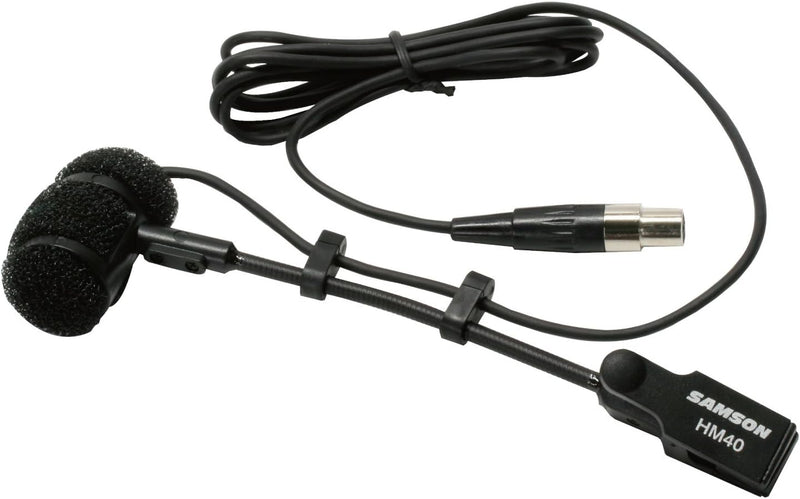
Samson SWA3W4 HM40 Wind Instrument Microphone P3
★★★★★
0.050 lb
Purpose-built condenser pickup for horn instruments — the HM40 clips on and delivers clean, accurate wind instrument tone for live reinforcement and studio tracking.
$110.44*
View on Amazon
✓ In Stock on Amazon.com
*Price sourced from Amazon.com. Last updated:Jul 21, 2026.Price and availability are subject to change.
Affiliate Disclosure: Studio Supplies may earn a commission from qualifying purchases made through links on this page, at no additional cost to you. This helps support our editorial team.
Notice a mistake? Let Us Know
Overview
Key Features
Package quantity: 1
Product Type: MICROPHONE
Package weight: 0.050 lb
Country of Origin: China
Specifications
Brand
Samson
Model
SWA3W4 / HM40
Product Type
Condenser Microphone
Connectivity
Wired
Connector Type
P3
Polar Pattern
Unidirectional
Signal-to-Noise Ratio
78 dB
Self-Noise
16 dB
Item Weight
1.76 oz
Dimensions
6.69 x 1.57 x 0.98 inches
Country of Origin
China
Frequently Asked Questions
What gain staging does the HM40 require at the preamp?
With a 78dB signal-to-noise ratio and 16dB self-noise, the HM40 doesn't demand extreme gain from your preamp. Set conservatively — the unidirectional polar pattern rejects off-axis bleed effectively enough that you won't need to push gain hard to pull the instrument signal above stage noise.
Does the HM40 require phantom power?
The HM40 uses a P3 connector rather than standard XLR, meaning it receives power through its proprietary connector and associated Samson bodypack or wired interface. Confirm the specific power requirements with the Samson receiving unit you're pairing it with before integrating it into your rig.
How does the unidirectional polar pattern perform in a live brass section?
The cardioid pattern keeps the HM40 focused on the instrument rather than the surrounding ensemble. In a live brass section, this provides meaningful separation between adjacent players, giving the FOH engineer cleaner individual channels with less cross-bleed to manage at the board.
Is 16dB self-noise acceptable for studio recording?
For live reinforcement and standard performance recording it's fully workable. In a quiet studio tracking situation — recording soft sustained woodwind passages, for example — the noise floor can become audible on close listening. Engineers tracking for broadcast or high-fidelity studio release should compare against lower-noise alternatives before committing to this mic for critical sessions.
How does the condenser element handle the transient attack of brass instruments?
The condenser element reproduces the strong initial transient of a brass note with good clarity — the front edge of the attack is clean and defined rather than compressed or smeared, which is where many dynamic clip-on alternatives fall short on horn instruments.
Related Products


