



Samyang
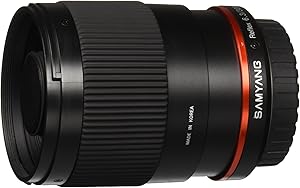
Samyang SY300M-PO-BK 300mm F6.3 Mirror Lens - MFT Mount
★★★★★
Compact 300mm mirror telephoto lens brings distant subjects into sharp focus on Micro Four Thirds mirrorless cameras.
$277.65*
Check availability
*Price sourced from Amazon.com. Last updated:Jul 14, 2026.Price and availability are subject to change.
Affiliate Disclosure: Studio Supplies may earn a commission from qualifying purchases made through links on this page, at no additional cost to you. This helps support our editorial team.
Notice a mistake? Let Us Know
Overview
Key Features
300mm Mirror Lens with F6.3 Aperture
Constructed of 9 elements in 9 groups
Designed for mirrorless interchangeable lens cameras
Minimum focusing distance 2.95 feet; angle of view 5.4 degrees on Canon M, Fuji X and Sony NEX, 4.2 degrees for MFT
Specifications
Focal Length
300mm (600mm equivalent on MFT)
Aperture
Fixed F6.3
Lens Construction
9 elements in 9 groups
Lens Mount
Micro Four Thirds (MFT)
Minimum Focusing Distance
2.95 feet (0.9m)
Angle of View (MFT)
4.2 degrees
Focus Type
Manual
Lens Type
Mirror (Catadioptric)
Pros & Cons
👍 Pros
- Extremely compact and lightweight for a 300mm telephoto, making it easy to carry in the field.
- Provides 600mm equivalent reach on MFT bodies, ideal for distant wildlife and sports subjects.
- Nine-element optical construction delivers sharp results for a mirror lens at this price point.
- Close minimum focusing distance of 2.95 feet allows for versatile shooting situations.
- No batteries or electronics required — purely mechanical operation ensures long-term reliability.
👎 Cons
- Fixed F6.3 aperture limits low-light performance and provides no aperture control for depth-of-field adjustment.
- Manual focus only, which can make tracking fast-moving subjects challenging.
- Mirror lens design produces distinctive donut-shaped bokeh that may be distracting in some images.
- Narrow 4.2-degree angle of view on MFT requires precise aiming and steady handling.
- Lacks image stabilization, so a tripod or fast shutter speeds are recommended for sharp results.
Frequently Asked Questions
What camera bodies is the Samyang 300mm F6.3 Mirror Lens compatible with?
This specific version is the MFT (Micro Four Thirds) mount, compatible with Olympus and Panasonic mirrorless cameras. It is also available in mounts for Sony NEX, Fuji X, and Canon M systems.
Does this lens have autofocus?
No, the Samyang 300mm F6.3 Mirror Lens is a manual focus lens. You will need to focus by hand using the focus ring.
What is the effective focal length on a Micro Four Thirds camera?
With the 2x crop factor of MFT sensors, this 300mm lens provides an effective focal length of 600mm, giving you exceptional reach for wildlife and sports subjects.
Does the mirror lens design affect image quality in any way?
Mirror lenses produce characteristic ring-shaped bokeh (sometimes called "donut bokeh") in out-of-focus areas. This is inherent to the catadioptric design and is a distinct visual characteristic some photographers appreciate and others do not.
Can the aperture be adjusted on this lens?
No, this is a fixed-aperture lens at F6.3. Exposure is controlled through shutter speed and ISO settings on your camera body.
Related Products


