



Samyang
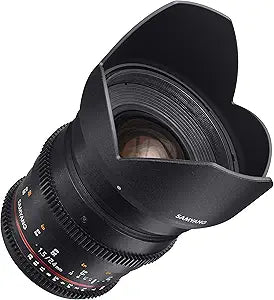
Samyang SYDS24M-MFT 24mm T1.5 Cine Lens MFT
★★★★★
Shoot cinematic wide-angle sequences with color-matched T1.5 glass that drops seamlessly into any Samyang VDSLR II follow focus workflow on Micro Four Thirds.
$699.58*
Check availability
*Price sourced from Amazon.com. Last updated:Jul 14, 2026.Price and availability are subject to change.
Affiliate Disclosure: Studio Supplies may earn a commission from qualifying purchases made through links on this page, at no additional cost to you. This helps support our editorial team.
Notice a mistake? Let Us Know
Overview
Key Features
Full frame coverage with aperture range of T1.5 - T22
New VDSLR II line that is color matched with other Samyang VDSLR II lenses and have unified gear and aperture positions among all Samyang VDSLR II lenses
84.1 degrees angle of view on full frame cameras & 57.6 degrees angle of view on APS-C
Minimum focusing distance of 9.8 inches; uses filter size of 77mm
Specifications
Focal Length
24mm
Maximum Aperture
T1.5
Minimum Aperture
T22
Angle of View (Full Frame)
84.1 degrees
Angle of View (MFT)
57.6 degrees
Minimum Focus Distance
9.8 inches (approx. 25cm)
Filter Thread
77mm
Lens Mount
Micro Four Thirds (Olympus/Panasonic)
Lens Line
VDSLR II
Color Matching
Factory-tested across VDSLR II line
Focus Scales
Dual (both sides of barrel)
Electronic Contacts
None (fully manual)
Brand
Samyang
Pros & Cons
👍 Pros
- The T1.5 maximum aperture provides cinematic subject separation and low-light capability on MFT sensors that slower kit lenses cannot match.
- Unified gear positioning with other Samyang VDSLR II lenses means a single follow focus ring setting works across your entire set of primes without resetting between shots.
- Factory color matching across the VDSLR II line eliminates inter-lens color correction in grading — cuts between focal lengths are clean straight out of the timeline.
- The 77mm filter thread is a practical professional standard, making it easy to share ND filters and matte box stages across a multi-lens kit.
- Dual focusing scales on both sides of the barrel let a focus puller read distance from either side of the rig without repositioning.
👎 Cons
- No electronic contacts means the camera body receives no EXIF aperture or focal length data — metadata logging and automatic IBIS focal length selection require manual intervention on every lens swap.
- On Micro Four Thirds the effective 48mm equivalent angle of view loses the dramatic wide perspective that makes 24mm compelling on larger formats — users wanting ultra-wide cinematic coverage will need to look at the 14mm in the VDSLR II line.
- The fully manual aperture ring, while standard for cine work, creates an additional workflow step for run-and-gun or documentary shooters accustomed to electronic aperture control.
- Corner sharpness wide open at T1.5 shows some softness typical of fast prime designs — critical sharpness across the full frame requires stopping down to T2.8 or beyond.
Frequently Asked Questions
Does this lens cover a full-frame sensor, and what field of view does it produce on a Micro Four Thirds camera?
Full-frame coverage is built in, but on a Micro Four Thirds body the 2x crop factor narrows the effective angle of view to approximately 57.6 degrees — equivalent to roughly a 48mm full-frame perspective. It's a useful moderate wide on MFT rather than an ultra-wide architectural or landscape lens.
How close can I focus, and is the focus throw long enough for precise follow focus operation?
The minimum focusing distance is 9.8 inches (approximately 25cm), which allows closer environmental and product framing than many 24mm lenses. The manual focus ring is dampened and geared specifically for follow focus compatibility — the throw is long enough for precise rack focus pulls between foreground and background subjects.
Is there any electronic communication between this lens and the camera body for exposure or stabilization data?
No — this is a fully manual lens with no electronic contacts. Aperture is set via the dedicated aperture ring on the lens barrel, not through the camera menu. In-body image stabilization on compatible MFT bodies will still function, but the camera will not receive focal length data automatically; you'll want to set the IBIS focal length manually in the camera menu for optimal stabilization.
How does the T1.5 aperture perform for low-light narrative work versus a comparable f/1.4 photo lens?
T-stops measure actual light transmission rather than theoretical aperture, so a T1.5 rating reflects the true light throughput after accounting for lens element losses. In practice, a T1.5 cine lens at maximum aperture delivers the same exposure as a photo lens rated f/1.4 in equivalent conditions — making it a reliable low-light and shallow-depth-of-field tool for narrative and documentary cinematography.
Is this lens color matched with other focal lengths in the Samyang VDSLR II range?
Yes — the VDSLR II line is factory-tested for consistent color rendition and contrast across focal lengths. Cutting between this 24mm and other VDSLR II primes (such as the 14mm, 35mm, or 85mm) in the same production will not require color grading correction for lens-to-lens variance, which is a significant time saver in post.
Related Products


