



Sennheiser
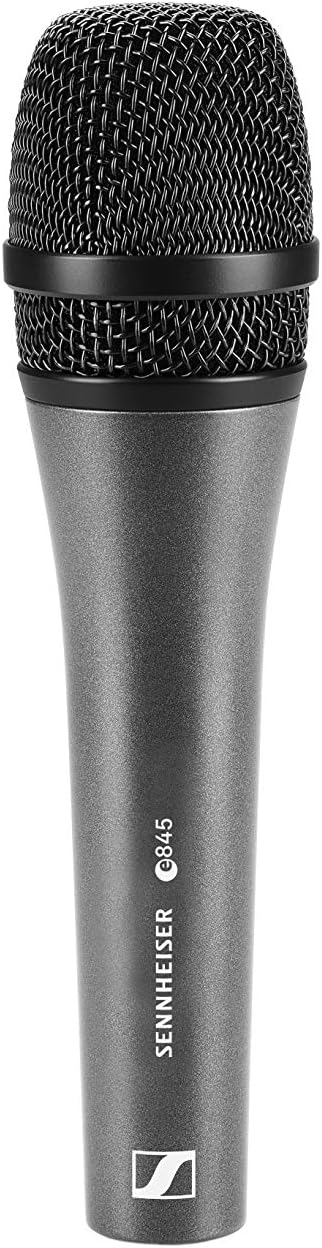
Sennheiser 004515 E845 Dynamic Supercardioid Microphone
Built for the stage and trusted in the studio, the Sennheiser E845 delivers tight supercardioid focus and dynamic punch that cuts through any mix.
$93.24*$93.99Save 0%
Check availability
*Price sourced from Amazon.com. Last updated:Aug 28, 2026.Price and availability are subject to change — details.
Affiliate Disclosure: As an Amazon Associate, Studio Supplies earns from qualifying purchases made through links on this page, at no additional cost to you. This helps support our editorial team.
Notice a mistake? Let Us Know
Overview
Key Features
Frequency response: 40 - 16,000 Hz
Open Circuit Sensitivity: 1.6 mV/Pa +- 1 dB (free sound field, no load, 1KHz)
Nominal Impedance: 350 Ohm
Super Cardioid Dynamic Microphone
Specifications
Type
Dynamic Supercardioid
Frequency Response
40 – 16,000 Hz
Polar Pattern
Supercardioid
Open Circuit Sensitivity
1.6 mV/Pa ±1 dB (free field, no load, 1 kHz)
Nominal Impedance
350 Ω
Connector
XLR
Phantom Power Required
No
Brand
Sennheiser
Model
004515 / E845
Frequently Asked Questions
Does the E845 require phantom power to operate?
No — it's a dynamic microphone and operates entirely passively. No phantom power is needed, which makes it universally compatible with any XLR-equipped interface, console, or snake without worrying about phantom power state.
How does the supercardioid polar pattern affect gain-before-feedback on a live stage?
The supercardioid pattern offers tighter off-axis rejection than a standard cardioid, which translates directly to higher gain-before-feedback when monitors are placed at the rear null points. Position wedges at roughly 125–135 degrees off-axis from the capsule for best results.
What's the self-noise level, and does it matter for close-miked vocals?
As a dynamic microphone, the E845 has no active electronics and therefore no measurable self-noise in the traditional sense. At close vocal distances (2–6 inches), the signal-to-noise ratio is excellent — the floor is set by your preamp, not the mic.
How does the E845 handle high-SPL sources compared to its cardioid sibling, the E835?
The E845 shares robust SPL handling with the E835 but the supercardioid pattern makes it more directional, which means less bleed from adjacent sources in dense stage setups. For loud vocalists in loud bands, the tighter pickup means more isolation, not less headroom.
What preamp gain is typically needed to drive the E845 to a healthy signal level?
At 1.6 mV/Pa sensitivity, the E845 is in the normal range for dynamic mics. Expect to dial in 40–55 dB of clean gain on most console preamps for a vocalist at 6 inches. High-output preamps are not required, but low-noise designs will reward you with a cleaner floor.
Related Products


