

Sennheiser
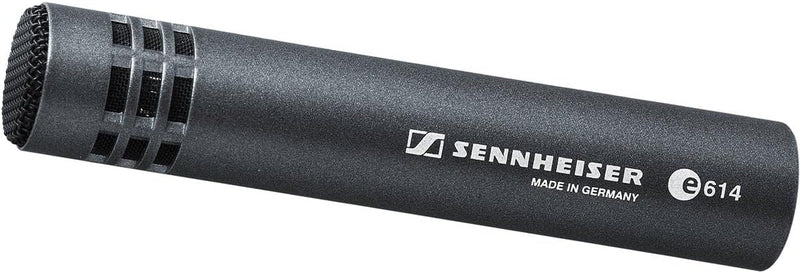
Sennheiser e 614 Supercardioid Condenser Instrument Microphone
Condenser
The Sennheiser e 614 captures the precise attack and shimmer of percussion and acoustic instruments with supercardioid discipline that survives high-SPL sessions.
$199.95*
View on Amazon
✓ In Stock on Amazon.com
*Price sourced from Amazon.com. Last updated:Aug 30, 2026.Price and availability are subject to change — details.
Affiliate Disclosure: As an Amazon Associate, Studio Supplies earns from qualifying purchases made through links on this page, at no additional cost to you. This helps support our editorial team.
Notice a mistake? Let Us Know
Overview
Key Features
Nearly flat response from 40 Hz to 20 kHz and a supercardioid pattern
Designed for demanding applications where extended frequency range, high SPL handling, fast transient response and small size are required
Captures the shimmer and the contact of sticks, mallets and hands
Phantom powering: 12 – 52 V / 3 mA
Includes e 614, Microphone pouch and Microphone clip MZQ 100
Specifications
Frequency Response
40 Hz to 20 kHz
Polar Pattern
Supercardioid
Phantom Powering
12 – 52 V / 3 mA
Included Accessories
Microphone pouch, Microphone clip MZQ 100
Frequently Asked Questions
Is the e 614 suited for drum overheads, or is it better used as a spot mic?
It works well in both roles, but it truly shines as a spot mic on hi-hats, cymbals, acoustic guitar, and hand percussion where you want precise transient capture without smearing. As an overhead, the supercardioid pattern's tighter pickup angle means you get a more focused image of the kit with less room ambience than a cardioid overhead would provide — useful in rooms with less-than-ideal acoustics, but something to plan for in your stereo technique.
What phantom power voltage does the e 614 require, and will any standard interface supply it?
The e 614 accepts 12–52V phantom power at 3mA. Virtually every audio interface, mixer, and mic preamp with phantom power will supply compatible voltage in this range. There are no exotic power requirements to worry about.
How does the supercardioid polar pattern affect placement and bleed rejection in a drum kit context?
Supercardioid provides tighter off-axis rejection than a standard cardioid — typically about 10dB more side rejection. In a dense drum kit environment, this translates to noticeably cleaner separation between the hi-hat mic and the snare, or between tom spots and cymbals overhead. The trade-off is a rear lobe of sensitivity at roughly 180°, so position the null zones (about 125° off-axis) toward unwanted sources, not directly behind the mic.
What is the maximum SPL this microphone can handle?
The product listing references high SPL handling as a design objective for the e 614. Sennheiser typically rates the e 600 series condensers for 155dB SPL or higher at their maximum setting — sufficient for loud acoustic instruments and drum overheads without distortion. Confirm exact SPL figures in the full Sennheiser e 614 datasheet for critical applications.
Does the e 614 include a pad or high-pass filter switch?
No. The e 614 is a fixed-circuit microphone with no onboard pad or HPF switch. For sources requiring a pad (e.g., a very loud snare at close range), use a preamp-side pad. For low-frequency filtering, apply a high-pass in your DAW or on your console.
Related Products


