



Sennheiser
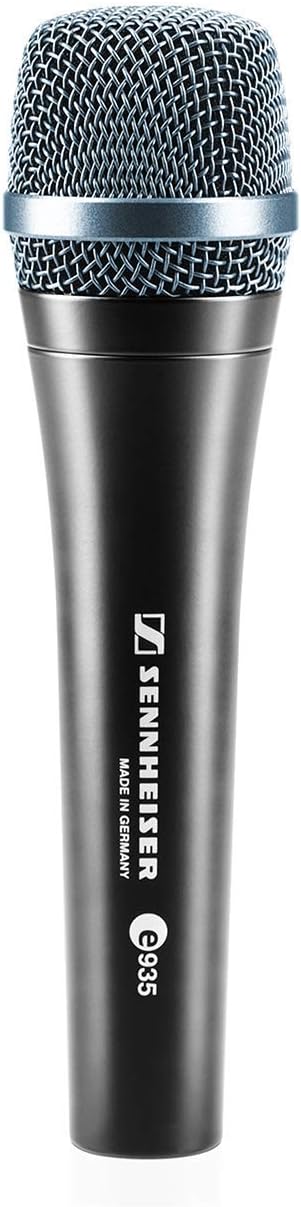
Sennheiser e 935 Cardioid Dynamic Handheld Microphone
The Sennheiser e 935 delivers German-engineered vocal presence with cardioid rejection tight enough to hold its own on a loud stage.
$199.95*
View on Amazon
✓ In Stock on Amazon.com
*Price sourced from Amazon.com. Last updated:Oct 21, 2026.Price and availability are subject to change — details.
Affiliate Disclosure: As an Amazon Associate, Studio Supplies earns from qualifying purchases made through links on this page, at no additional cost to you. This helps support our editorial team.
Notice a mistake? Let Us Know
Overview
Key Features
Cardioid characteristics: isolation from other signals on the stage
Neodymium iron magnet with boron: keeps the microphone stable regardless of the climate
Made in Germany
International products have separate terms, are sold from abroad and may differ from local products, including fit, age ratings, and language of product, labeling or instructions.
Specifications
Model
e 935
Microphone Type
Dynamic
Polar Pattern
Cardioid
Frequency Response
40 Hz – 16,000 Hz
Sensitivity
2.8 mV/Pa (-51 dBV re 1 V/Pa)
Nominal Impedance
350 ohms
Minimum Termination Impedance
1,000 ohms
Connector
XLR-3
Dimensions
47 x 181 mm
Weight
330 g
Phantom Power Required
No
Country of Manufacture
Germany
Frequently Asked Questions
Does the e 935 require phantom power to operate?
No. The e 935 is a dynamic microphone and requires no phantom power. It draws nothing from the preamp and can be used with any XLR-equipped console, interface, or PA head without phantom power concerns.
How does the e 935's frequency response hold up at high SPLs during loud stage performances?
The e 935 is built for high-SPL environments. The neodymium iron boron magnet assembly maintains stable output under loud sources without the saturation you'd get from a less robust dynamic capsule — it handles screaming vocalists and loud monitoring without distorting.
How does the cardioid polar pattern of the e 935 compare to tighter supercardioid patterns for stage use?
The cardioid pattern offers a wider pickup angle than supercardioid, which means slightly less rear rejection but more forgiving microphone technique for performers who move around. For most live vocal applications this is the right trade-off. If you need maximum isolation in an extremely loud monitor environment, a supercardioid like the e 945 may serve better.
Is the e 935 suitable for recording vocals in a project studio as well as live use?
Yes, though it's optimized for live performance. In a studio context it captures a clean, present vocal signal with minimal coloration — practical for tracking when you want a no-fuss dynamic with a known sound. It won't replace a large-diaphragm condenser for nuanced studio work, but it's a reliable utility mic for sessions.
What's the nominal impedance, and will it work with budget interfaces that have lower-quality preamps?
The e 935 presents a nominal impedance of 350 ohms and a sensitivity of 2.8 mV/Pa (-51 dBV). It's reasonably sensitive for a dynamic and will work with most budget interfaces, though lower-quality preamps may need to be pushed higher to achieve optimal gain structure.
Related Products


