



Sennheiser
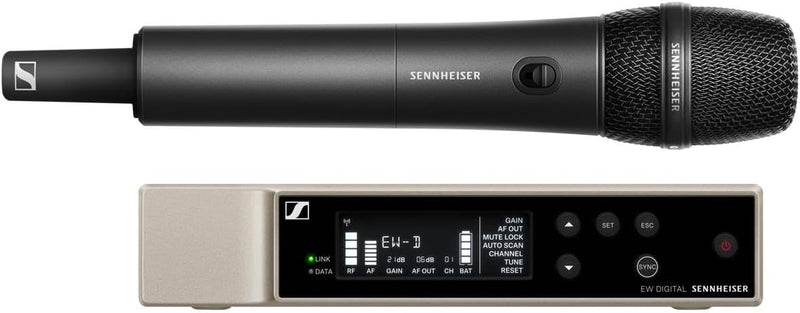
Sennheiser EW-D 835-S SET Wireless Microphone System
Sennheiser's EW-D 835-S delivers broadcast-grade digital clarity and rock-solid RF performance for live vocal work on any stage.
$699.00*$735.00Save 4%
View on Amazon
✓ In Stock on Amazon.com
*Price sourced from Amazon.com. Last updated:Aug 28, 2026.Price and availability are subject to change — details.
Affiliate Disclosure: As an Amazon Associate, Studio Supplies earns from qualifying purchases made through links on this page, at no additional cost to you. This helps support our editorial team.
Notice a mistake? Let Us Know
Overview
Key Features
Digital wireless eliminates noise, interference and static bursts
UHF transmission greatly enhances range, reliability and scalability
Mobile App streamlines setup and operation and eliminates complicated menu
Automated setup creates reliable connections with minimal time and effort
56 MHz Bandwidth will allow for up to 90 channels
Specifications
System Type
Digital UHF Wireless
Microphone Capsule
Sennheiser e 835 (dynamic cardioid)
Frequency Bandwidth
56 MHz
Maximum Simultaneous Channels
Up to 90
Connector
XLR (receiver output)
Power Source
Battery (alkaline)
Color
Black
App Integration
EW-D Smart Assist App
Compatibility
3D / 4K Ready (receiver output agnostic)
Frequently Asked Questions
What is the noise floor like compared to analog wireless systems?
Digital transmission eliminates the analog noise floor entirely — there's no hiss, no static bursts, and no compander artifacts coloring your signal. What you hear through the EW-D is the e 835 capsule working clean, without the subtle saturation that UHF analog systems introduce at moderate gain settings.
Does the EW-D 835-S require phantom power from the receiver?
No. The handheld transmitter is self-powered via AA batteries. Phantom power is irrelevant to this RF link — the capsule is integrated into the transmitter, so your receiver simply passes the digital audio signal downstream to your console or interface via XLR.
How does the e 835 capsule perform for live vocals compared to condenser options?
The e 835 is a dynamic cardioid capsule, which means it handles high SPL without distortion and rejects stage wash naturally. You won't get the extended high-frequency air of a condenser, but you get consistent, feedback-resistant performance — a sound that cuts through a live mix without needing aggressive EQ.
How many EW-D systems can run simultaneously in a single venue?
The 56 MHz tuning bandwidth supports up to 90 channels in a single frequency coordination pool, making this system genuinely scalable for festival stages, corporate events, and touring productions where RF real estate is tight.
How does the Smart Assist App integrate into a live show workflow?
The app handles frequency scanning, channel assignment, and gain setting — tasks that typically require navigating nested menus under pressure. For a front-of-house engineer setting up a multichannel RF rig, this reduces soundcheck time meaningfully and surfaces RF conflicts before they become problems during the performance.
Related Products


