



Shure
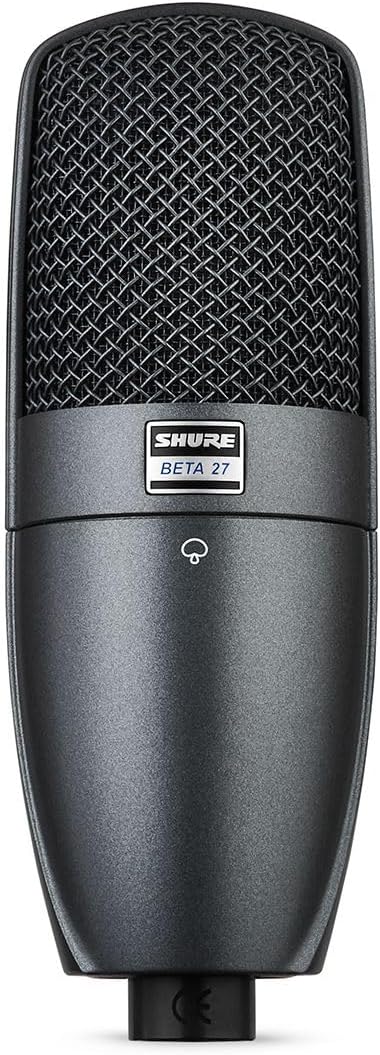
Shure BETA 27 Supercardioid Condenser Microphone
Condenser
A supercardioid studio condenser with surgical off-axis rejection and vanishingly low self-noise — engineered for critical instrument tracking and high-SPL stage work.
$419.00*
View on Amazon
✓ In Stock on Amazon.com
*Price sourced from Amazon.com. Last updated:Aug 30, 2026.Price and availability are subject to change — details.
Affiliate Disclosure: As an Amazon Associate, Studio Supplies earns from qualifying purchases made through links on this page, at no additional cost to you. This helps support our editorial team.
Notice a mistake? Let Us Know
Overview
Key Features
Side-address Supercardioid Condenser Instrument Microphone with 15dB Pad Switch
Specifications
Transducer Type
Externally biased condenser
Diaphragm
1" ultra-thin 24K gold-layered Mylar
Polar Pattern
Supercardioid
Frequency Response
20 Hz – 20 kHz
Sensitivity
-37.5 dBV/Pa
Self-Noise
15 dB-A
Signal-to-Noise Ratio
78 dB
Maximum SPL
140 dB (without pad) / 155 dB (with -15 dB pad)
Pad
-15 dB switchable
Low-Frequency Filter
3-position switchable
Power Requirement
48V phantom power
Connector
XLR (gold-plated)
Weight
2.2 lbs (1.0 kg)
Dimensions
10 x 5.5 x 4 inches
Included Accessories
Padded zippered carrying bag, swivel mount adapter
Frequently Asked Questions
What phantom power voltage does the BETA 27 require?
It requires standard 48V phantom power and draws minimal current, so any professional interface, mixer, or outboard preamp with phantom power will drive it cleanly. It will not operate on lower phantom voltages.
How does the supercardioid pattern affect positioning compared to a standard cardioid mic?
The supercardioid pattern has a tighter front pickup and a small rear lobe, which means you get superior side rejection but need to be aware of sources directly behind the mic. Position it so the rear lobe points away from monitors or bleed sources. The payoff is noticeably better isolation on crowded stages and in multi-mic studio setups.
When should I engage the -15 dB pad switch?
Engage the pad when tracking extremely loud sources — close-miked brass, cranked guitar cabinets, or kick drum shells at high stage volumes. The BETA 27 handles 140 dB SPL without the pad, but engaging it gives you headroom to keep your preamp input clean when SPLs are consistently punishing.
What does the 3-position low-frequency filter do in practice?
It offers flat response plus two roll-off settings to tame proximity effect when close-miking or to cut low-frequency stage rumble. In a live setting, engaging the filter cleans up muddiness from floor vibration. In the studio, it can reduce the need for post-production high-pass EQ on boomy sources.
Is the BETA 27 suitable for vocal recording or is it primarily an instrument mic?
While Shure positions it as an instrument microphone, its flat frequency response and low 15 dB self-noise make it very capable on vocals — particularly for singers who want a neutral, uncolored capture. The supercardioid pattern demands good mic discipline, so vocalists who move around may prefer a cardioid alternative.
Related Products


