

Shure
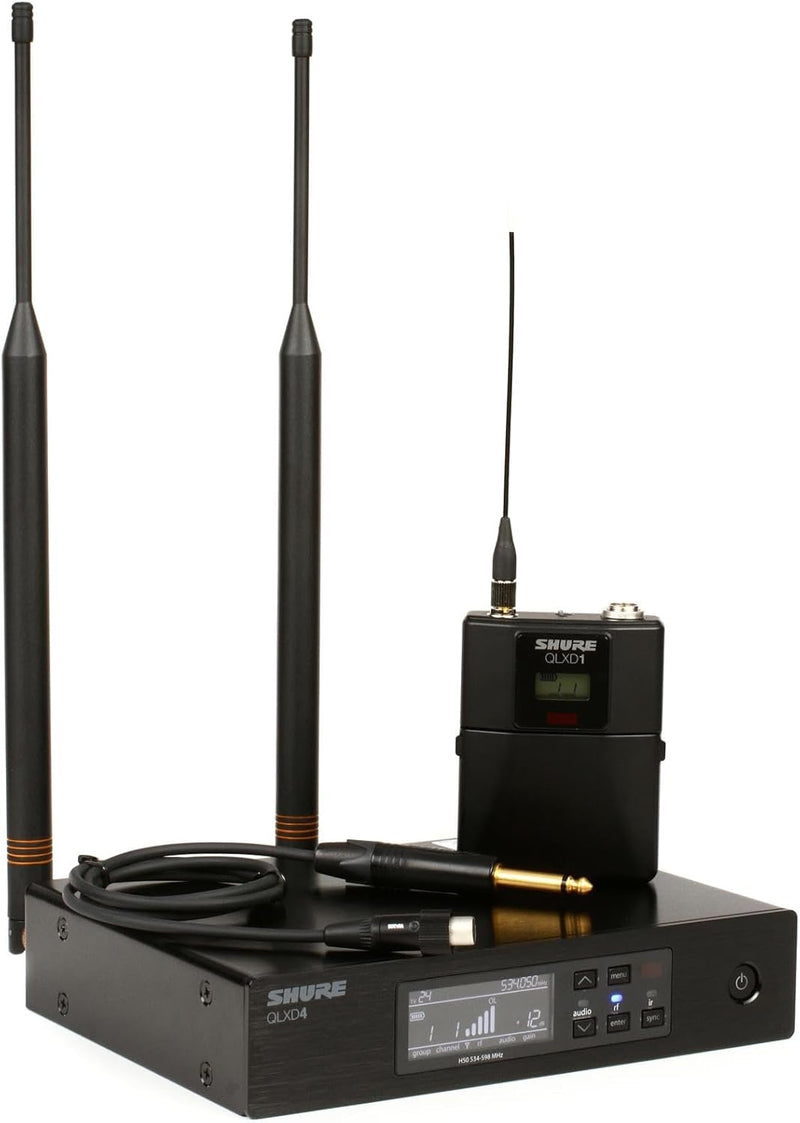
Shure QLXD14 Digital Wireless Guitar System H50
Studio-grade 24-bit digital wireless guitar transmission over 330 feet — the QLXD14 keeps your tone honest from pedalboard to FOH in any live or broadcast setting.
$1,077.00*
Check availability
*Price sourced from Amazon.com. Last updated:Oct 24, 2026.Price and availability are subject to change — details.
Affiliate Disclosure: As an Amazon Associate, Studio Supplies earns from qualifying purchases made through links on this page, at no additional cost to you. This helps support our editorial team.
Notice a mistake? Let Us Know
Overview
Key Features
QLX-D Series Wireless System with WA305 Instrument Cable, QLXD1 Bodypack Transmitter, and QLXD4 Receiver - H50 Band (534-598MHz)
QLXD4 Digital Wireless Receiver - H50 Band: QLX-D Series Digital Wireless Receiver with High-contrast LCD, and LED Meters - H50 Band (534-598MHz)
QLXD1 Wireless Bodypack Transmitter - H50 Band: QLX-D Series Wireless Bodypack Transmitter with Backlit LCD, Selectable Display Mode, and 330' Operating Range - H50 Band (534-598MHz)
WA305 Premium 1/4-inch to TA4F Instrument Cable for Wireless Bodypack Transmitter: 1/4"-TA4F Instrument Cable for Shure Digital Wireless Systems
Specifications
Brand
Shure
Model
QLXD14
Frequency Band
H50 (534–598 MHz)
Audio Resolution
24-bit digital
Operating Range
Up to 330 ft (100 m)
Transmitter
QLXD1 Bodypack (backlit LCD, selectable display mode)
Receiver
QLXD4 (high-contrast LCD, LED meters)
Included Cable
WA305 (1/4" to TA4F instrument cable)
Transmitter Power
Battery (AA)
Receiver Power
AC mains
Frequently Asked Questions
Does the QLXD14 color or compress the guitar's tone the way analog wireless systems can?
The QLXD1 transmitter uses 24-bit digital audio encoding, which means the conversion is lossless within the system's operating parameters — you're not getting the high-frequency rolloff and compander artifacts that characterize analog FM wireless. The guitar signal arriving at the QLXD4 receiver retains the transient character and pick attack you hear plugged directly into a cable.
What is the operating range, and what affects it in real-world use?
Shure rates the QLXD1 at up to 330 feet (100 meters) in line-of-sight conditions. In practice, human bodies, metal rigging, speaker cabinets, and other RF sources reduce this figure. Proper antenna placement on the QLXD4 receiver — elevated, angled outward at 45 degrees, away from power cables — recovers most of the stated range in dense stage environments.
How does gain staging work between the QLXD1 transmitter and my amp or DI?
The QLXD1 transmitter accepts instrument-level input from the included WA305 cable. Set the transmitter gain so that your hardest-playing passages reach no higher than −6 dBFS on the transmitter's level indicator — leaving headroom prevents clipping in the digital conversion stage, which sounds harsh and unrecoverable unlike analog saturation.
Does the QLXD14 require phantom power?
No. The QLXD1 bodypack transmitter is battery-powered and does not interact with your receiver's phantom power circuit. The QLXD4 receiver is powered via AC mains only.
Is the H50 band (534–598 MHz) clear for use in my region?
H50 operates in the 534–598 MHz range. Frequency clearance depends on your location and local broadcast spectrum allocation — confirm that H50 frequencies are legally available in your region before purchasing. In the US, check FCC coordination guidelines and the Shure Wireless Workbench tool for interference analysis at your venue.
Related Products


