



Shure
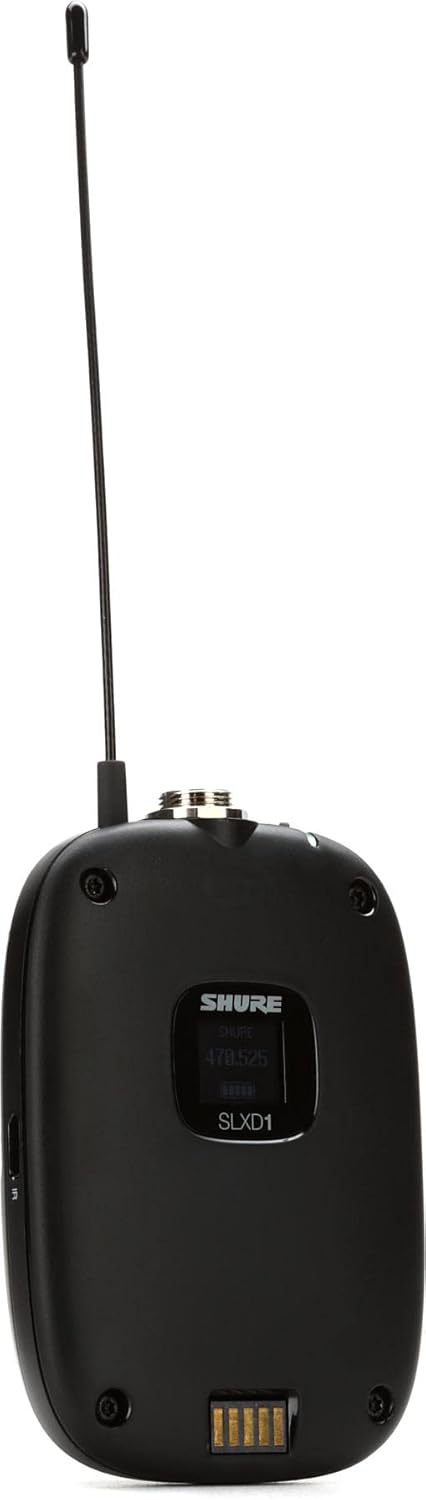
Shure SLXD1=-G58 Digital Wireless Bodypack Transmitter
Shure's SLXD1 bodypack transmitter delivers 24-bit/48 kHz digital audio and 120 dB dynamic range for transparent, artifact-free wireless performance over 330 feet.
$299.00*
View on Amazon
✓ In Stock on Amazon.com
*Price sourced from Amazon.com. Last updated:Aug 29, 2026.Price and availability are subject to change — details.
Affiliate Disclosure: As an Amazon Associate, Studio Supplies earns from qualifying purchases made through links on this page, at no additional cost to you. This helps support our editorial team.
Notice a mistake? Let Us Know
Overview
Key Features
WIRELESS FREQUENCY BAND SELECTION: Before purchasing, please ensure that the wireless frequency band you select works in your area (refer to Shure website for details > search Shure Wireless Frequency Finder).
COMPONENT ONLY: For this SLXD1 digital wireless bodypack transmitter to work, please make sure it matches the frequency band (style) on your SLX-D receiver. The SLXD1 bodypack is compatible with a number of instrument cables, lavalier, headworn and instrument microphones via a 4-Pin Mini connector (TA4F) on the top of the bodypack.
WHAT'S IN THE BOX: (1) SLXD1 bodypack transmitter, (1) zippered bag and (2) AA batteries.
DIGITAL WIRELESS TECHNOLOGY: Digital predictive switching diversity. 44 MHz tuning bandwidth (region dependent). 32 available channels per frequency band (region dependent). Up to 10 compatible systems per 6MHz TV band; 12 systems per 8 MHz band. RF Scan and IR Sync to quickly find an open frequency and link the transmitter to a SLX-D receiver. Easy pairing of transmitters and receivers over IR scan and sync.
BATTERY LIFE: Up to 8 hours from 2 AA batteries. Upgrade to the optional Shure SB903 Lithium-ion rechargeable battery to monitor battery charge status in hours and minutes, as well as battery life and health statistics.
SOUND QUALITY: Crystal clear 24-bit / 48 kHz digital audio. Extended 20 Hz to 20 kHz frequency response (microphone dependent) for natural and clear sound. Stable digital RF signal transmission. 120 dB dynamic range - excellent for vocals & acoustic and wind instruments.
OPERATING RANGE: 330-feet (100-meters).
APPLICATIONS: A variety of compatible microphone/instrument cable choices guarantees the right solution for a wide range of applications, from day-long presentations to nighttime performances.
LEGENDARY SHURE ENGINEERING: Durable and ergonomic plastic transmitter construction.
Specifications
Type
Digital Wireless Bodypack Transmitter
Frequency Band
G58
Tuning Bandwidth
44 MHz (region dependent)
Available Channels
32 per frequency band (region dependent)
Compatible Systems
Up to 10 per 6 MHz TV band; 12 per 8 MHz band
Audio Resolution
24-bit / 48 kHz digital
Frequency Response
20 Hz – 20 kHz (microphone dependent)
Dynamic Range
120 dB
Operating Range
330 feet (100 meters)
Connector
4-Pin Mini (TA4F)
Power
2 AA batteries (included); optional Shure SB903 Li-ion rechargeable
Battery Life
Up to 8 hours (AA alkaline)
Display
OLED
Construction
Plastic
Dimensions (L x W x H)
11.02 x 5.28 x 3.15 inches
Weight
11.7 oz
In Box
SLXD1 transmitter, zippered bag, 2 AA batteries
Frequently Asked Questions
What connector does the SLXD1 use, and which microphones and cables are compatible?
The SLXD1 uses a 4-Pin Mini connector (TA4F) on the top of the bodypack. This is compatible with Shure's range of lavalier, headworn, and instrument microphones, as well as instrument cables terminated with the TA4F connector. Verify connector type before pairing with third-party microphone capsules.
Does the SLXD1 work with any SLX-D receiver, or must the frequency band match?
The frequency band must match exactly. The SLXD1 is a component transmitter designed to pair exclusively with SLX-D series receivers. Before purchasing, confirm the frequency band (G58 in this listing) matches your existing SLX-D receiver. Mismatched bands will not pair regardless of firmware.
What is the real-world dynamic range performance, and how does it affect gain staging?
The SLXD1 delivers 120 dB of dynamic range via 24-bit/48 kHz digital audio — wide enough to handle the loudest acoustic instruments and softest spoken dialogue without compression artifacts. From a gain staging perspective, this means you can set transmitter gain conservatively and trust that soft passages won't disappear into the noise floor the way they might on analog systems.
How does the RF Scan and IR Sync workflow function in a multi-channel setup?
The SLX-D receiver scans available frequencies and identifies open channels, then the transmitter links via IR sync — a close-range line-of-sight handshake that transfers the frequency assignment. This process takes seconds per transmitter and eliminates the manual frequency-entry workflow that slows down multi-channel setup on older systems.
What are the battery options, and is the optional rechargeable battery worth the upgrade?
Standard operation runs on 2 AA alkaline batteries for up to 8 hours. The optional Shure SB903 Lithium-ion rechargeable battery adds hour-and-minute battery life readout and health statistics to the OLED display — a meaningful operational upgrade for touring and broadcast situations where knowing exactly how much runtime remains is preferable to guessing from a percentage indicator.
Related Products


